
Related Posts
Online Message
Which Surface Treatment Is Most Reliable for Structural Steel in 2026?
Published: Aug 25, 2026
As structural steel projects move into 2026, the question is no longer whether steel needs protection, but how long that protection must last under more demanding site conditions. Coastal exposure, industrial pollution, higher humidity swings, tighter maintenance budgets, and faster project schedules are all changing the answer to what surface treatment is best for structural steel fabrication.
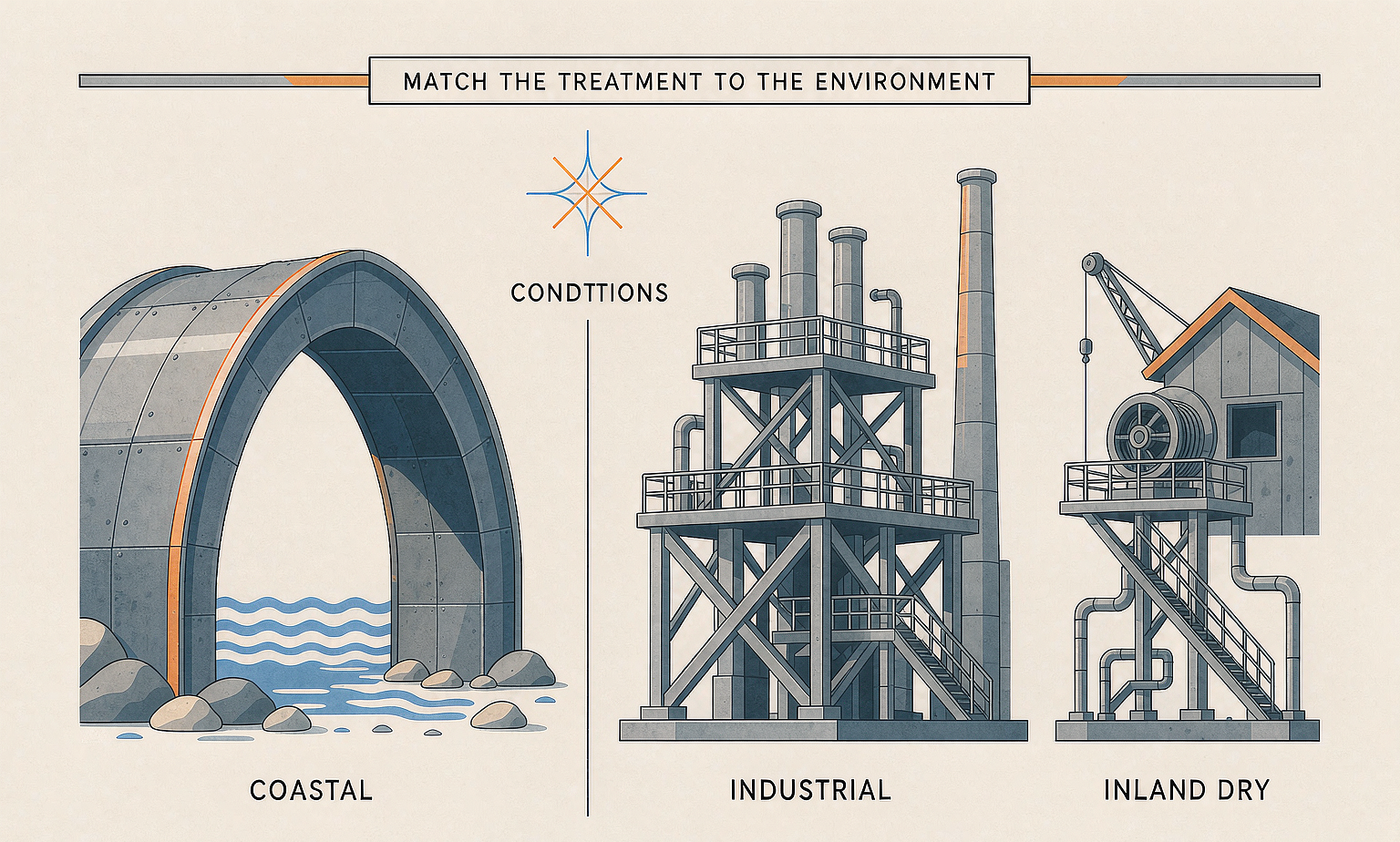
There is no single finish that wins every time. The most reliable option depends on where the steel will be used, how it will be fabricated and transported, what appearance is expected, and whether the owner is willing to maintain the system later. In practice, reliability comes from matching the treatment system to the environment and applying it correctly, not from choosing the most expensive coating on paper.
That distinction matters in building materials and prefabricated construction. Since its establishment on November 26, 2003, Ke Ming Steel Structure Factory has been deeply involved in the fields of new materials and high-end intelligent prefabricated construction. Experience in that space tends to make one point very clear: surface treatment should be decided early, while detailing, welding sequence, transport method, and installation rhythm are still being planned. If it is treated as an afterthought, even a technically sound coating system can underperform.
Reliability starts with service conditions, not with the coating name
Many project teams begin by comparing galvanizing, paint, and powder coating as if they were interchangeable product categories. They are not. A warehouse frame in a dry inland area faces a very different risk profile from a steel canopy near the sea, a heavy industrial plant, or a humid enclosed structure with intermittent condensation.
When fabricators ask what surface treatment is best for structural steel fabrication, the better question is usually this: what failure mode are you trying to avoid? Red rust at cut edges? Coating breakdown near welds? Abrasion during transport? Early cosmetic deterioration? Difficulty repairing damage on site? Those are different problems, and they do not all point to the same treatment.
In 2026, owners are also paying more attention to lifecycle cost. A cheaper initial finish may look attractive in procurement, but if access for maintenance is difficult once the structure is erected, repainting later becomes expensive and disruptive. For roofs, elevated pipe racks, long-span industrial frames, and modular steel components, reliability often means reducing future intervention rather than only lowering upfront coating cost.
Hot-dip galvanizing remains one of the safest choices for harsh outdoor exposure
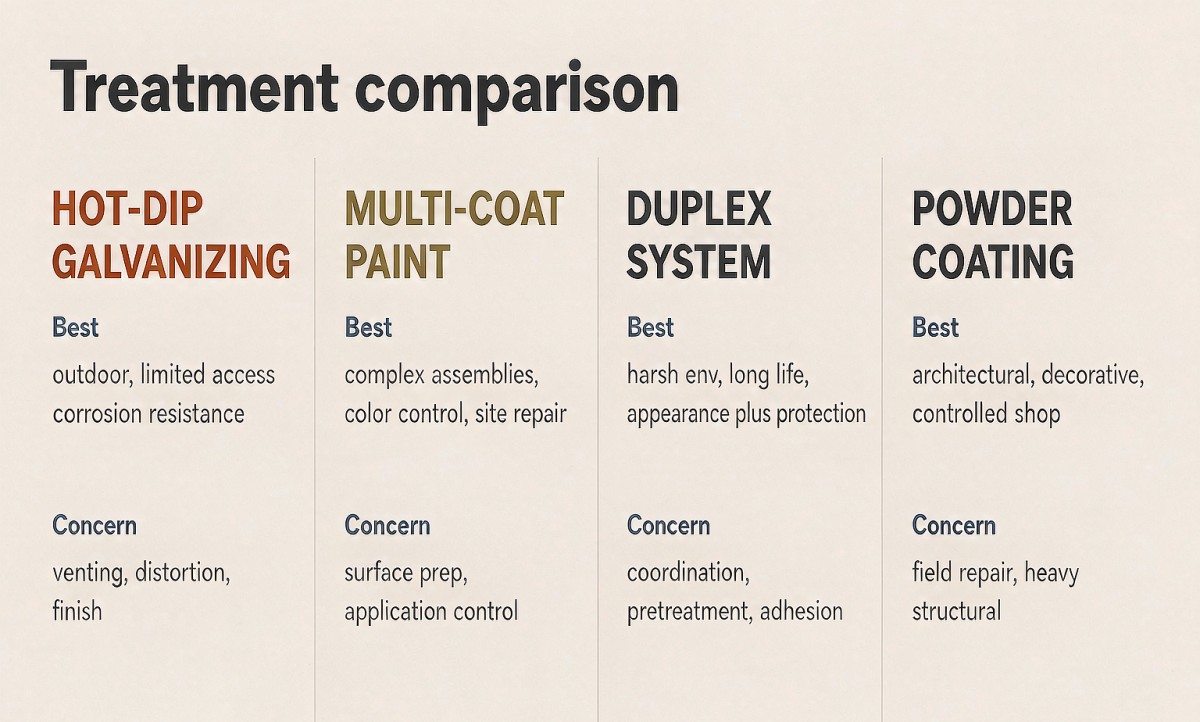
If the steel will operate outdoors and corrosion resistance is the main priority, hot-dip galvanizing is still one of the most dependable options. Its practical advantage is not just coverage, but the zinc layer's sacrificial protection. Minor scratches do not expose the steel in the same way a simple organic coating system might.
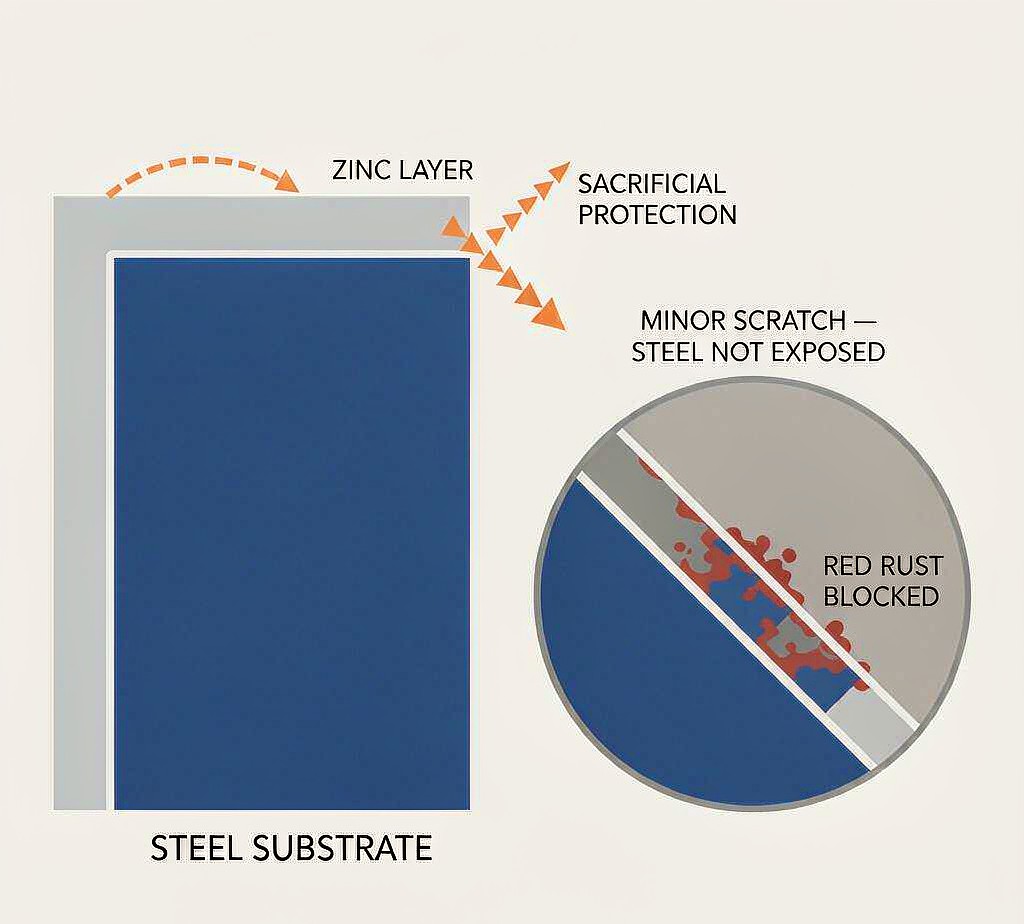
For many structural members, especially in infrastructure-like conditions or semi-aggressive outdoor environments, galvanizing offers a level of consistency that project teams trust. It is particularly useful where maintenance access is limited, where components are handled multiple times before erection, or where the project wants long service life without frequent recoating.
That said, it is not universal. Member size, venting and drainage design, weld quality, distortion risk, and post-fabrication dimensional tolerance all matter. Some assemblies are difficult to galvanize well if detailing was not developed for the process. In prefabricated construction, those issues should be coordinated early between design, fabrication, and finishing teams.
Galvanizing also raises appearance questions. The finish can vary in texture and color tone, which may be acceptable for hidden or industrial steelwork but less suitable where architects expect a highly uniform decorative surface. Reliability and aesthetics do not always align perfectly, so the project needs to decide which matters more in each zone of the structure.
Multi-coat paint systems are still essential where flexibility matters
A well-designed paint system remains highly relevant in 2026, especially when the project requires color control, staged fabrication, field touch-up, or compatibility with fire protection systems. Epoxy-rich primers, intermediate coats, and weather-resistant topcoats are common choices in structural work, though the exact combination depends on exposure and specification.
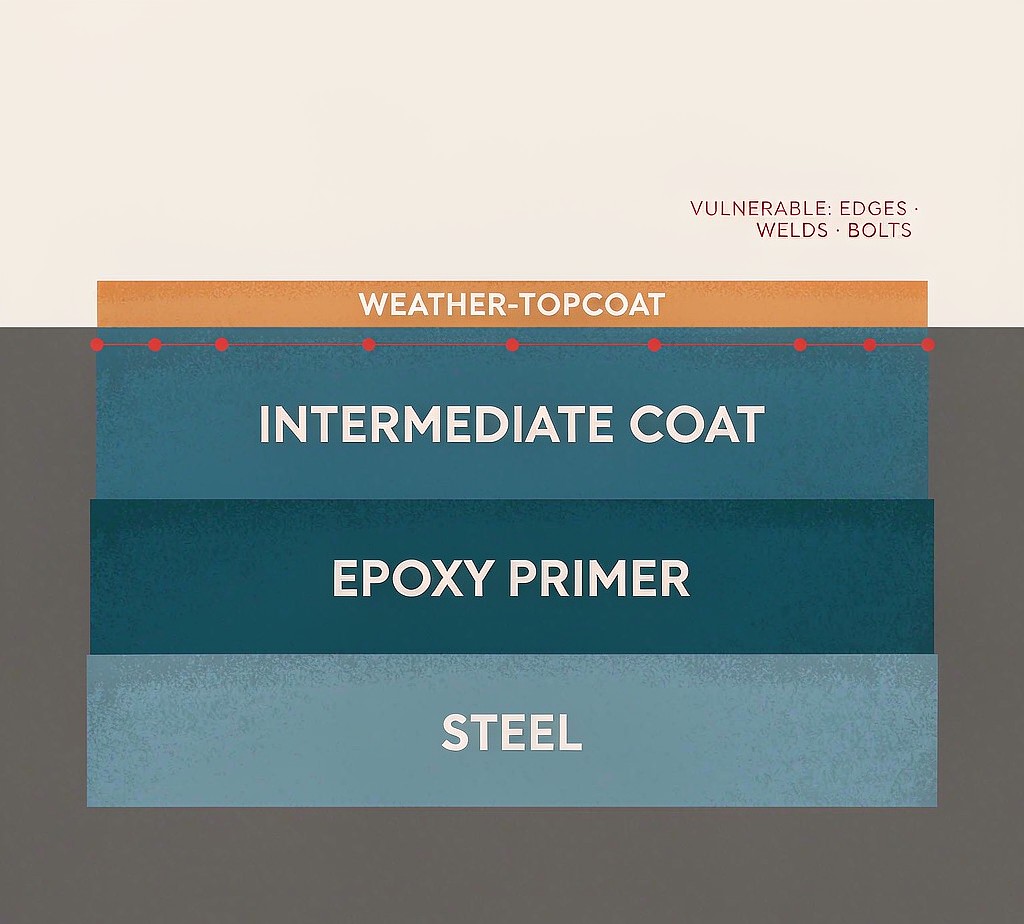
Paint systems are often the better route when the structure includes large welded assemblies that are difficult to galvanize, when site welding is expected, or when components may need local repair after transport and installation. They also offer more control over appearance and can be adapted to project-specific maintenance plans.
The weakness is obvious: paint is far more sensitive to surface preparation, film thickness control, curing conditions, and edge treatment. A coating specification that looks robust in a tender document can fail early if blast cleaning, humidity control, or dry film verification are not managed properly. On structural steel, corners, weld seams, bolt areas, and handling points are usually where the real story begins.
This is one reason experienced fabricators rarely reduce the discussion to "galvanized or painted." They focus on process discipline. In intelligent prefabricated construction, factory-controlled coating application often improves consistency, but only if shop sequencing is aligned with inspection and packing. Coated members damaged by poor stacking or rushed delivery do not become reliable simply because the original system was technically correct.
Duplex systems often make the strongest case when long life is the goal
For many demanding projects, the most reliable answer is not a single treatment at all, but a duplex system: hot-dip galvanizing plus a paint or powder top layer. This approach combines zinc protection with an additional barrier and, when specified and applied correctly, can provide a more durable result than either system alone.
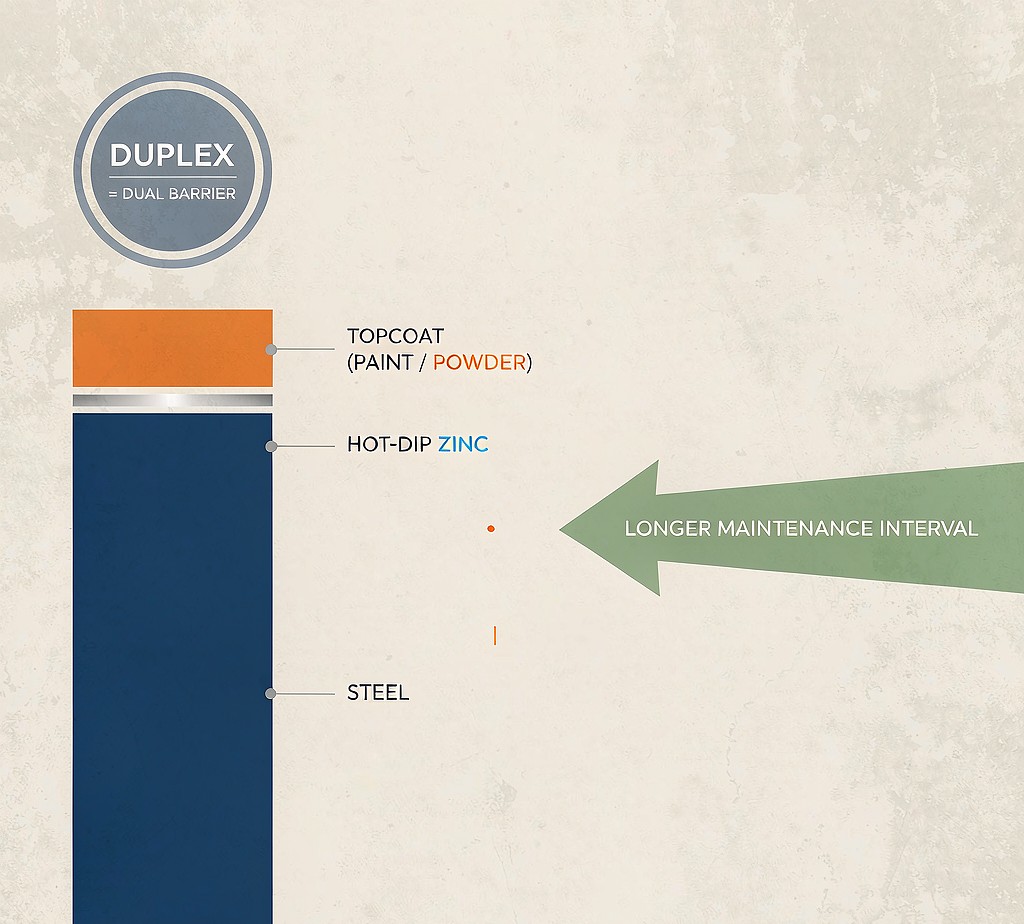
Duplex systems are often considered for coastal buildings, high-humidity industrial plants, transport hubs, exposed public structures, and projects where the owner wants both corrosion resistance and a controlled appearance. They are also useful where future maintenance access will be costly. The extra upfront process complexity may be justified by a longer maintenance interval.
The catch is coordination. Not every topcoat behaves the same on galvanized surfaces, and pretreatment is critical. If the top layer is chosen without regard to the galvanized substrate, adhesion issues can appear. So while duplex systems are often among the most reliable in harsh environments, they are also less forgiving of poor process integration.
Where powder coating fits, and where it usually does not
Powder coating has a place in construction, but it is often over-assumed in structural applications. It can produce a clean, attractive finish and works well for certain architectural elements, lighter steel components, and controlled fabrication conditions. However, for heavy structural steel exposed to severe outdoor corrosion, it is not automatically the most reliable answer.
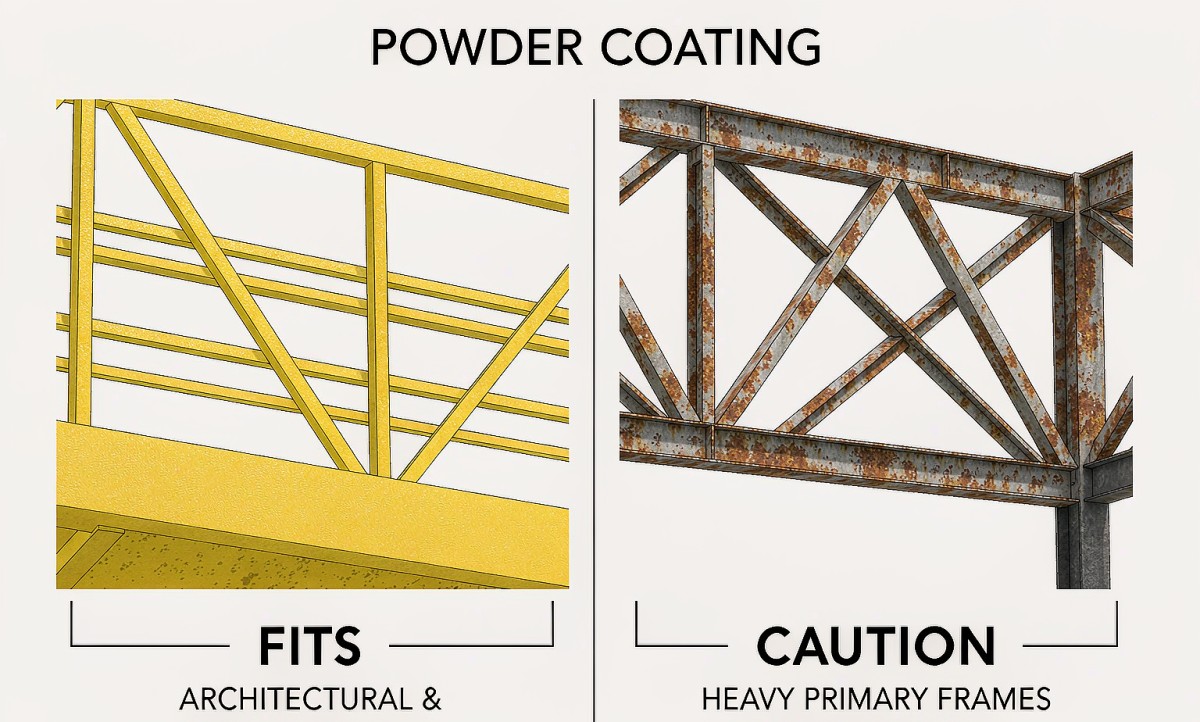
Its suitability depends on geometry, pretreatment quality, repair strategy, and service exposure. If the member is likely to be damaged during lifting or erection, field repair can be more complicated than with conventional paint. For that reason, powder coating is often better suited to visible secondary steel or architectural metalwork than to primary structural frames facing aggressive environmental loads.
A practical comparison
The common mistakes are rarely chemical; they are procedural
Failures in structural steel protection are often blamed on the coating type, but the root cause is usually somewhere else. Poor weld cleanup, unsealed crevices, sharp edges left unprepared, trapped moisture during shipment, and incompatible site touch-up materials can undermine otherwise sound systems.
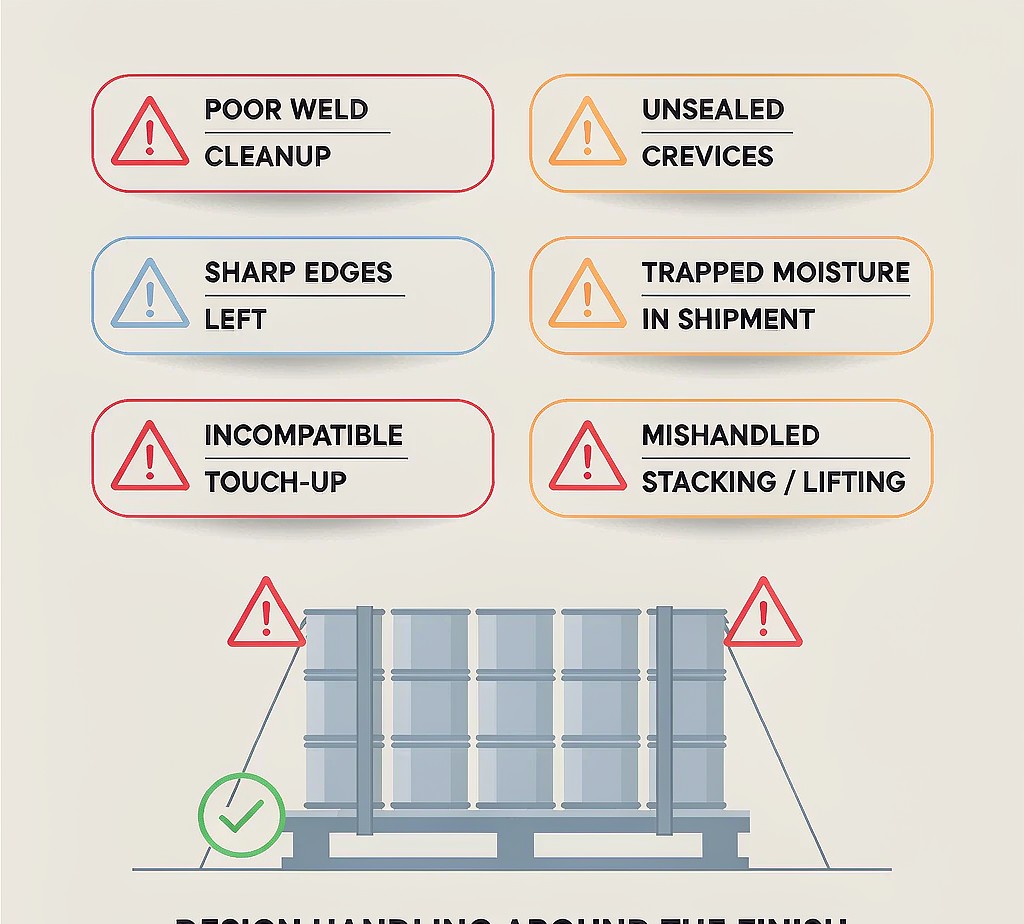
Another frequent issue is assuming that shop-applied protection will survive unlimited handling. It will not. The more modular and prefabricated the project becomes, the more important it is to design transport supports, lifting points, and stacking methods around the finish. This is where manufacturers with long involvement in prefabricated construction often add value quietly, by preventing avoidable coating damage before the steel ever reaches site.
Ke Ming Steel Structure Factory's background in new materials and intelligent prefabricated construction is relevant here not because it changes corrosion science, but because it supports earlier coordination between design intent and fabrication reality. That tends to produce better decisions on where galvanizing is practical, where a paint system is easier to maintain, and where hybrid protection makes more sense.
So, what surface treatment is best for structural steel fabrication in 2026?
If the project needs a short answer, it is this: for general structural reliability in demanding outdoor conditions, hot-dip galvanizing remains one of the most trusted choices; for flexibility, repairability, and controlled appearance, a properly specified paint system is often more practical; and for long-life performance in aggressive environments, a well-executed duplex system frequently offers the strongest balance.
But the real answer should never be picked from a generic ranking. It should come from the exposure category, member geometry, fabrication route, transport plan, maintenance access, and project standards. In some jobs, the best treatment is the one that can be inspected, repaired, and consistently delivered within the actual construction sequence.
Before freezing the specification, it is worth confirming a few things with the fabricator and coating team: where the steel will be exposed, whether site welding is expected, what touch-up method is acceptable, which areas are visually sensitive, and how long the owner expects the system to perform before maintenance. Those answers usually narrow the choice faster than any brochure can.
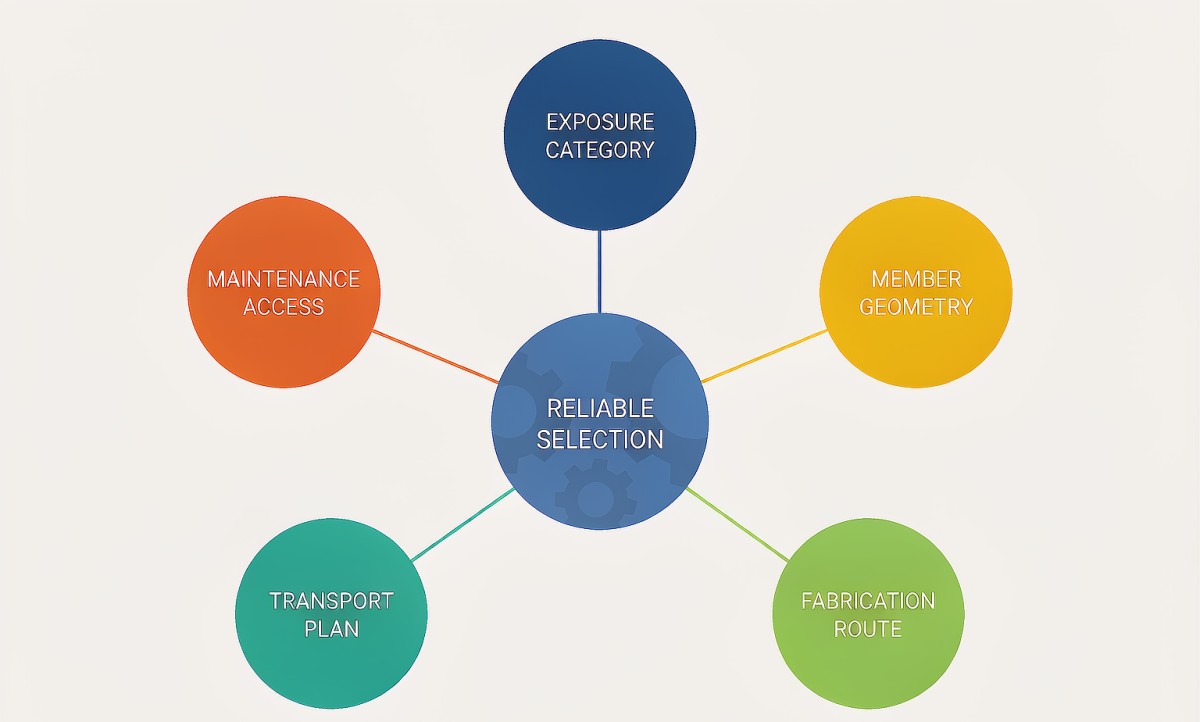
In 2026, reliability is less about chasing a fashionable finish and more about making the treatment fit the structure, the environment, and the delivery method. That is the difference between a surface treatment that looks good at handover and one that still makes sense years later.
We are more than happy to serve you here. If you have any question, please feel free to contact us.