
News center
Related Posts
Online Message
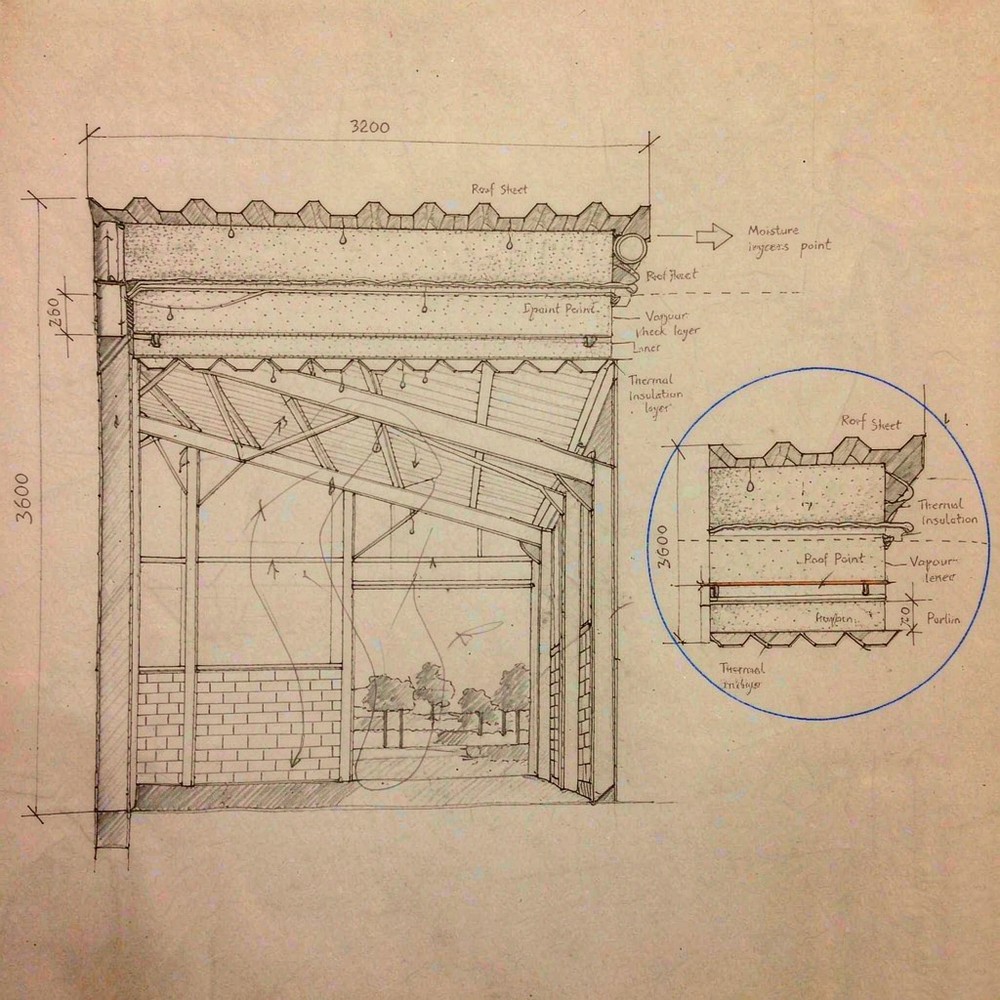
Steel Structure Workshop Condensation Prevention
Moisture control, insulation, dew-point checks, ventilation and corrosion protection
Condensation in a steel workshop is worth addressing early because the visible water is usually only the last stage of the problem. Moist indoor air reaches a steel sheet, purlin, fastener, skylight frame, or other surface that has cooled below its dew point. Water then forms on the surface, drips onto equipment or stock, and can keep concealed joints wet long after the floor has dried.
In most workshops, the reliable answer is a combined approach: limit moisture generated indoors, keep the inner roof and wall surfaces warm enough, control air movement, and remove unavoidable humid air. A thicker roof sheet or a more powerful extractor alone rarely solves a recurring condensation problem. The correct measure depends on when the water appears, where it forms, and whether the workshop air is humid because of the operation or because outside air is being brought in at the wrong time.
Start by identifying the condensation pattern
The timing and location of moisture usually reveal more than a general complaint that the building is “sweating.” Inspect the workshop early in the morning, during a cold spell, after rain, and while moisture-producing processes are operating. Note whether droplets occur across the whole roof, only around rooflights and ridge details, on walls near loading doors, or under local ductwork.
Uniform droplets on the underside of a metal roof after a cold night usually point to warm, humid internal air meeting a cold roof liner. Moisture concentrated at laps, screws, penetrations, or around rooflights may indicate thermal bridging, damaged insulation, or air leakage through the envelope. Water that appears only after rainfall should not automatically be called condensation. A roof leak, failed flashing, blocked gutter, or poorly sealed penetration needs a different repair.
A simple observation helps separate the two. Condensation often changes with occupancy, heating, production, and overnight temperature. A leak more often follows rain direction or accumulates at a particular construction detail. Both conditions can exist together, and a wet insulation system may make each harder to diagnose.
Look for the moisture source before changing the roof
People, wet clothing, vehicle traffic, washdown, curing, open water, wet goods, and process steam all add water vapour to workshop air. A large loading door held open during humid weather can do the same. Combustion heaters without a flue are another frequent source: burning fuel produces water vapour directly into the space. They may make workers feel warmer while increasing the chance of condensation on cold steel.
The moisture balance can change substantially after an operational change. A workshop that was dry as a fabrication bay may begin to condense after it is used for washing, packing damp products, storing freshly treated timber, or bringing wet vehicles indoors. Before specifying insulation, list the processes that create moisture, their operating hours, and whether they can be isolated or exhausted at source.
Source control does not remove the need for a suitable envelope, but it lowers the demand placed on every other measure. It is often the most economical starting point where one process is responsible for most of the moisture.
Keep internal steel surfaces above the dew point
Condensation occurs when the surface temperature falls below the dew point of the surrounding air. Raising the temperature of the inner face of the roof and walls is therefore central to prevention. In a Steel Structure Workshop, this normally means a continuous insulated roof and wall build-up designed for the local climate, the internal temperature target, and the expected humidity load.
Insulation performs poorly when it is compressed, discontinuous, wet, or bypassed by air movement. Gaps at eaves, ridge junctions, roof penetrations, wall-to-roof transitions, and around rooflights can create cold strips where moisture starts first. Steel framing also conducts heat more readily than insulated panels. Purlins, rails, fasteners, and unbroken metal flashings can become thermal bridges if the construction detail does not account for them.
The practical question is not simply “how much insulation?” A workshop with modest humidity may perform well with a standard insulated panel system, while a warm and humid process area may require a more carefully engineered assembly, including a vapour-control layer on the warm side of the insulation. The layer must be continuous and sealed at laps, edges, service penetrations, and interfaces. A perforated vapour barrier is not a vapour barrier in practice.
For new construction, resolve the roof build-up before fabrication and erection. Retrofitting is possible, but it can be disruptive because the details around purlins, lights, ducts, crane supports, and service openings determine whether the new system remains continuous. Do not cover an existing damp roof assembly until the source of wetting is addressed and trapped water has been allowed to dry. Concealed moisture can corrode steel members and reduce insulation performance.
Roof geometry and details matter as much as insulation thickness
Warm indoor air rises, making the roof the usual first location for condensation. Rooflights, ridge vents, valleys, gutters, and penetrations deserve close attention because they interrupt the regular insulated plane. A translucent rooflight with poorer thermal performance than the surrounding roof can become a cold surface even when the main panels are adequate. The same applies to poorly insulated smoke vents, fan curbs, and access hatches.
Roof drainage also matters. Ponding water can keep the external roof surface colder for longer and expose defective laps or fasteners. Maintaining falls, gutters, downpipes, and overflow routes will not stop internally generated condensation by itself, but it protects the roof from conditions that confuse diagnosis and worsen local cold spots.
Where intermittent heating is used, avoid assuming that a brief warm-up will cure a wet roof. Heating the air quickly can raise its moisture-holding capacity without immediately warming the steel lining. If that warmer air later contacts cold roof surfaces, droplets may increase. A steadier heating profile, better insulation, and humidity control are generally more effective than cycling the temperature sharply.
Ventilate for humidity, not simply for air movement
Ventilation removes indoor moisture only when the incoming air contains less moisture than the air being exhausted. In cool, dry weather, natural or mechanical ventilation can be highly effective. In warm, humid weather, introducing large volumes of outside air may raise the indoor moisture load, even if occupants perceive the air as fresh. This is why an open-door approach can fail in humid climates or during rainy periods.
Natural ridge and eave ventilation can support a dry, low-moisture workshop, particularly when the roof is insulated and warm air can rise freely to the ridge. It is less predictable where the building is subdivided, equipment blocks the air path, or a process releases moisture in a concentrated area. Mechanical extraction is more controllable, especially when paired with local hoods, ducting, and make-up air paths.
Do not install extract fans without considering where replacement air enters. Excessive negative pressure may draw humid air through gaps, pull rain through poorly protected openings, interfere with combustion appliances, or make doors difficult to operate. The air path should move from relatively dry areas toward the moisture source and then to the exhaust point.
For workshops with regular wet processes or strict protection requirements for stock, a humidity sensor and controlled ventilation can be more useful than a timer. The purpose is not to chase a fixed relative-humidity number in every climate. It is to respond when indoor conditions create a condensation risk on the actual roof and wall surfaces. In challenging conditions, a building-services engineer can assess dew point, ventilation rate, heating, and envelope performance together rather than sizing one component in isolation.
Do not overlook hidden air paths and altered layouts
Condensation is often blamed on insulation after a building layout has changed. New storage racks, enclosed offices, suspended ceilings, partition walls, and mezzanine floors can prevent warm air from reaching the ridge or create sheltered pockets beneath a cold roof. They can also conceal drips until corrosion, mould, or damaged cartons reveal the problem.
A mezzanine deserves special attention because it changes both heat and air distribution. Storage or office accommodation beneath an upper level may hold warmer, more humid air close to cold wall panels or uninsulated interfaces. A solid deck can also separate the upper and lower zones, leaving each with a different ventilation and heating requirement. Where workshop space is being expanded vertically, the proposed Steel Warehouse Mezzanine System should be coordinated with the ventilation layout, sprinkler arrangement, roof access, fire compartmentation, and the required clear height below before fabrication. Treating it as only a structural addition can leave a persistent moisture problem in the occupied space beneath it.
Inspect enclosed corners, spaces above offices, the underside of mezzanine decks, and roof zones behind high racking. These areas may need transfer grilles, separate extraction, insulation improvements, or a revised air-supply route. The right option depends on whether the area is intended to be conditioned, whether products stored there release moisture, and whether people occupy it for long periods.
Choose temporary measures with care
Dehumidifiers can be useful while a permanent repair is planned, after water ingress, or in a small enclosed zone. Their capacity, operating temperature range, drainage arrangement, and energy use must match the space. A small portable unit placed in a large, frequently opened workshop is unlikely to control the overall moisture load. It may still protect a cabinet, office, archive area, or a temporarily enclosed storage room.
Anti-condensation fleece or factory-applied absorbent roof liners can reduce dripping by holding a limited amount of moisture and releasing it as conditions improve. They can be useful in buildings where the expected condensation risk is occasional and low. They are not a substitute for insulation, vapour control, or moisture extraction in a humid operation. Once saturated, they cannot absorb more water, and their drying depends on suitable ventilation conditions.
Coatings and corrosion protection are also defensive measures, not a moisture-control strategy. Galvanizing, epoxy systems, or more robust coating specifications may reduce damage where damp exposure cannot be fully avoided, but they will not prevent slippery floors, wet inventory, or poor worker comfort. Repeated wetting around joints and damaged paint should still be investigated.
A practical inspection and action sequence
For an existing workshop, begin with evidence rather than a major retrofit. Record indoor temperature and humidity during the periods when condensation occurs. Compare them with external conditions, note production activity, and map wet surfaces. Inspect the roof from both sides, including insulation continuity, liner laps, penetrations, rooflights, gutters, and signs of staining on purlins or fasteners.
Then rank corrective actions by cause. Fix roof leaks and drainage defects first. Control major internal moisture sources next. Seal obvious air leaks and repair damaged insulation. Review whether heating and ventilation are working together, especially around doors and high-level roof spaces. If moisture remains, assess the roof and wall build-up for thermal bridges and vapour-control defects rather than adding equipment blindly.
Condensation prevention is most durable when the workshop is treated as a system. A dry operation in a well-detailed insulated enclosure may need only modest ventilation. A wet or heated process in a cold metal building may require source extraction, controlled make-up air, upgraded insulation, and better air distribution at the same time. The visible droplets are the warning; the lasting solution comes from correcting the conditions that allowed the steel surface to fall below the dew point.
We are more than happy to serve you here. If you have any question, please feel free to contact us.