
Related Posts
Online Message
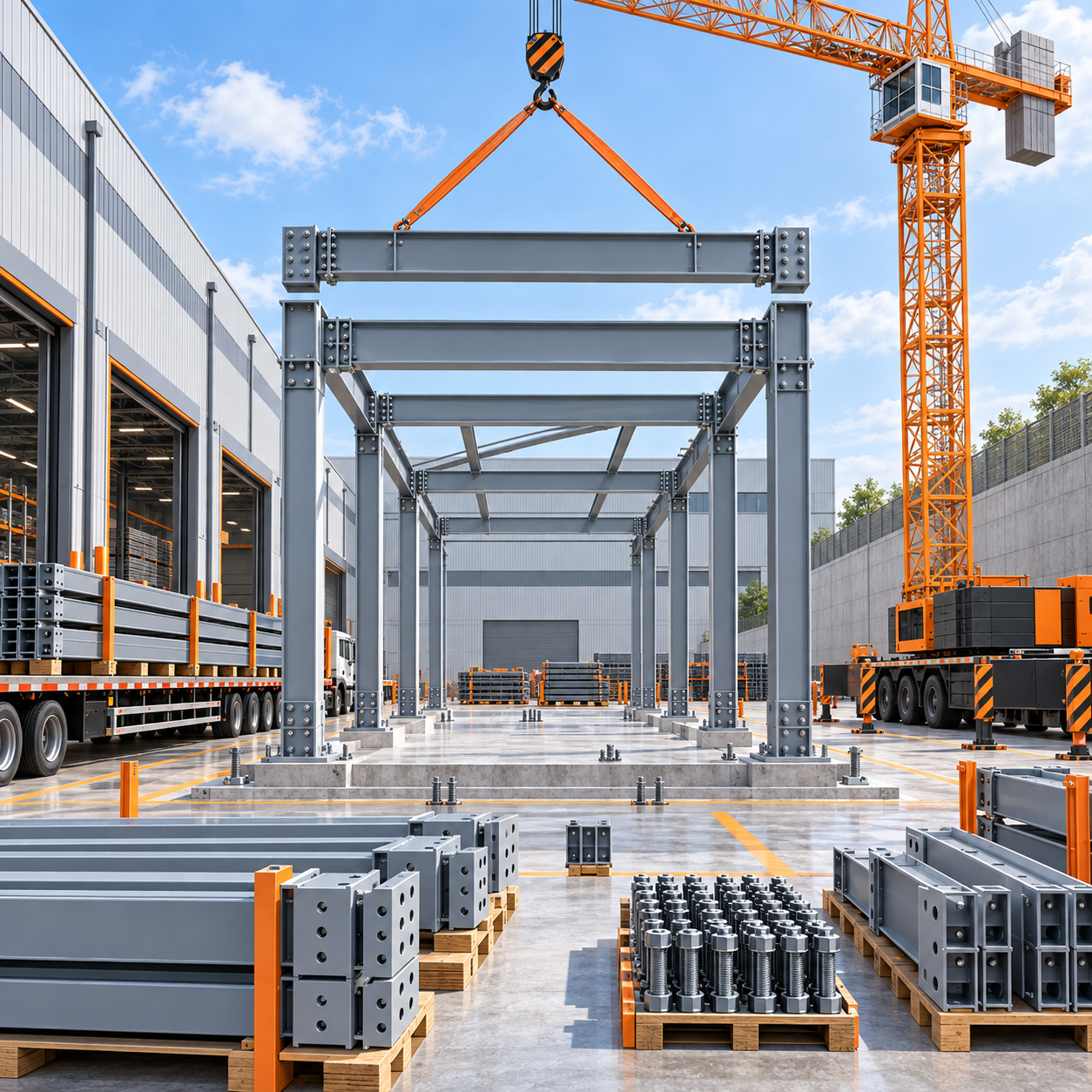
Yes, but only when prefabrication is planned as a site-delivery strategy rather than treated as an off-site purchasing decision. Prefabricated Steel Structures can reduce labor risk on congested job sites by moving repetitive cutting, drilling, welding, fitting, and coating work into a controlled factory environment. The result is usually fewer people performing high-exposure tasks in a restricted space, for a shorter period of time.
That does not mean a prefabricated frame automatically makes a difficult site safe. Congestion still affects deliveries, crane positioning, traffic control, work-at-height activities, and the sequencing of follow-on trades. The practical value of off-site steel fabrication comes from reducing the amount of uncertain, improvised work that must happen after materials arrive at the project.
For projects with limited laydown space, active operations nearby, restricted access roads, multiple subcontractors, or a fixed shutdown window, this distinction matters. Labor risk is not only the risk of an individual injury. It also includes the conditions that make injuries and costly disruption more likely: rushed work, overlapping trades, blocked routes, repeated material handling, late design changes, and crews working around incomplete structures.
Why crowded sites create a different risk profile
On an open greenfield site, steel can often be delivered, sorted, adjusted, and assembled with relatively generous working space. A congested project rarely has that luxury. It may be an urban warehouse expansion, an industrial retrofit, a distribution facility that remains operational, or a build beside public roads and occupied buildings.
In these conditions, every additional on-site activity competes for access. A steel crew may need room for members, welding equipment, aerial lifts, temporary bracing, and lifting operations. At the same time, civil crews may still be working on foundations, mechanical contractors may be installing services, and logistics teams may need a clear vehicle route. The problem is not simply that the site is smaller. It is that work interfaces multiply.
Traditional site-intensive fabrication often introduces several exposure points:
- Steel members are cut or modified close to other active trades.
- Field welding creates hot-work controls, fire-watch requirements, fumes, and weather sensitivity.
- Components are moved multiple times because there is insufficient staging space.
- Crews wait for access, then work under schedule pressure once an area becomes available.
- Temporary works remain in place longer when erection sequencing is unclear.
- Vehicle and pedestrian routes change frequently as materials accumulate.
Prefabrication does not remove all of these hazards, but it can shrink the number of tasks that depend on site conditions. That is why the market interest in factory-fabricated steel is strongest where labor availability is tight, project schedules are compressed, and site logistics are difficult to control.
How prefabricated steel changes labor exposure
The main safety benefit is not that steel becomes “risk-free.” It is that more work is completed where the work environment is stable. In a fabrication plant, jigs, fixtures, material flow, lifting arrangements, inspection points, and workstations can be organized around repeated operations. On site, the same operation may be affected by weather, access limitations, work at height, changing ground conditions, and nearby activity.
For a well-coordinated project, fabricated columns, beams, bracing, connection plates, and secondary members arrive identified and prepared for their intended sequence. Site labor is then focused more heavily on unloading, lifting, bolting, alignment, and verification. This can reduce ad hoc cutting and fitting, which are common sources of delay and exposure when drawings, tolerances, or interfaces are not resolved early.
The labor-risk advantage is especially clear in four areas.
Less hot work in active areas
Reducing field welding can reduce the need to establish hot-work zones around flammable materials, finished surfaces, stored goods, or occupied facilities. Some site welding may still be required by the structural design or connection strategy, but the goal is to avoid using field welding as the routine solution for unresolved fabrication details.
Fewer handling cycles
Every time a beam is unloaded, shifted, stored, re-rigged, and repositioned, the project adds potential interaction between workers, mobile equipment, and suspended loads. Prefabricated packages can be planned around erection zones and lift sequences, limiting unnecessary movement. This only works when package weights, delivery order, lift plans, and available laydown space have been coordinated before dispatch.
Shorter periods of work at height
Preassembled subcomponents can reduce the amount of individual-piece installation performed from elevated work platforms. However, larger assemblies may demand more complex lifting and temporary stability planning. Prefabrication changes the task; it does not eliminate the need for competent erection engineering, fall protection, exclusion zones, and controlled lifting practices.
More predictable trade handoffs
Congested sites become hazardous when one trade is forced to work around another trade’s unfinished activities. A steel package with clear member identification, connection details, and erection sequence makes it easier to release areas for roofing, cladding, mechanical work, or dock equipment installation. Predictable handoffs reduce the temptation to crowd several crews into the same restricted zone.
The market is moving from “more prefabrication” to better-defined prefabrication
The useful market shift is not simply toward larger prefabricated pieces. It is toward earlier coordination between structural design, fabrication, transportation, and site assembly. Projects now place greater value on information that can be used before fabrication begins: connection schedules, delivery zones, crane access, tolerances at interfaces, installation order, and the location of temporary works.
This matters because a fabricated component is only valuable when it can be delivered and installed as planned. A highly finished assembly that cannot clear a site entrance, fit beneath a bridge, be stored safely, or be lifted within the available crane radius may transfer risk back to the site. Crews then face unplanned unloading, repackaging, modification, or delay, which undermines the original safety objective.
For this reason, experienced procurement teams increasingly assess fabrication capability alongside design coordination. A supplier’s plant capacity may support consistent production, but the project also needs disciplined quality control, traceable identification, clear drawings, suitable export packing where relevant, and a delivery plan that reflects actual site constraints. Manufacturers operating at scale, including facilities that work to ISO, CE, AS-NZS, and ASTM-related requirements for different markets, can support complex supply programs when the project specifications and local engineering responsibilities are clearly defined.
Where prefabrication has the strongest safety case
Prefabricated steel is usually most effective when congestion is structural, not temporary. In other words, the project is inherently constrained by its location, operating environment, access rules, or schedule, rather than merely experiencing a short-term coordination problem.
Loading dock construction is a good example. A dock is not just a door opening with equipment added later. It combines structural framing, impact resistance, drainage, canopy support, leveler pit requirements, door interfaces, and vehicle clearances. On a live distribution site, treating these components as separate purchases can create repeated access conflicts and last-minute site adjustments.
A coordinated solution such as the Warehouse Loading Dock & Canopy System can be relevant where steel framing, a cantilever canopy, dock shelters, and reinforced leveler-pit interfaces need to work together. The important principle is not the product label. It is resolving the structural and operational interfaces before materials are fabricated. Dock height, for example, should reflect the actual vehicle fleet rather than a default trailer assumption. A facility serving box trucks, vans, flatbeds, and standard trailers may need a different approach to dock elevation and leveler range.
What prefabrication cannot solve by itself
A common mistake is to assume factory fabrication compensates for incomplete design. It does not. In fact, incomplete decisions can become more expensive once steel has been cut, drilled, coated, packed, and shipped. The more fabrication moves off site, the more important it becomes to resolve interfaces before production release.
Three issues deserve particular attention. The first is foundation accuracy. Steel frames are adaptable within reasonable erection tolerances, but significant variation in anchor bolt positions, elevations, or concrete geometry can create site rework. The second is connection design. Bolted connections can accelerate assembly, but only when access for tightening, inspection, and erection equipment has been considered. The third is temporary stability. A completed steel building may be stable by design, yet an incomplete frame can be vulnerable during erection if bracing and installation sequence are not properly planned.
Transport is another practical boundary. Larger prefabricated assemblies may reduce work at height or field fitting, but they can create oversized-load challenges and more demanding lifts. There is no universal rule that “bigger is better.” The right degree of prefabrication is the largest package that can be manufactured, transported, unloaded, and erected safely within the actual constraints of the project.
Questions to resolve before selecting the fabrication scope
Before comparing suppliers or approving a steel package, project teams should define the site problem they are trying to remove. A useful review is less about asking whether prefabrication is available and more about asking where the risk is concentrated.
- Which on-site fabrication tasks are currently expected, and which can realistically move into the plant?
- What space is available for unloading, crane setup, member storage, and exclusion zones?
- Can deliveries be sequenced by erection area rather than by production convenience?
- Are foundation dimensions, anchor locations, and adjacent building interfaces sufficiently verified?
- Which activities will continue around the steel work, including vehicle traffic and facility operations?
- Does the design allow bolted installation without creating inaccessible or awkward connections?
- What happens if a delivery is delayed or a lift window is lost?
These questions expose whether prefabrication will simplify the site or merely relocate complexity. They also help distinguish between a standard steel supply package and a coordinated construction solution. The latter requires communication between structural engineering, fabrication, logistics, erection, and the building systems that connect to the frame.
Measure the decision by exposure removed, not by steel tonnage
The strongest business case is rarely “more steel was fabricated off site.” A better measure is whether the project removed high-risk, variable, labor-intensive work from the most constrained location. This could mean fewer hot-work permits, fewer material movements, shorter occupation of a traffic-sensitive area, fewer simultaneous trades, or a more reliable handover sequence.
That perspective also prevents overbuying. A straightforward, open-site structure with easy access and abundant local skilled labor may not require an aggressive prefabrication strategy. Conversely, an operating warehouse retrofit or a site with little storage can justify more detailed factory work even when the structural frame itself is relatively simple.
Prefabricated steel works best when it is aligned with the construction method from the first design decisions. On congested sites, that alignment can reduce labor exposure, improve schedule control, and make safety planning more practical. The question is not whether off-site fabrication is inherently safer. The question is whether the chosen fabrication scope removes the specific site activities creating the greatest risk.
- Last One:No more articles
- Next Article:What drives the cost of a steel structure warehouse2026-09-29
We are more than happy to serve you here. If you have any question, please feel free to contact us.