
Which Codes Matter Most When Reviewing Steel Building Design
It often starts the same way: a set of structural drawings looks complete, the framing seems reasonable, and the connection notes appear familiar. Then, during review, small doubts begin to surface. A load combination is referenced but not clearly tied to the governing standard. A member size seems efficient, yet the note on material grade is vague. Fire protection is mentioned, but the route from code requirement to practical detail is missing. When you are reviewing Steel Building Design, these are not minor drafting issues. They are the points where compliance, safety, and buildability can quietly separate.
This is why code review in steel projects can feel more difficult than checking geometry alone. A steel building may look coordinated on paper while still carrying hidden risks in load assumptions, stability provisions, welding criteria, corrosion protection, or seismic detailing. Many people run into this when they move from general drawing review to technical evaluation: the real question is not "Is there a code note?" but "Are the right codes governing the right decisions?"
Where reviews usually go off track
A common mistake is to treat the design code as one document that covers everything. In practice, steel projects are controlled by a set of related standards, each addressing a different layer of performance. One code governs minimum building loads. Another governs steel member design. Another addresses welding, bolting, inspection, fire resistance, or cold-formed secondary members. If the review stays too general, conflicts between these layers can be missed until fabrication or site installation.
Another problem appears when reviewers focus on calculations without checking whether the calculation path matches the project type. A low-rise industrial frame, a multi-story commercial building, a prefabricated plant structure, and a bridge-related steel assembly may all use steel, but they are not reviewed the same way. The applicable code family may shift depending on occupancy, loading environment, fabrication method, and whether the component is part of a building system or a transport structure.
That is why the most useful review habit is to work from governing code categories rather than from drawing sheets alone. Once that habit is in place, unclear notes become easier to test, and missing information becomes visible much earlier.
The codes that usually matter first
If you are trying to sort priorities during a technical review, start with the codes that control life safety and primary structural behavior. In most projects, the first layer includes the building code adopted by the jurisdiction, the load standard, and the main structural steel design standard. Those three establish the legal framework, the loading basis, and the member strength and stability rules.
The building code matters because it connects the project to occupancy classification, fire requirements, egress-related structural implications, and the adopted references that become enforceable. Reviewers sometimes jump directly into member design, but if the base code edition is not clear, later checks can become inconsistent. A change in adopted edition may affect load maps, seismic triggers, detailing expectations, or fire-resistance requirements.
The load standard matters just as much. Wind, seismic, snow, rain, live load reduction, collateral load, crane loads where relevant, and load combinations all start here. Many review comments that look like "design disagreement" are really load-basis disagreements. If the steel frame seems overbuilt or underbuilt, the cause is often in the assumptions upstream rather than the steel design equations downstream.
Then comes the main steel design standard. This is where flexural strength, compression behavior, lateral-torsional buckling, local buckling, combined forces, serviceability-related checks, and connection references start to align. For Steel Building Design, this is the document that usually carries the most weight once the load path has been established.
Connections are where code review becomes practical
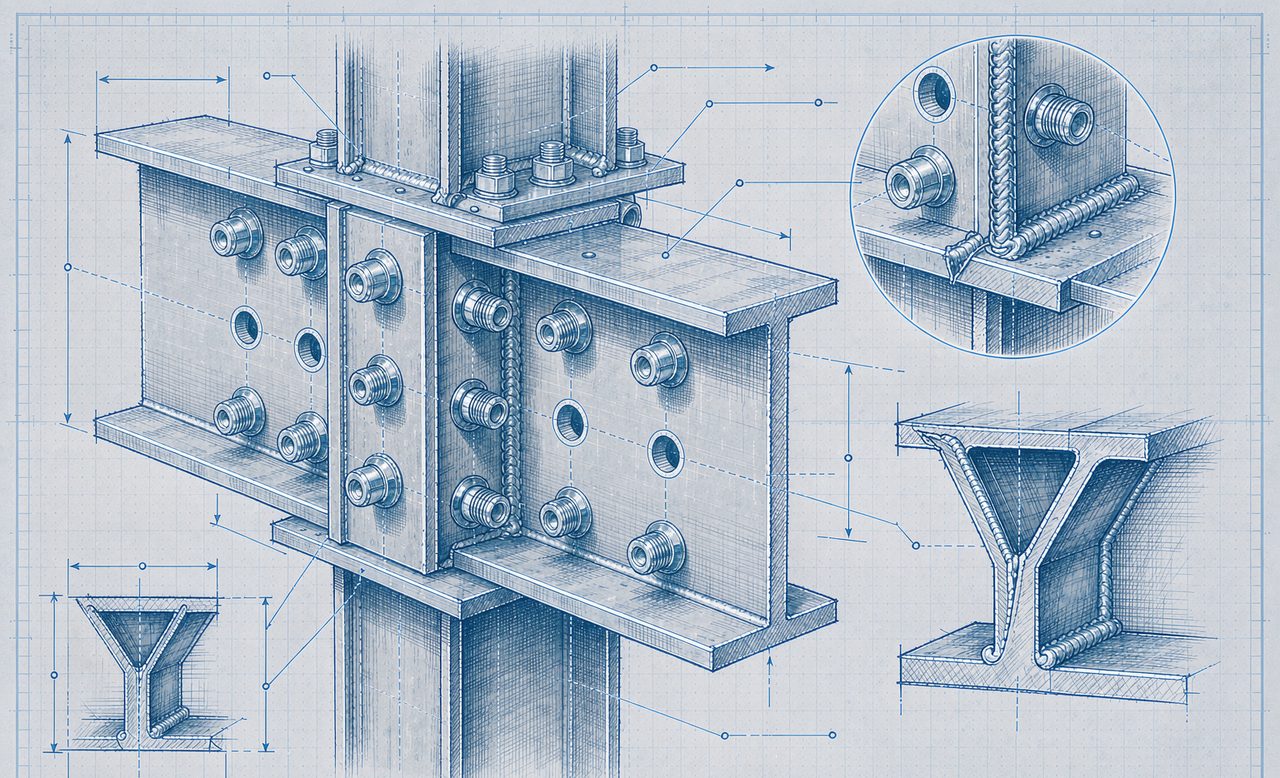
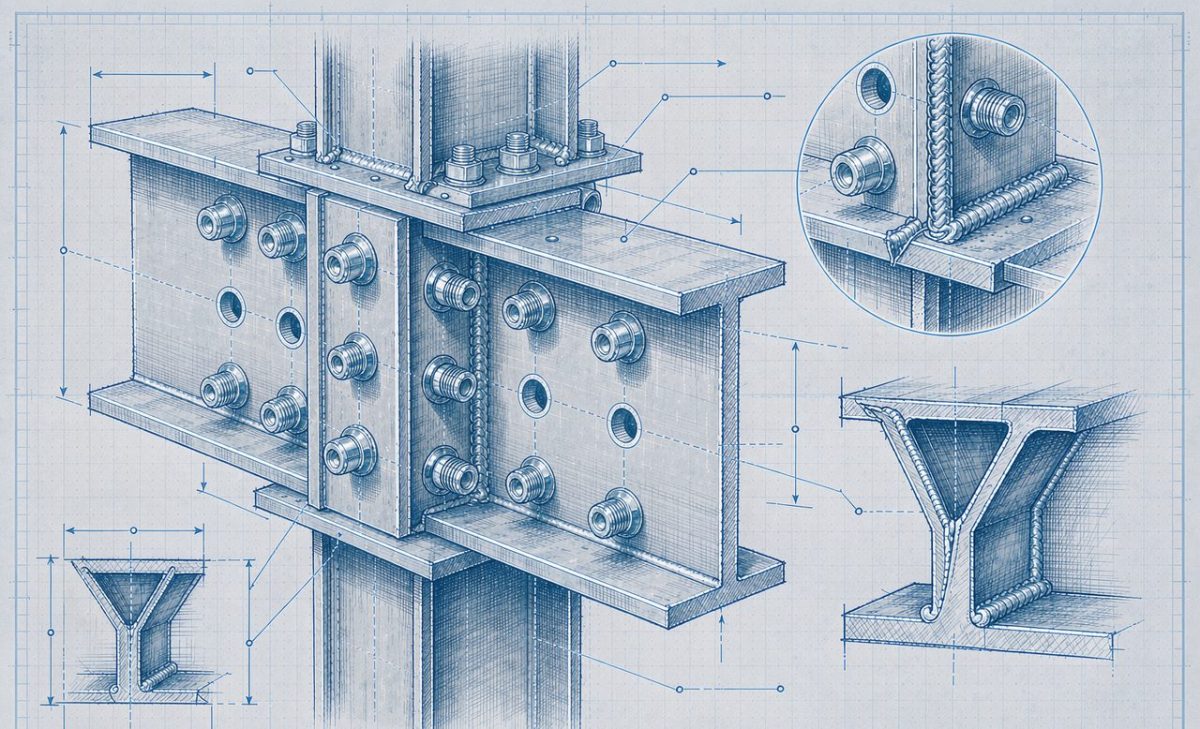
A surprising number of review problems are connection problems disguised as framing problems. The member schedule may appear clean, but if the connection philosophy is undefined, the structure is not truly reviewable. Is the frame relying on simple shear connections, partially restrained behavior, or fully restrained moment connections? Are brace gussets detailed for expected deformation? Are slip-critical bolts required, or are bearing-type connections acceptable for the condition?
This is the point where the bolting and welding standards become essential. The steel design standard may tell you that a connection must resist a given force, but the detailed requirements for weld procedure, weld quality, bolt installation, pretensioning, hole type, and inspection often sit elsewhere. If those references are missing or mixed carelessly, the design can pass a paper review while becoming difficult to fabricate or risky to install.
One practical way to review this area is to compare three things side by side: the design intent shown in the framing drawings, the connection assumptions embedded in calculations, and the fabrication-level requirements implied by welding and bolting codes. If those three do not point in the same direction, the issue is not just documentation quality. It is a technical coordination issue.
This becomes especially important in prefabricated steel work, where fabrication decisions are often locked in early. Repetitive connection details can improve efficiency, but repetition only helps if the details are code-consistent across strength, tolerance, and inspection requirements.
Stability checks deserve more attention than they usually get
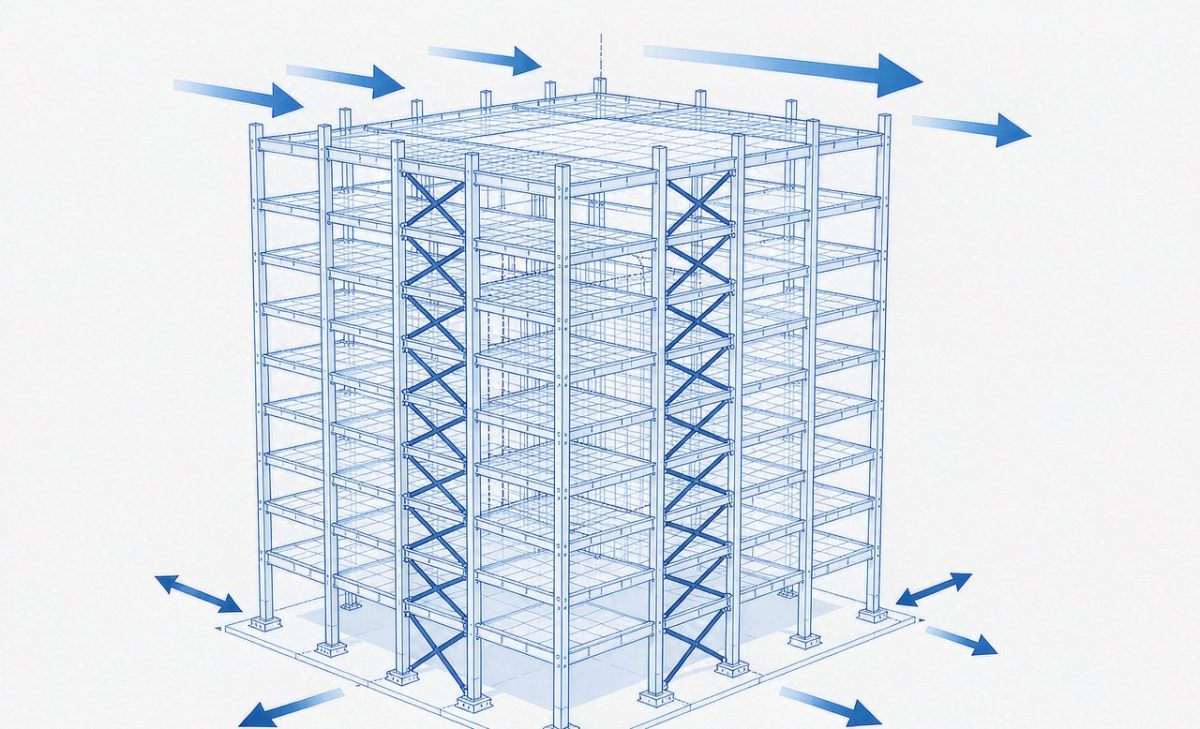
In many reviews, axial capacity and beam strength get checked quickly, while system stability gets less attention because it is spread across multiple drawings and notes. That is risky. A steel frame can have adequately sized members and still be vulnerable if the bracing logic is incomplete, if diaphragm assumptions are unclear, or if temporary and permanent stability are confused.
Look carefully at the code path for second-order effects, effective length assumptions, notional loads where required, and bracing force demands. Reviewers should also verify whether the design method being used matches the standard's permitted approaches. A calculation package may look polished, but if it treats a sway frame like a braced frame without support from the actual layout, the result is misleading.
This part of the review becomes even more sensitive in long-span or irregular structures. Transfer areas, expansion joints, canopy projections, mezzanine attachments, and mixed gravity-lateral framing zones often create local exceptions that are not obvious from the general notes.
When steel assemblies are linked to transport or heavy infrastructure work, the code boundary should be checked early. For example, some teams reviewing industrial or civil-support packages find it useful to separate true building-frame requirements from component packages such as Highway Bridge Components, because the review logic, loading context, and detailing expectations may not be identical even when fabrication methods overlap.
Fire resistance and durability are not secondary items
Another common review gap is treating fire protection and corrosion control as finish issues rather than structural code issues. In reality, they affect section selection, exposed conditions, maintenance planning, and sometimes the entire feasibility of a detail.
Fire resistance requirements usually begin with the adopted building code, but the review should go further. If a rating is required, is the chosen method compatible with the connection geometry, member shape, and service environment? Intumescent coatings, board systems, and concrete encasement can all carry different detailing implications. A connection that works structurally may become awkward or noncompliant once the fire-resistance method is applied.
Durability is similar. Corrosion exposure category, coating system compatibility, galvanizing considerations, drainage, crevice conditions, and maintenance access should not be left to broad notes. If the project environment is humid, coastal, industrial, or chemically aggressive, the code-referenced material and protection standards should be visible in the design review trail. Otherwise, the building may meet strength requirements while carrying avoidable long-term risk.
Seismic and wind provisions often reveal whether the review is deep enough
In routine projects, general gravity framing can make the design appear straightforward. But lateral systems tell you quickly whether the code review has been done carefully. Wind and seismic provisions are not just bigger load numbers. They affect torsion, drift, collector forces, diaphragm transfer, anchorage, connection ductility, and detailing categories.
For seismic review, it helps to verify the whole chain rather than isolated equations: site class assumptions if provided by others, structural system classification, response modification or similar factors depending on jurisdiction, drift checks, connection detailing expectations, and compatibility between the selected lateral system and the standard's limits. A mismatch here can invalidate much of the downstream design logic.
For wind, reviewers should be cautious with enclosure classification, roof zones, parapet effects, local pressure components, and cladding-versus-main-frame distinctions. Many drawing packages are internally consistent until one notices that member design uses one set of wind assumptions while connection design or anchor design uses another.
If the project includes modular, prefabricated, or transportable steel portions, these checks become more demanding because temporary load cases, erection stages, and transportation constraints may influence the final detailing. The governing standards may still be familiar, but their application becomes less generic and more sequence-dependent.

What to verify before accepting a code reference at face value
Not every code citation in a drawing set is equally useful. Some notes are broad enough to create the appearance of compliance without showing how compliance is achieved. A better review approach is to test whether each major code reference is tied to a design decision.
For example, if a material standard is cited, does it match the grades used in calculations and schedules? If a welding code is listed, are the weld symbols, inspection expectations, and fatigue-sensitive details consistent with that reference? If a fire code requirement is mentioned, can you trace it to a rated assembly or protected member condition? If a seismic provision is claimed, does the connection detailing actually reflect the required behavior?
This sounds basic, but it is where many reviews gain clarity. Technical evaluation improves when code references are treated as active design controls rather than as general notes for legal comfort.
A workable review sequence for Steel Building Design
When the package is large, trying to check everything at once often leads to scattered comments. A more reliable sequence is to move in layers.
First, confirm the governing code editions and the project classification basis. Then verify load assumptions and load combinations. After that, review the primary gravity and lateral systems for consistency with the selected design standard. Only then move into connection details, material standards, fire protection, corrosion provisions, and fabrication-related notes.
At that stage, compare the calculations to the drawings and ask a practical question: could a fabricator or installer build this exactly as the code assumptions require? If the answer is uncertain, the issue may not be drafting quality alone. It may indicate a gap between analytical compliance and real-world execution.
This is also the point where related component packages should be sorted carefully. If a project includes special assemblies, utility-support steel, or bridge-adjacent fabricated elements, do not assume they should be reviewed under one simplified building-only lens. Even when supply chains overlap with items like Highway Bridge Components, the governing technical checks may still differ by function and code scope.
What usually helps prevent repeat review issues
Most repeat problems come from unclear boundaries: unclear edition control, unclear design responsibility, unclear connection assumptions, or unclear separation between delegated design and engineer-of-record requirements. The best prevention is not a longer note block. It is cleaner alignment between calculation basis, drawing language, and referenced standards.
When reviewing Steel Building Design, the most important codes are usually the ones that define loading, member behavior, connection execution, fire resistance, durability, and lateral performance. But their importance is not just in being listed. It is in whether they genuinely control the design choices shown in the package. If that link is visible, review becomes faster and more defensible. If that link is missing, even a polished drawing set deserves a closer look.