
Related Posts
Online Message
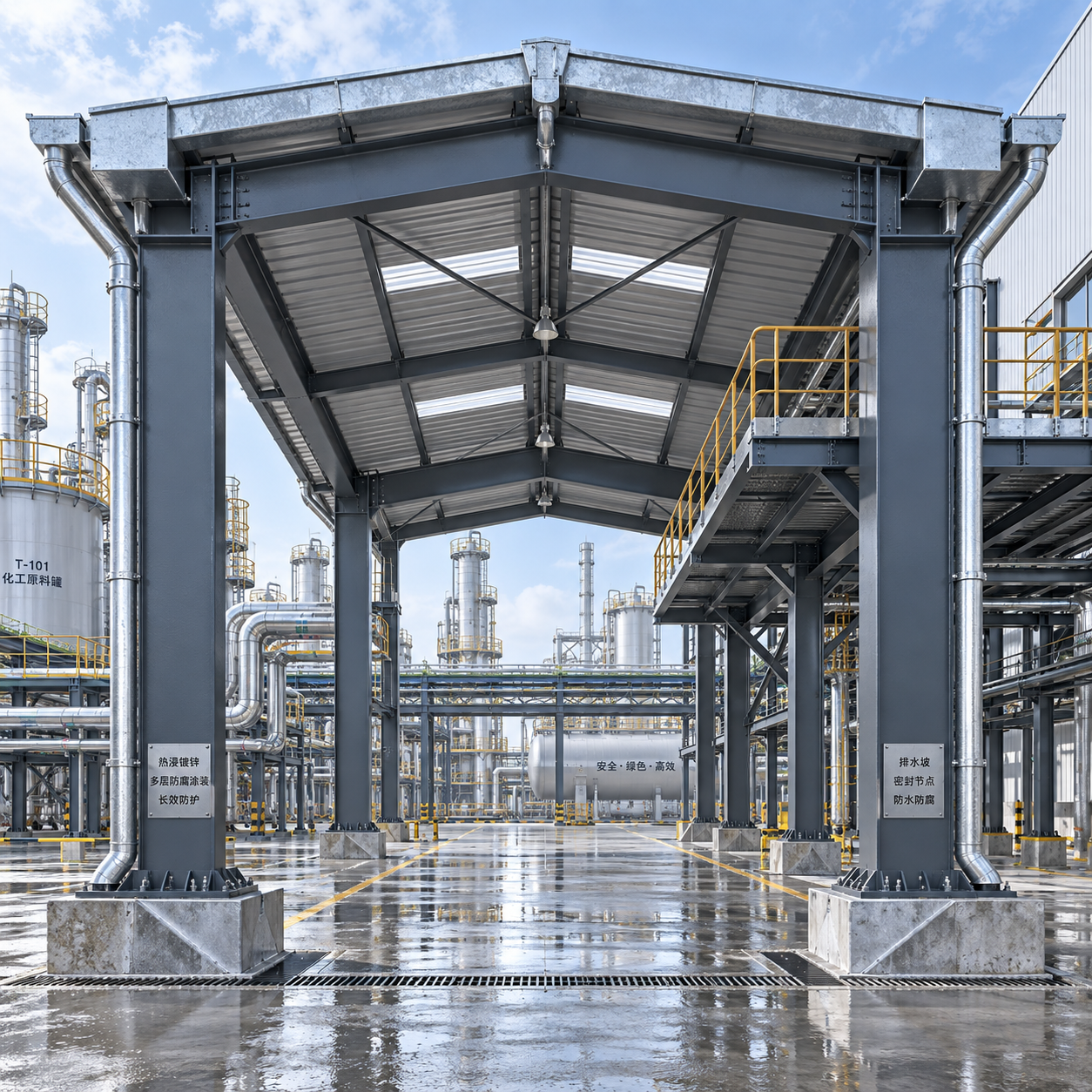
Corrosion-resistant design for industrial steel structures begins with defining the exposure, not with choosing a stronger steel grade or specifying a thicker paint film. A portal frame in a dry warehouse, a structure over a wastewater basin, and a rack supporting acid-process ductwork may all use similar primary steel sections, yet they face fundamentally different deterioration mechanisms. The design basis must distinguish between atmospheric corrosion, condensation, chemical splash, immersion, chloride deposition, abrasive contamination, and corrosion occurring beneath insulation or retained debris.
The critical engineering question is not whether corrosion will occur, but where it will occur first, how quickly it may compromise section capacity or connections, and whether the protection system can be inspected and renewed without stopping the process plant. Industrial steel structures perform reliably in aggressive environments when material selection, member geometry, fabrication quality, coating specification, drainage, and maintenance access are treated as one system.
Exposure classification must precede structural and coating decisions
“Corrosive industrial environment” is not a sufficiently useful design description. Technical specifications should identify the corrosion agents, their concentration where known, the temperature range, wet-dry cycling, expected deposition, ventilation conditions, and the likelihood of mechanical damage to coatings. An outdoor steel frame near a marine terminal may be driven mainly by airborne chlorides. A fertilizer plant may expose steel to hygroscopic dusts that retain moisture. A pulp, food-processing, wastewater, or chemical facility may create persistent condensation combined with acidic or alkaline contaminants.
ISO 9223 provides a framework for classifying atmospheric corrosivity, including categories from C1 through C5 and CX. It is useful for initial environmental assessment, but it does not replace project-specific process data. A local condition such as a leaking flange, cooling-tower drift zone, washdown area, or roof valley can be much more severe than the general site classification. Steelwork close to such sources should be separately zoned in the corrosion protection schedule.
This zoning matters because one building can contain several exposure conditions:
- externally exposed primary framing subject to rain, ultraviolet radiation, chlorides, and industrial pollutants;
- internal roof steel exposed to intermittent condensation;
- columns in washdown zones or near open process vessels;
- platforms, handrails, ladders, and gratings subject to foot traffic, impact, and chemical splash;
- steel below insulation, cladding, or enclosed wall systems where moisture may remain undetected.
A single generic “painted steel” requirement for all these locations usually produces either under-protection in severe zones or unnecessary cost in low-risk areas. A more defensible approach establishes separate durability requirements and protective systems by exposure zone, with clearly identified interfaces between them.
Steel grade is only one part of corrosion durability
Carbon structural steels such as Q235, Q345, ASTM A36, or comparable grades are regularly used for Industrial Steel Structures because their strength, weldability, and availability support economical fabrication. Their basic atmospheric corrosion resistance, however, is not a substitute for a protection strategy in wet or chemically contaminated service. Choosing higher-strength structural steel reduces the required section size in some cases; it does not inherently solve the corrosion problem.
Corrosion allowance can be appropriate where loss of thickness is predictable, accessible for inspection, and does not create unacceptable consequences before the next planned intervention. It is more commonly justified for certain exposed platework, tubular members, or robust secondary items than for slender cold-formed purlins, bolted connections, or members whose stability depends on limited wall thickness. It should never be used as a reason to accept crevices, water traps, or inaccessible uncoated surfaces.
For members where corrosion could affect buckling resistance, fatigue performance, crane alignment, or the integrity of bracing systems, section loss must be assessed against the applicable structural design standard rather than handled with an arbitrary thickness increment. The required check is particularly important for hollow sections, thin-gauge roof and wall support members, and connections carrying cyclic equipment loads.
Geometry often determines whether a coating system succeeds
A high-specification coating cannot compensate indefinitely for poor detailing. Water retention and oxygen concentration differences around laps, crevices, and debris deposits create local corrosion cells that can progress beneath apparently intact paint. Design drawings should therefore show corrosion-sensitive details, rather than leaving them entirely to fabrication interpretation.
Members should be arranged to shed water. Horizontal surfaces need a defined slope or a drainage route; the small reverse slopes formed by connection plates, cap plates, and local stiffeners deserve the same attention as roof drainage. Open-ended rectangular hollow sections and tubular members should be sealed or drained and vented according to the selected treatment process. If hot-dip galvanizing is specified, vent and drain holes must be designed to permit safe immersion, complete drainage, and proper zinc coverage.
Crevice control is equally important. Continuous welding is generally preferable to intermittent welding where a joint will be exposed to moisture or chemical deposits, because stitch-welded overlaps can retain contaminants. Where continuous welding is not practical, joint configuration, sealing provisions, and inspection access need explicit review. Narrow gaps between parallel steel elements can remain damp for long periods and are difficult to coat effectively.
Sharp edges are another recurring weakness. Coatings pull away from acute edges during application and cure, leaving a lower dry-film thickness at precisely the locations most exposed to damage and runoff. Fabrication specifications commonly require edge rounding, grinding, or another approved edge-preparation method before painting. Weld spatter, slag, rough weld profiles, laminations, and ungrounded cut edges can similarly reduce coating continuity.
Protection system selection depends on the failure mechanism
Hot-dip galvanizing, multi-coat paint systems, thermal spray metallic coatings, and duplex systems each have valid roles. Selection should be based on the exposure zone, required design life, permissible shutdown periods, repair access, steel geometry, and compatibility with the operating environment.
Hot-dip galvanizing in accordance with standards such as ISO 1461 or ASTM A123 can provide robust sacrificial protection for many external members, purlins, bracing elements, handrails, and secondary steel components. It is particularly valuable where mechanical damage is likely and where complete factory coverage is achievable. Galvanizing is not universally suitable, however. Strong acids and strong alkalis can consume zinc rapidly, and elevated temperatures or certain chemical exposures require specific compatibility review. Large fabricated assemblies may also face dimensional distortion risks during galvanizing, which should be addressed during detailing and fabrication planning.
Paint systems offer broader chemical-resistance options and can be matched to a defined corrosivity category. ISO 12944 is widely used to frame protective paint system selection, surface preparation, durability expectations, and execution requirements. In a typical engineered system, abrasive blast cleaning to an appropriate cleanliness grade is followed by a primer, intermediate coat, and topcoat selected for the relevant environment. The exact chemistry may involve zinc-rich primers, epoxy coats, epoxy mastic systems, polyurethane finishes, vinyl ester linings, or other specialist products. The correct system depends on the manufacturer’s technical data and the process exposure, not simply on nominal total dry-film thickness.
For severe atmospheric service, a duplex approach—hot-dip galvanizing followed by a compatible paint system—can provide long-term protection and easier visual condition monitoring. Its benefits depend on surface preparation of the galvanized substrate, appropriate sweep blasting or other approved preparation, compatible primers, and detailed treatment of cut edges and field repairs. Applying an ordinary paint system over poorly prepared galvanized steel can lead to adhesion failure despite a high nominal coating thickness.
In splash zones, immersion conditions, or areas exposed to specific chemicals, generic architectural coatings are rarely adequate. The chemical-resistance schedule should identify the expected medium, temperature, concentration, exposure frequency, cleaning regime, and contact duration. A coating resistant to occasional acidic vapor may fail under continuous immersion or repeated high-temperature washdown.
Connections, interfaces, and enclosed spaces need separate review
Bolted joints are often the first location where a protective system becomes discontinuous. Bolt assemblies, washers, nuts, backing plates, and faying surfaces should be specified with compatible corrosion protection. Mixing stainless steel fasteners with carbon steel can create galvanic corrosion risk where an electrolyte is present; electrical isolation, material compatibility, and water exclusion may be necessary. Conversely, using lightly protected carbon-steel fasteners on a heavily protected structure can create a premature maintenance point.
Field connections require a realistic repair method. Site welding burns back adjacent galvanizing and paint. Abrasion during erection damages corners, lifting points, and bolted interfaces. Specifications should define acceptable repair materials, minimum repair extents, surface preparation requirements, and inspection criteria. ASTM A780 is commonly referenced for repair of damaged or uncoated areas on hot-dip galvanized surfaces, but the selected repair method must still suit the environment and the project coating system.
Interfaces between steel and concrete deserve attention because trapped water at column bases can cause rapid corrosion. Base plates should not create inaccessible pockets. Grout detailing, drainage around pedestals, sealant use, and the termination of protective coatings must be coordinated. Where steel penetrates insulated wall panels or roof assemblies, the design should prevent condensation and capillary water from reaching concealed surfaces.
Insulated panels themselves affect the local corrosion regime. EPS, glass-fiber, rock-wool, mineral-wool, and PU sandwich systems differ in thermal behavior, moisture management, fire performance, and interface details. Their suitability cannot be judged solely by the core material. Joint sealing, flashing continuity, vapor control, cut-edge protection, and the compatibility of fasteners with external sheets are central to whether the supporting steel remains dry.
Similar interface discipline applies to modular steel packages used in infrastructure and industrial facilities. Products such as Highway Bridge Components may include galvanized or painted steel elements, but corrosion performance remains dependent on the complete assembly: drainage paths, connection exposure, access for recoating, and the compatibility of all materials at the joint.
Roof drainage is a structural durability issue, not a finishing detail
Industrial roofs frequently concentrate corrosive risk at gutters, valley gutters, eaves, penetrations, and locations around exhaust stacks. Standing water accelerates coating deterioration, while overflow can wet column lines, wall girts, and equipment supports that were not intended for repeated saturation. Where pollutants or process dust settle on roofs, rainfall can create a concentrated electrolyte rather than a cleaning action.
Gutter material, coating system, fall, outlet capacity, support spacing, expansion provisions, and cleanout access should be coordinated. A colored steel sheet gutter may be suitable in a controlled exterior atmosphere, but it requires different evaluation in a zone exposed to acidic condensate or aggressive wash water. The corrosion resistance of roof fasteners, sealants, flashings, and dissimilar-metal interfaces must be considered with the same care as the main roof sheet.
Fabrication and inspection control the difference between specification and reality
Coating performance is highly sensitive to surface preparation and application conditions. The project specification should state the required surface-cleaning standard, profile range where relevant, coating manufacturer approval, stripe-coat requirements, dry-film thickness ranges, curing conditions, and inspection hold points. ISO 8501 provides widely used visual surface-preparation grades, while ISO 8502 and ISO 8503 address related contamination and surface-profile considerations. Applicable project standards may also call for SSPC/NACE preparation references.
Dry-film thickness readings alone are not enough. Inspection should also cover surface salts where relevant, edge treatment, weld quality, pinholes, runs, missed areas, intercoat adhesion where required, and coverage within difficult geometries. Holiday detection may be appropriate for certain linings or immersion-service systems, but the test method and voltage must suit coating thickness and substrate conditions.
Traceability is valuable when fabricated steel is delivered from one country and erected in another. Material certificates, welding records, galvanizing certificates, paint batch information, inspection reports, and repair records allow later maintenance teams to identify what system was applied. ISO, CE, AS/NZS, ASTM, or other stated compliance credentials can support procurement review, but the decisive question remains whether the delivered fabrication and coating records correspond to the project’s actual environmental specification.
Maintenance assumptions must be built into the design
No practical protection system should be evaluated as permanently maintenance-free in a severe process environment. The intended inspection interval, likely repair locations, and safe access routes should influence the original design. A frame that requires removing process lines or scaffolding large inaccessible areas to repair a small corroded bracket carries a lifecycle penalty that may exceed the initial savings from simplified detailing.
Inspection plans should focus on predictable initiation points: roof drainage lines, column bases, connection crevices, damaged galvanizing, cut edges, areas behind cladding, supports near chemical equipment, and zones subject to condensation. Early localized repairs are generally more manageable than allowing corrosion to progress beneath a coating film or into bolted and welded joints.
The soundest design decision is therefore not a universal preference for galvanized steel, thicker paint, or larger structural members. It is a documented match between actual exposure, structural consequence of section loss, protective-system capability, detailing quality, fabrication control, and maintainability. When those elements are aligned, Industrial Steel Structures can meet demanding safety and durability requirements even where moisture, salts, chemicals, and pollutants make corrosion an unavoidable design condition.
We are more than happy to serve you here. If you have any question, please feel free to contact us.