
Related Posts
- ▶ Prefab vs. Conventional Warehouse Construction: Comparing Timelines
- ▶ Planning a Prefab Warehouse: Clear Span, Height and Loading Bays
- ▶ How Long Does It Take to Build a Commercial Steel Building?
Online Message
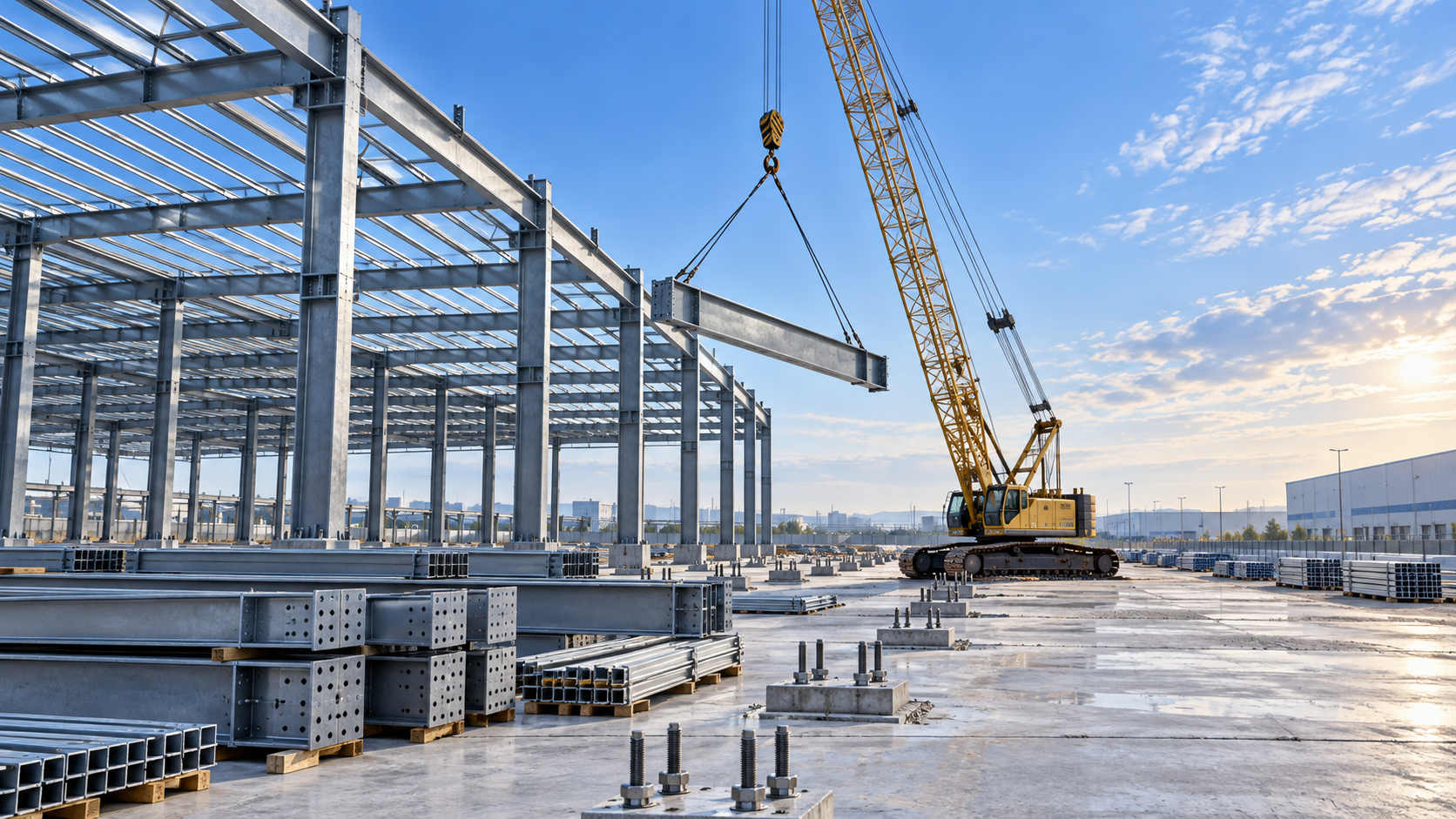
Fast-track projects rarely fail because a team does not understand how to erect a frame. They fail when structural work becomes dependent on too many uncertain site activities: late material releases, variable labor availability, weather interruptions, incomplete information flowing between trades, and revisions discovered after fabrication has already begun. Prefabricated Steel Structures can reduce several of those dependencies by moving a substantial portion of the structural process into a controlled manufacturing environment before the site is ready for full-scale erection.
For project managers, the appeal is not simply that steel goes up quickly. The more important advantage is schedule predictability. When engineering, procurement, fabrication, delivery, and erection are planned as one linked sequence, a prefabricated steel package can turn part of the construction schedule from a weather-exposed field operation into a factory-managed production activity. That distinction matters most when the completion date is commercially sensitive, such as a new logistics facility, industrial expansion, transport-related structure, warehouse, or public-use building with a fixed opening window.
Fast-track delivery depends on overlapping work, not just faster erection
Traditional site construction often follows a mostly sequential logic. Foundations are completed, materials arrive, site teams prepare components, structural work progresses, and subsequent trades gain access when enough of the frame is in place. Some overlap is possible, but the workfront can remain constrained by site conditions and by the availability of labor, lifting equipment, temporary works, and materials at the same time.
Prefabrication changes the sequence. Detailed design and shop drawing approval are completed early, then columns, beams, bracing, connection plates, and other defined components can be cut, drilled, welded, assembled, and coated in the factory while foundation work continues on site. The schedule benefit comes from concurrent activity. Site progress and factory production no longer have to wait on one another as completely as they would in a field-intensive structural approach.
That does not make all projects suitable for acceleration. It does, however, create a clearer route for managing critical path items. A project team can identify when each structural zone must be released for fabrication, when foundations must be ready for erection, how transport loads will be sequenced, and when the enclosure contractor can begin work. With those dates tied to a coordinated model and fabrication plan, the construction programme becomes more measurable than a broad assumption that steel will arrive when needed.
The practical distinction is important: prefabricated steel supports a fast-track programme when decisions are made early enough to protect fabrication. It is less effective when the team expects factory production to absorb late architectural changes, unresolved service routes, or changing loads without affecting delivery.
Factory production removes some site uncertainty, but only after design is stable
Structural steel fabrication benefits from repeatable processes. Members can be produced under controlled conditions, with documented cutting, fit-up, welding, drilling, marking, and surface preparation procedures. Components can be checked before dispatch rather than relying on field teams to resolve every dimensional issue under lifting, access, and weather constraints.
For a project manager, this can improve more than workmanship. It improves the ability to inspect and release work before it becomes difficult to change. A fabrication inspection can identify an incorrect connection detail or missing plate before a component is loaded for shipment. By contrast, discovering the same issue after a member is erected may require lifting equipment, a revised method statement, field welding, coating repair, and disruption to adjacent trades.
Quality control is therefore part of the schedule case, not a separate technical benefit. Reduced rework helps protect the programme because fewer surprises are transferred to the site. This is particularly relevant for projects with repetitive bays, long clear spans, standard connection families, or multiple buildings using related structural logic. Repetition allows production planning to stabilize and makes inspection checkpoints more efficient.
Yet factory conditions do not compensate for incomplete inputs. Before fabrication starts, the project team should have confidence in the following items:
- Design loads, member sizes, and connection responsibilities are clearly assigned.
- Foundation geometry, anchor bolt locations, and tolerances are coordinated with the steel package.
- Roof, wall, fire protection, mechanical, electrical, and drainage interfaces have been reviewed at the structural level.
- Material grades, coating systems, testing requirements, and applicable standards are defined in the contract documents.
- Approval authority and turnaround times for shop drawings are realistic for the intended fabrication window.
Fast-track programmes often break down at the approval stage. A supplier may have available production capacity, but capacity cannot create reliable output if drawings remain under review for weeks or if design comments reopen already released areas. Teams that want the speed advantage of Prefabricated Steel Structures need disciplined release management: freeze what is genuinely ready, track what is not, and avoid treating every area of the building as equally mature.
Site erection becomes more efficient when the logistics plan is designed early
A steel frame can be erected rapidly once materials, foundations, equipment, and crews are aligned. However, fast erection is not the same as fast delivery. It depends on whether the site can receive, unload, store, identify, lift, and install the components in the order required.
Prefabricated components are usually marked and packaged for a planned sequence, but the project must support that sequence. An urban site with restricted vehicle access may need timed deliveries and minimal laydown space. A remote industrial location may need larger shipment buffers because transport reliability is harder to control. A project with heavy columns or transfer beams must confirm crane capacity, crane positions, lift radii, ground bearing conditions, and access routes before delivery plans are finalized.
These are not minor construction details. A frame can be fully fabricated and still become a schedule liability if it arrives too early for the available storage area, too late for the erection crew, or in an unloading order that creates repeated handling. The best programmes connect the fabrication schedule to an erection sequence rather than treating shipping as an administrative handoff.
Project managers should also look beyond the primary frame. Secondary steel, purlins, girts, stairs, platforms, handrails, roof accessories, and interface plates can determine whether later trades gain access on time. A main frame may stand quickly, yet enclosure work can stall if the supporting secondary members, edge details, or connection information are incomplete. The relevant question is not “When can the steel be erected?” It is “When can the next critical trade work safely and productively?”
Transport structures show why interface planning matters
Bridges and pedestrian connections illustrate this point clearly. A prefabricated steel bridge may reduce time spent working over a road, waterway, landscaped area, or active circulation route because major components can be prepared before a planned installation window. But the benefit depends on more than the bridge itself. Bearing locations, approach works, lifting studies, traffic management, drainage, deck interfaces, and site tolerances all need to be resolved in advance.
For projects where architectural appearance and load-bearing performance must be coordinated, Landscape Bridge Systems can be considered as part of an early interface review. Steel's strength, durability, and adaptability can support long spans and varied architectural configurations, but the structure still needs a defined installation method and clear responsibility for every connection to surrounding civil work.
The schedule advantage is strongest in the right project types
Prefabricated steel is usually well suited to projects where time, repetition, and structural clarity are more valuable than unlimited late-stage flexibility. Industrial buildings, manufacturing extensions, warehouses, distribution centers, agricultural facilities, vehicle maintenance buildings, commercial shells, and certain infrastructure structures often meet these conditions. They commonly require long spans, open internal areas, repeatable structural bays, and a practical route for delivery and crane access.
The approach can also work well for phased projects. A project may need one operational zone completed while later areas continue. If the structural package is divided into logical release zones, fabrication and erection can be planned around those handover priorities. This requires careful consideration of temporary stability and site access, but it can give the programme a useful degree of control.
Projects become less straightforward when the final layout remains highly fluid, multiple parties own overlapping design decisions, or architectural geometry drives frequent structural revisions. Complex buildings are not excluded from prefabrication, but they require stronger digital coordination and more disciplined change control. A complex steel assembly fabricated from outdated information can create a larger problem than a simpler field-built element because correcting it may affect transport, erection, coating, and connected systems.
There is also a difference between standardization and oversimplification. Standardizing member families, connection details, bay spacing, and secondary steel layouts can shorten engineering and fabrication cycles. It should not lead a team to ignore building performance requirements. Fire resistance, corrosion exposure, acoustic separation, thermal movement, seismic requirements, deflection limits, and maintenance access still need project-specific resolution.
What project managers should test before committing to a fast-track steel strategy
A useful early decision is to assess whether the programme has enough definition to support procurement. The decisive issue is often not the total construction duration but the date by which structural design information must be frozen. If that date arrives before the owner, architect, engineer, and key specialists can make coordinated decisions, then an aggressive prefabrication plan may create pressure without creating certainty.
Several questions expose whether the strategy is ready:
- Which structural areas are on the critical path, and when must each area be released for shop drawings and fabrication?
- Who has final authority to approve connections, fabrication drawings, substitutions, and coating requirements?
- Are anchor bolt templates, survey controls, and foundation tolerances aligned with the steel erection method?
- Can the site receive steel in erection sequence without excessive double handling or storage risk?
- Are crane planning, temporary bracing, weather procedures, and work-at-height requirements included in the installation programme?
- Have downstream trades confirmed the structural interfaces they need before enclosing or fitting out the building?
- Does the supplier's manufacturing and quality documentation align with the contract's required standards and inspection process?
These questions are more valuable than a generic promise of shortened construction time. They force the team to identify which risks have moved into the preconstruction phase. Prefabrication shifts effort forward: more decisions are needed before site work begins, but the reward can be a more controlled construction period with fewer late structural interventions.
Common assumptions that can undermine the programme
One common assumption is that steel fabrication can begin while major design issues remain unresolved. Limited early procurement may be possible for standard materials, but fabricating specific members too soon can create expensive revisions when loads, openings, service penetrations, or connection geometry change. The discipline is to distinguish between information that is sufficiently stable for production and information that is only convenient to assume.
Another assumption is that prefabrication eliminates weather risk. Factory production reduces exposure for many fabrication activities, but site erection, lifting, bolting, decking, roofing, and cladding remain weather-sensitive. Wind restrictions can affect crane operations, and rain can affect access, coating repairs, concrete works, and the pace of follow-on trades. A resilient programme retains allowances for site conditions even when the frame itself is largely factory-made.
A third is that the lowest steel package price will produce the fastest project. Delivery performance depends on engineering responsiveness, document control, production planning, inspection practices, packaging, transport coordination, and the supplier's ability to manage changes. Price remains important, but an incomplete scope or weak interface definition can consume any initial saving through site disruption. For fast-track work, the commercial comparison should examine what is included in engineering support, connection design, material traceability, quality records, packing, delivery sequencing, and technical response during erection.
Finally, teams sometimes focus on the visible frame and underestimate the value of early coordination with enclosure and services packages. The steel structure establishes geometry for many later systems. When roof penetrations, façade supports, suspended equipment loads, access platforms, or fire protection requirements are identified late, the structural package becomes the place where delays accumulate.
A market shift toward controlled delivery, with a higher bar for coordination
The growing interest in Prefabricated Steel Structures for fast-track construction reflects a broader commercial preference for certainty. Owners and contractors facing compressed programmes are looking for methods that make production, inspection, and delivery easier to plan before site conditions become the dominant constraint. Steel fabrication is well positioned for this because components can be engineered, manufactured, and tracked as defined assemblies rather than formed entirely through field operations.
That advantage will continue to favor teams that can make decisions early and manage interfaces rigorously. The market value of prefabrication is not simply the ability to manufacture off site. It is the ability to convert a construction schedule into coordinated release dates, accountable approvals, controlled production, sequenced logistics, and reliable workfronts for the trades that follow.
For a project manager, the practical conclusion is measured: use prefabricated steel when the programme requires early operational access and the project team can commit to early design discipline. Under those conditions, it can reduce uncertainty where fast-track projects are most vulnerable. Without that discipline, the same approach can merely move unresolved issues from the site to the factory and back again.
We are more than happy to serve you here. If you have any question, please feel free to contact us.