
Related Posts
- ▶ Prefab vs. Conventional Warehouse Construction: Comparing Timelines
- ▶ Planning a Prefab Warehouse: Clear Span, Height and Loading Bays
- ▶ How Long Does It Take to Build a Commercial Steel Building?
Online Message
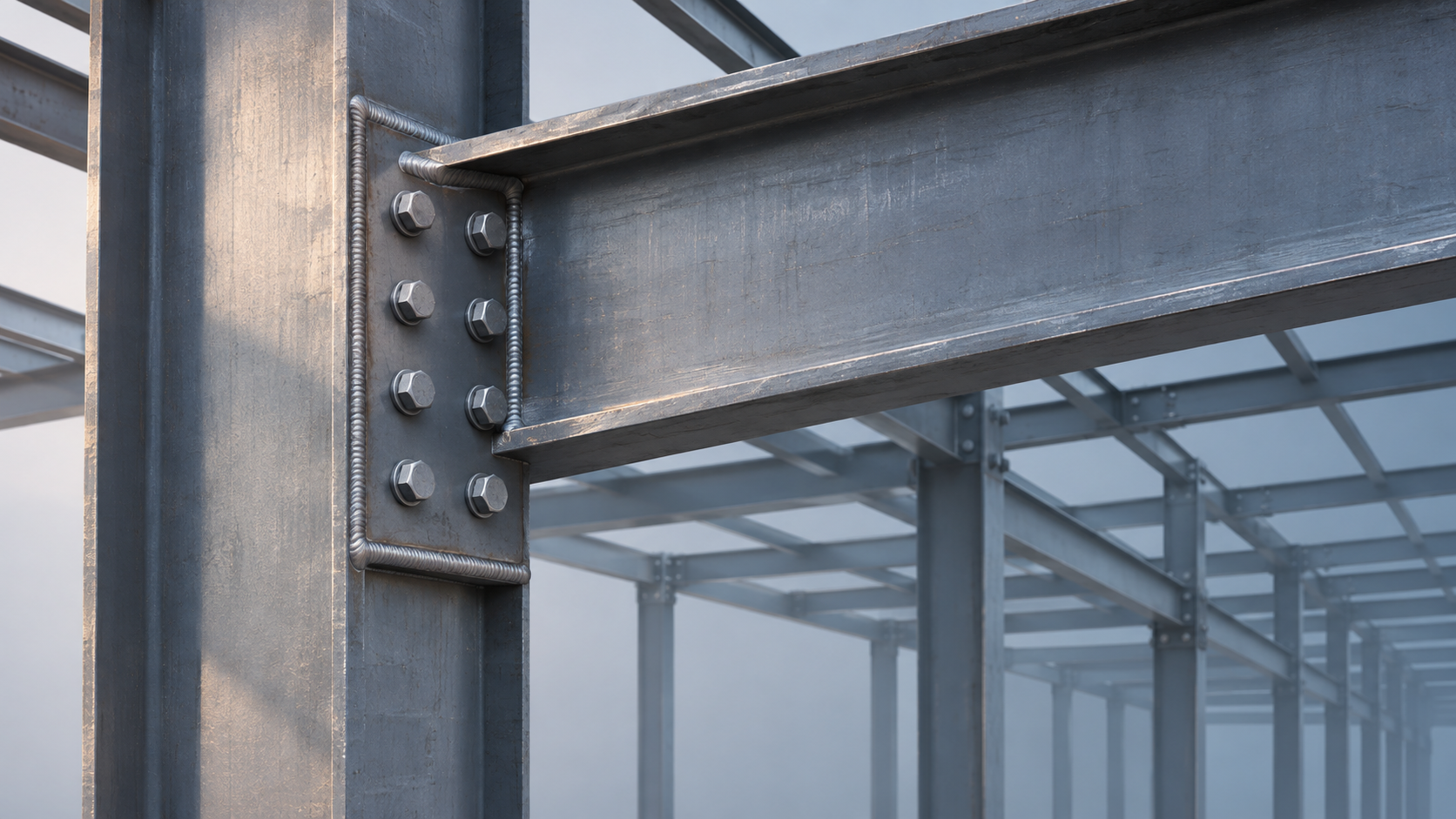
The strength and reliability of a steel building depend not only on its beams and columns, but also on how those elements are joined.
Understanding structural steel components connection types helps project teams select solutions that meet load, fabrication, and installation requirements. From bolted and welded joints to less common riveted connections, each method offers distinct advantages for different applications.
This guide explains the main connection types, where they are used, and the factors to consider when choosing the right option for a prefabricated steel structure.
For most new prefabricated buildings, bolted field connections and welded factory assemblies provide a practical combination of installation speed and fabrication control. The final choice, however, depends on the forces at each joint and the project’s design requirements.
What Are the Main Types of Structural Steel Connections?
Structural steel components are commonly joined by bolts or welds. Rivets are mainly encountered in older structures, while pins and other specialized connectors serve particular structural purposes.
Connections are also described by how they transfer forces. A shear connection primarily transfers forces perpendicular to a member, while a moment connection is designed to transfer bending moments as well.
These classifications answer different questions: bolts and welds describe the joining method; shear and moment describe the intended structural behavior. A connection can use both bolts and welds.
Bolted Connections: Where Are They the Best Fit?
Bolted connections join steel parts through aligned holes using bolts, nuts and, where required, washers. Plates, angles or other connecting elements transfer forces between the members.
They are widely used for site erection because crews can assemble prepared components without relying on extensive field welding. This can shorten installation time, particularly when access and weather are challenging.
Common examples include beam-to-column connections, column splices, bracing connections and end-plate joints between frame sections. Base plates also use anchor rods to connect columns to concrete foundations.
For a building buyer, the practical advantage is predictability. Clearly marked components and a coordinated bolt schedule make installation easier to plan, including the crew, equipment and access required.
Bolted joints still require careful execution. Hole alignment, edge distances, bolt grade, tightening requirements and the condition of contact surfaces all affect the completed connection.
Some joints transfer load through bearing between bolts and connected material. Others are designed as slip-critical connections, where the clamping force and prepared surfaces resist slip under specified loading conditions.
A slip-critical joint requires the specified surface preparation and pretensioning method. It should not be assumed that every high-strength bolted connection is automatically slip-critical.
Before purchasing, ask the supplier which bolts are supplied, how they must be installed, and whether local crews have the tools and experience to meet the specified inspection requirements.
Welded Connections: When Do They Make Sense?
Welding joins steel parts by fusing material at the connection. Common structural welds include fillet welds and groove welds, selected according to the forces and joint details.
In a prefabrication plant, welding is often used to assemble built-up columns and beams, attach stiffeners and plates, and fabricate connection components before shipment.
Factory welding benefits from controlled working conditions and repeatable fabrication processes. It can also reduce the amount of site work needed when components arrive ready for bolting.
Welded joints can provide compact details where bolt access is limited. However, a smaller-looking joint is not necessarily cheaper once preparation, welding, inspection and protective coating are included.
Quality depends on suitable procedures, qualified personnel and inspection appropriate to the design and governing code. Some welds require nondestructive examination; the extent depends on the specified joint and project requirements.
Field welding may be appropriate for certain details, modifications or erection constraints. It also introduces site considerations such as access, weather protection, power supply, fire precautions and inspection scheduling.
For overseas projects, identify field-welded joints before ordering. Confirm who supplies the welding procedures, who performs the work and how completed welds will be accepted.
Shear and Moment Connections: Why Does the Difference Matter?
A shear connection is designed primarily to transfer shear force while allowing the joint rotation assumed by the structural model. Examples include certain shear tabs, angles and end plates.
Such connections are common where beams frame into columns or other beams and the overall structure has a separate system for resisting lateral loads.
A moment connection is designed to transfer bending moment between connected members, along with other applicable forces. It is often used where frame action contributes to lateral stability.
Moment connections can be bolted, welded or combined. Their design may involve end plates, flange plates, stiffeners or other details, depending on the frame and loading.
The distinction affects cost and erection. Moment connections may require more material, tighter fabrication tolerances or additional inspection, but they can be necessary to achieve the intended structural system.
A connection described as “simple” should not be treated as carrying no moment under every condition. The engineer must verify that its actual behavior is compatible with the design assumptions.
Ask the design team to identify which joints provide lateral resistance and which rely on bracing or other elements. This helps prevent changes during procurement from undermining the frame design.
Where Are Common Connections Used in a Steel Building?
Beam-to-Column Connections
These joints support beams and transfer their forces into columns. Depending on the structural system, they may act primarily as shear connections or as moment-resisting connections.
In a portal-frame building, bolted end plates are commonly used at eaves and ridge joints. The exact plate thickness, bolt arrangement and stiffening depend on the engineered forces.
Beam-to-Beam Connections
Secondary beams often connect to primary beams through shear tabs, angles or end plates. Designers must account for member depths, clearances and any notches needed for fit-up.
Where connections interfere with decking, services or fire protection, resolving the detail before fabrication can prevent expensive site modifications and delays.
Column Splices and Base Connections
Column splices join sections where transport limits, fabrication constraints or building height make continuous columns impractical. Bolted splice plates are a common solution.
At the foundation, base plates and anchor rods transfer forces between columns and concrete. Some bases are designed to approximate pinned behavior; others are designed to resist significant moments.
Anchor rod positions, projection, grout space and foundation tolerances must be coordinated before concrete placement. Errors at this stage can affect the entire erection sequence.
Bracing Connections
Bracing connections transfer forces from the lateral-load-resisting system into the frame and foundations. Gusset plates are often used to connect braces to beams and columns.
Depending on the design, braces may experience tension, compression or both. Their connections and clearances must be detailed for the forces and deformation expected.
Are Riveted and Pinned Connections Still Relevant?
Riveted connections are most likely to appear in older bridges, industrial buildings and heritage structures. Their assessment requires attention to existing condition, load paths and applicable repair requirements.
Bolts and welds have largely replaced rivets in new building fabrication because modern fabrication and erection methods generally make them more practical.
Pinned connections remain useful where a joint must permit rotation or where a particular structural detail calls for a pin. Examples can include selected braces and supports.
A pin does not remove the need for structural checks. The pin, connected plates, bearing surfaces and any restraints must all be designed for the expected forces and movement.
How Should You Choose Between Connection Options?
The most economical connection is the one that satisfies the structural design while fitting the project’s fabrication, shipping, erection and inspection conditions. Compare complete installed costs rather than component prices alone.
Start with the load path. Confirm the required shear, axial force and moment at each joint, including forces from wind, seismic action, cranes or other project-specific loading.
Check the structural system. Identify whether stability comes from bracing, moment frames or another system. The connection must behave consistently with the engineer’s analysis.
Review site capabilities. Consider crane access, crew experience, available tools, inspection resources and exposure to weather. A detail that works well in a factory may be difficult to execute onsite.
Account for transport. Larger shop-welded assemblies can reduce site work but may increase freight costs or exceed transport limits. Confirm maximum shipping dimensions and weights early.
Plan for the environment. Corrosion protection, drainage, access for maintenance and any fire-protection requirements can influence connection detailing and long-term performance.
Consider future changes. Bolted connections may make disassembly or modification easier, but reuse depends on the connection design, condition, regulations and the assessment of a qualified engineer.
What Should Buyers Confirm Before Ordering a Prefabricated Structure?
Provide the manufacturer with the building location, intended use, dimensions, applicable design criteria and known equipment loads. Include local requirements for wind, seismic design, fire protection and corrosion exposure.
Ask for drawings that identify connection locations, member marks, bolt grades, weld details and the division between factory and site work. The documents should also show relevant foundation interfaces.
Confirm the governing design and fabrication standards for the destination project. References to ISO, CE, AS/NZS or ASTM should be matched to the specific products, standards and documentation required.
Request relevant certification and inspection records for the actual scope of supply. A manufacturer’s credentials do not replace project-specific engineering approval or verification of local compliance.
For international delivery, agree on bolt quantities, spare fasteners, packaging, part identification and the sequence of shipment. These details help the erection team find the right components when needed.
Finally, establish who is responsible for connection design, foundation coordination, installation and inspection. Clear responsibilities reduce the risk of gaps between the supplier, designer and site contractor.
Conclusion
Bolted and welded joints are the primary structural steel components connection types in modern buildings. Riveted and pinned joints remain relevant for particular existing structures or specialized details.
For prefabricated steel buildings, shop welding combined with site bolting is often practical. The right arrangement still depends on load transfer, shipping constraints, site capabilities and the applicable design standards.
Involve the structural engineer, manufacturer and erector early. Their coordinated review can turn connection selection into a safer, more predictable and more cost-effective building process.
We are more than happy to serve you here. If you have any question, please feel free to contact us.