
News center
Related Posts
- ▶ Prefab vs. Conventional Warehouse Construction: Comparing Timelines
- ▶ Planning a Prefab Warehouse: Clear Span, Height and Loading Bays
- ▶ How Long Does It Take to Build a Commercial Steel Building?
Online Message
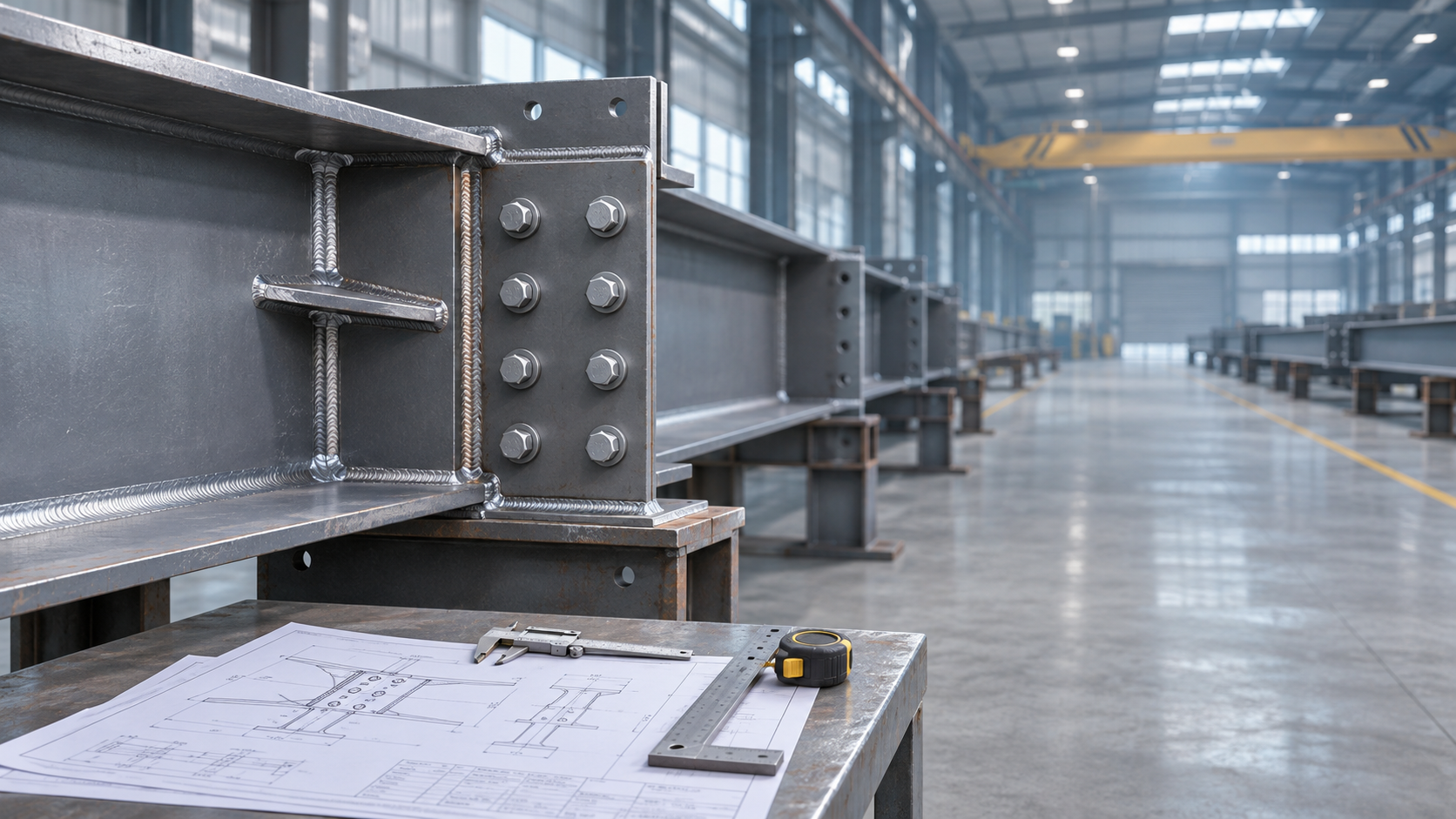
The standards that apply to steel structure design and fabrication depend primarily on where the building will be erected, what it will be used for, and which requirements the project has adopted. A typical project needs a coordinated set of rules for structural design, loads, steel materials, welding, fabrication, inspection, and protective coatings. No single certificate or standard covers all of them.
For a prefabricated steel building, the most useful starting point is the local building code and the project specification. These establish the design framework and the evidence the engineer, building authority, and buyer will need. The fabricator can then price and manufacture the structure against a defined set of requirements.
How the main steel standards work together
When buyers ask what standards apply to steel structure design and fabrication, they are often looking for one document to put in a purchase order. In practice, each standard answers a different question.
These examples are starting points, not interchangeable packages. The governing building code and project documents determine which editions and supporting standards apply. For example, a steel grade specified under an ASTM material standard does not by itself establish the design loads or prove that welded connections have been fabricated correctly.
Which standards apply in the United States?
For a typical U.S. building, the adopted building code provides the overall framework. Structural engineers commonly use ASCE 7 to establish building loads and AISC 360 to design structural steel members and connections. Where seismic design requirements apply, AISC 341 may also be relevant, along with the applicable seismic provisions for connections.
Material specifications are selected for the products used. ASTM A992 is commonly associated with structural steel shapes, while ASTM A36 covers certain carbon structural steel products. The right specification depends on the required product form and properties; a drawing should identify the grade rather than simply state “ASTM steel.”
AWS D1.1 is widely used for structural steel welding when specified and applicable. Fabrication and erection practices may also be governed by the AISC Code of Standard Practice and the project documents. Inspection requirements come from the adopted code and specifications, and can involve both the fabricator’s quality control and independent inspection.
If a buyer orders a welded frame from overseas, it is useful to define the connection design responsibility as well as the standard. The engineer of record may provide complete connection details, or the project may assign part of the connection design to a qualified specialist. That division affects calculations, drawings, review, and lead time.
How does the European framework differ?
European steel building projects commonly use the Eurocodes for structural design. EN 1993, often called Eurocode 3, addresses steel structures, while EN 1991 covers actions on structures. The relevant national annex matters because it supplies nationally determined choices used with the Eurocodes. A design prepared for one country should not be assumed suitable for another without considering those choices and the site conditions.
For fabrication, EN 1090-2 sets technical requirements for the execution of steel structures. It covers matters such as fabrication, welding, tolerances, and inspection. The project specifies an execution class, which influences the applicable controls. That class should be established during design and communicated to the fabricator before quotation; it is not simply a label the factory chooses after production.
European projects may also involve EN 1090-1 conformity assessment and CE marking requirements for covered structural components where applicable. A supplier’s general statement that it is “CE certified” does not identify the product, assessment scope, or supporting declaration. Buyers should request the documentation relevant to the components being purchased and the destination market.
What about Australia and New Zealand?
Australian and New Zealand projects use their applicable building regulations together with referenced structural and loading standards. AS 4100 is a central standard for steel structure design in Australia, while the AS/NZS 1170 series addresses structural design actions. The applicable framework differs by jurisdiction, so a project in New Zealand should not be treated as identical to an Australian project simply because both use some joint standards.
Fabrication requirements may include AS/NZS 5131 for structural steelwork and AS/NZS 1554.1 for welding, where specified and applicable. Steel product standards, coating requirements, inspection, and documentation should also be included in the project specification.
For imported structures, the designer should establish the accepted material grades and the evidence required for them before procurement. A supplier may offer a grade with similar nominal properties, but substitution still needs an engineering review of the product standard, mechanical properties, weldability, and other requirements relevant to the design.
Design compliance begins with the building site
A prefabricated frame that is adequate for one location may not be adequate for another. Wind exposure, snow accumulation, seismic conditions, building height, occupancy, and the consequences of failure all affect the design. Openings and internal equipment matter too: a large door can influence the building’s load path, while a crane adds forces that must be addressed in the frame and its connections.
The buyer should provide the site location and intended use before accepting a structural proposal. If the building will later carry solar panels, suspended services, a mezzanine, or an overhead crane, these should be included in the design brief. Adding them after fabrication can require reinforcement or replacement of components.
Foundations and anchor bolts also need coordination. A steel supplier may provide column reactions and anchor-bolt requirements, while a local engineer designs the foundations for the site’s ground conditions. The drawings should make that boundary clear and identify who checks that the frame, base plates, anchors, and foundations work together.
What fabrication and inspection documents should buyers request?
A compliant design still depends on the correct steel being supplied and the components being made as specified. Before placing an order, agree on a document list suited to the project and its inspection requirements. It may include:
- Material certificates: records identifying the supplied steel products, grades, and relevant test results, with traceability to the fabricated components where required.
- Approved fabrication drawings: drawings showing member sizes, connection details, welds, bolt information, dimensions, and any specified tolerances.
- Welding documentation: applicable welding procedure specifications and evidence of required procedure and personnel qualifications.
- Inspection records: reports for visual inspection, dimensional checks, and any specified nondestructive testing, such as ultrasonic testing.
- Coating records: surface preparation, coating system, and inspection information where protective treatment is part of the order.
- Conformity and quality documents: certificates or declarations applicable to the supplied components and the project’s acceptance process.
The extent of inspection should follow the governing requirements and the risk associated with the work. Asking for a particular test on every weld may add cost without addressing the project’s actual requirements; leaving the test scope undefined can create disputes when the steel is ready to ship. The drawings and inspection plan should identify what is to be examined, when, and against which acceptance criteria.
Quality control and independent inspection also serve different roles. The fabricator checks its own work, while a third party or the purchaser’s representative may perform additional inspection when the contract or applicable rules require it. Access to the factory and notice of inspection points should be agreed early enough to avoid delaying production.
Can standards from different regions be combined?
Sometimes, but the combination needs a defined technical basis. A project may use a local design code while accepting imported steel produced to another recognized material specification. That does not make the material grades automatically equivalent. The engineer must establish whether the proposed product meets the design and fabrication requirements, including strength, toughness where relevant, and welding compatibility.
The same caution applies to connections, bolts, and welds. A bolt assembly specified under one system should not be substituted solely because its diameter resembles that of an assembly in another system. Strength, installation method, associated components, and inspection requirements all affect whether it is suitable.
The cleanest purchase specification identifies the governing design code, material standards, fabrication and welding standards, and inspection requirements together. If alternatives are allowed, it should state who can approve them and what evidence the supplier must submit. This gives bidders a common basis for pricing and reduces the chance that a cheaper quotation excludes necessary work.
Do coatings and fire protection have their own requirements?
Yes. Structural design standards do not automatically specify the corrosion protection or fire resistance needed for a building. Those requirements depend on the environment, building use, applicable regulations, design life assumptions, and the project specification.
For corrosion protection, a dry enclosed warehouse may need a different coating system from steel exposed to coastal air, industrial chemicals, or frequent condensation. The specification should describe the required surface preparation and coating system, as well as how application and inspection will be recorded. Hot-dip galvanizing may be appropriate for some components, but connection details, fabrication dimensions, and the intended exposure need to be considered when selecting it.
Fire protection is a separate design decision. Depending on the building and local requirements, protection may be provided by coatings, boards, encasement, or another accepted approach. The structural engineer, fire designer, and supplier should coordinate the required rating and the effect of the selected system on connections and installation.
What should be agreed before ordering a prefabricated steel building?
Start with a project-specific standards schedule rather than a broad request for an “international standard” building. It should identify the destination, building use, applicable code framework, design loads, material grades, fabrication requirements, inspection scope, and required documentation. The schedule should also state which party is responsible for structural calculations, connection design, foundations, and erection.
Then compare supplier quotations against that same schedule. A factory’s production capacity can be relevant to delivery planning, but it does not establish that the offered design meets the site requirements. Likewise, an ISO quality management certificate describes a management system; it does not replace project-specific calculations, material records, welding qualifications, or inspection reports.
For factory-direct procurement from China, ask the manufacturer to identify which requirements it will meet in its own scope and which depend on the local design team or erector. Review the proposed standards and document package before production begins. A clear agreement at that stage gives both buyer and fabricator a practical basis for approving the drawings, inspecting the work, and accepting the delivered structure.
We are more than happy to serve you here. If you have any question, please feel free to contact us.