
News center
Related Posts
- ▶ Prefab vs. Conventional Warehouse Construction: Comparing Timelines
- ▶ Planning a Prefab Warehouse: Clear Span, Height and Loading Bays
- ▶ How Long Does It Take to Build a Commercial Steel Building?
Online Message
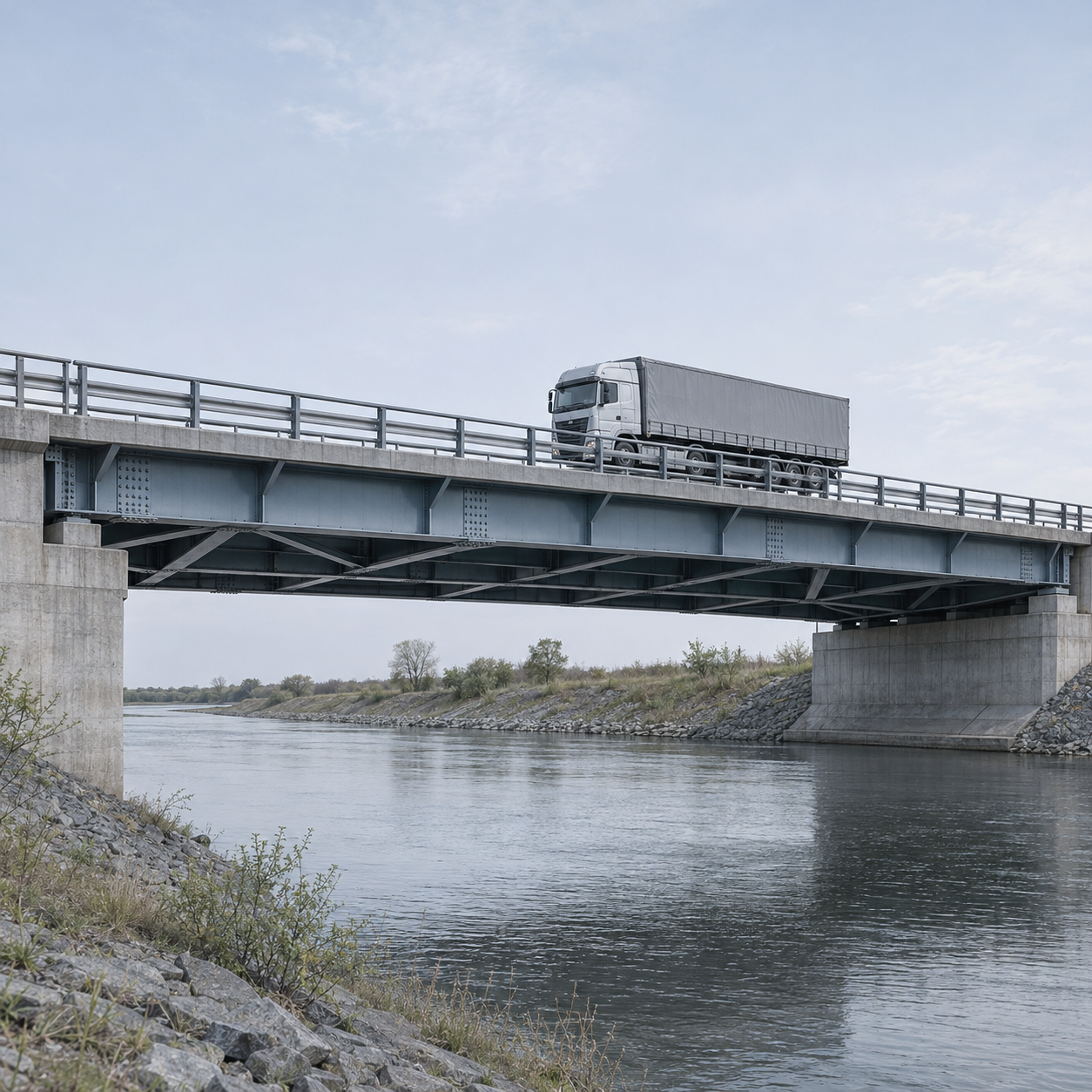
Steel bridge load ratings vary widely depending on span, structural design, material strength, and the traffic they are built to carry. There is no single typical tonnage that applies to every steel bridge. Engineers assess each structure against the relevant design standards, vehicle configurations, and—in the case of an existing bridge—its actual condition.
A highway bridge may be checked against a standard design vehicle and additional local requirements. A private access bridge might be governed by a fire engine, crane, or fully loaded delivery truck. For buyers comparing steel structures, the useful question is not simply “How many tons can it take?” but “Which vehicle, under what conditions, and according to which standard?”
Is there a typical load rating for a steel bridge?
There is no reliable universal figure. Steel bridges range from pedestrian crossings to structures carrying highway traffic and exceptionally heavy industrial vehicles. Even two bridges with the same span and similar-looking girders can have different ratings because of their deck systems, bracing, connections, fatigue history, or support conditions.
In the United States, highway bridge design commonly refers to the AASHTO LRFD Bridge Design Specifications. Its HL-93 design loading includes a design truck or design tandem combined with a design lane load, as specified by the code. That is a design model—not a statement that every compliant bridge has one fixed truck-weight limit.
Other jurisdictions use different standards and loading models. European projects may refer to the Eurocodes and the applicable National Annex, while Australian and New Zealand projects may use the relevant local bridge design requirements. The governing authority and the edition of the standard need to be established for the individual project.
A published rating or posted weight limit is also specific to the vehicle definition and assessment behind it. Treating a number from one jurisdiction as directly equivalent to a number from another can lead to an unsafe comparison.
Design load, load rating, and posted limit are different
These terms are often used interchangeably in preliminary discussions, but they answer different questions.
Design loading is the specified set of loads and combinations used to design a new bridge. It may cover traffic, the structure’s own weight, wind, braking forces, and other actions required by the governing code. It does not guarantee that any vehicle with a matching gross weight can cross without further checks.
Load rating is an engineering assessment of a bridge’s capacity for defined loading and evaluation criteria. For an existing bridge, it should account for relevant inspection findings and available records. In US practice, ratings may be expressed as rating factors for specified vehicles and levels of evaluation rather than as one universal tonnage.
A posted limit is an operational restriction established by the responsible authority. It can depend on the vehicle type and local rules. A permit for an exceptional vehicle, where available, may impose its own route, speed, escort, or crossing conditions.
The distinction matters when buying a replacement bridge. A supplier’s statement that a structure is “designed to HL-93” is useful, but it is not the same document as a completed load-rating report or approval for a specific oversized vehicle.
Why vehicle configuration matters as much as total weight
Gross vehicle weight is only the starting point. Axle loads, axle spacing, wheel spacing, and the position of the vehicle on the deck influence how forces reach the bridge members. A short vehicle with heavily loaded axles can be more demanding on some elements than a longer vehicle of similar total weight.
Consider a facility that normally receives highway trucks but occasionally brings in a mobile crane. The crane’s axle arrangement and loading may govern a check that ordinary deliveries do not. The main girders might be adequate while a deck plate, transverse beam, connection, or bearing needs closer examination. In another layout, the governing component may be a girder near midspan or a support region.
The number and position of vehicles also matter. A two-lane bridge may need to resist vehicles in more than one lane, subject to the applicable code’s loading rules. A private bridge intended for one vehicle at a time should have that operating assumption clearly stated; it should not be left for future users to infer.
For procurement, provide the heaviest credible vehicle’s axle diagram, not just its advertised operating weight. Include whether it will travel loaded, whether attachments or trailers are involved, and whether it might stop or brake on the bridge. For unusual equipment, ask the bridge engineer whether a separate vehicle-specific assessment is required.
What controls the capacity of a steel bridge?
Span and structural arrangement are major factors. A longer span generally changes bending and deflection demands, but span alone does not determine capacity. Girder depth, spacing, continuity, bracing, and the way the deck shares load all influence the result. Adding steel in the wrong place is not necessarily an efficient solution.
Material grade matters, but a higher-strength steel specification is not a shortcut to a higher bridge rating. Stability, fatigue, connection detailing, serviceability, and local buckling may govern before the nominal strength of a main girder is fully used. The design also needs to address the behavior of the complete system, including concrete or other deck materials where used.
Connections deserve particular attention on prefabricated bridges. Bolted field splices can make transport and erection practical, yet the splice design, bolt specification, hole preparation, fit-up, and inspection requirements must match the calculated forces. A sound girder design does not compensate for an inadequately detailed connection.
For an existing bridge, condition can change the answer substantially. Corrosion at girder ends, section loss around drainage points, damaged bracing, cracked welds, or deteriorated bearings may affect the rating. Inspection findings should be assessed by a qualified bridge engineer; a visual impression that the steel “looks heavy enough” is not a calculation.
Foundations and abutments are part of the decision too. A replacement steel superstructure may be strong enough for the intended traffic while the existing supports or ground conditions require strengthening. Ask whether the proposed scope includes checking those elements rather than assuming they are covered.
How to compare bridge proposals without comparing unlike figures
Early quotations often contain attractive headline capacities but different underlying assumptions. One offer may cover a single-lane superstructure only; another may include a deck, bearings, and parapets. A lower quoted weight does not necessarily mean the bridge is less capable, and a heavier steel package does not automatically mean it is more suitable.
Give each bidder the same basic brief: clear span and support arrangement, carriageway width, intended traffic, governing jurisdiction, design life, environmental exposure, and known site constraints. Identify any exceptional vehicles separately. Where the final foundation information is not yet available, state the assumptions and make clear that they need confirmation.
Then ask for a written basis of design and a scope breakdown. The most useful points to compare are:
- The standard and edition used, including the specified traffic loading and any project-specific vehicles.
- Whether the quoted package includes the deck, bracing, bearings, joints, barriers, fasteners, and corrosion protection.
- Which party designs and verifies the abutments, foundations, temporary works, and site connections.
- What calculations, fabrication drawings, material records, inspection documents, and erection instructions will be supplied.
- Transport-piece dimensions and weights, along with assumptions about lifting equipment and site access.
These details can change the cost and schedule more than a small difference in quoted steel tonnage. For example, a longer fabricated section may reduce field splices but require a difficult transport route or a larger crane. More, shorter sections may travel easily while adding site assembly and inspection work. The better choice depends on the route and erection plan, not on fabrication alone.
Where prefabricated steel supply fits into the decision
Prefabrication can be useful when site access is constrained or when buyers want defined fabrication and inspection stages before shipment. It does not remove the need for project-specific bridge design, local approvals, or coordination with the civil works.
Keming is a China-based prefabricated steel building manufacturer with a stated 120,000 m² plant and 100,000-tonne annual production capacity, supplying factory-direct steel structures to more than 20 countries. For buyers researching Keming prefabricated steel buildings export, that background is relevant to fabrication and international supply discussions, but a building manufacturer’s production capacity alone does not establish qualification for a particular bridge.
The business identifies ISO, CE, AS-NZS, and ASTM among its certification or standards credentials. Their relevance and scope should be checked against the specific product, material, fabrication process, and destination requirements; standards references are not interchangeable with proof that a complete bridge has been certified. Request the applicable certificates and supporting records rather than relying on a general credentials list.
Before placing an order, have the responsible bridge engineer confirm the design basis, governing vehicle loads, support assumptions, and required deliverables. If a supplier cannot show exactly what its stated load capacity covers, treat the figure as a preliminary claim—not as permission to put a truck on the bridge.
We are more than happy to serve you here. If you have any question, please feel free to contact us.