
News center
Related Posts
- ▶ Prefab vs. Conventional Warehouse Construction: Comparing Timelines
- ▶ Planning a Prefab Warehouse: Clear Span, Height and Loading Bays
- ▶ How Long Does It Take to Build a Commercial Steel Building?
Online Message
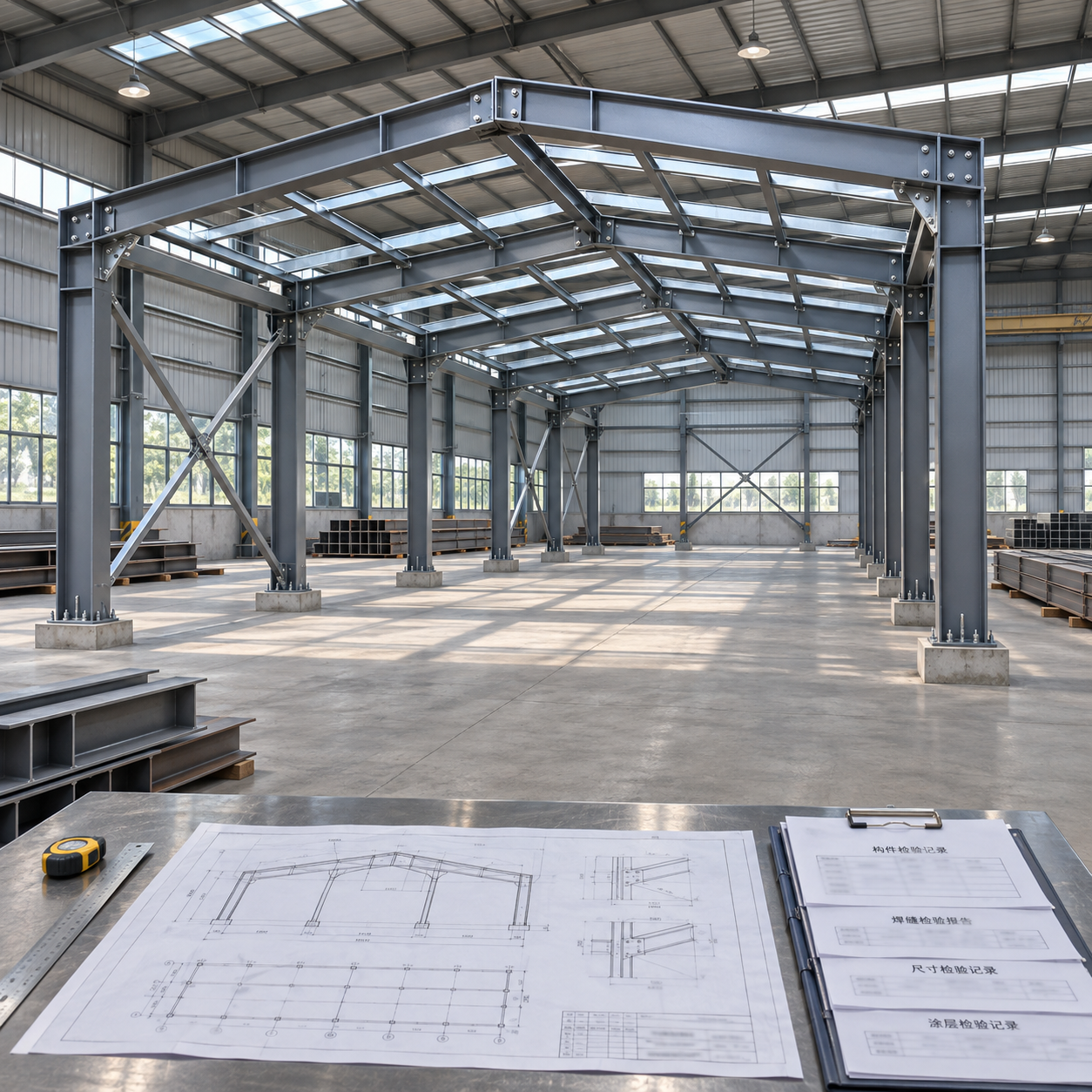
Prefabricated steel buildings do not have one universal certification that makes them acceptable everywhere. The required evidence depends on where the building will be installed, how its structural components are classified, the applicable building code and the conditions of the project permit.
A manufacturer’s ISO 9001 certificate, a CE mark on a structural component and an approved set of engineering drawings answer different questions. None should be treated as a substitute for the others. A compliant purchase therefore starts with the destination and the building’s intended use—not with a list of certificates in a supplier’s brochure.
Certification, code compliance and structural approval are different
A building authority is concerned with whether the completed structure meets applicable requirements for safety and use. Certification can support that assessment, but it does not automatically approve the building.
The distinction becomes clearer when the documentation is separated by purpose:
- Management-system certification assesses a manufacturer’s management processes. ISO 9001, for example, concerns a quality management system; it does not certify the structural capacity of a particular building.
- Product or component certification and marking relate to defined products, manufacturing controls or declared characteristics under a specified scheme. Their relevance depends on the product’s scope and the destination market.
- Material documentation identifies the steel supplied and its reported properties. A mill test certificate is not the same as independent certification of the completed structure.
- Project design and approval documents demonstrate how the building is intended to meet local requirements for loads, connections, foundations, fire safety and other conditions. They may require review or approval by locally authorized professionals and authorities.
A factory can have a certified quality system and still supply a building that does not meet a project’s wind-load requirement. Conversely, a well-engineered design needs fabrication controls and traceable materials to give confidence that the delivered components match it. Compliance depends on the connection between design, manufacture and installation.
Start with the destination’s building rules
The most important question is not simply, “What certificates does the manufacturer have?” It is, “What must be demonstrated for this building at this site?” A warehouse, workshop, agricultural building and occupied commercial structure can face different requirements even when their steel frames look similar.
The applicable rules are determined by the jurisdiction and project details. They can include building-code provisions, referenced structural design standards, product-marking rules, fire regulations and permit conditions. The local authority having jurisdiction, the project engineer and the contract specifications all play a part in identifying the required evidence.
Location also determines design actions. Wind speed and exposure, snow accumulation, seismic effects, ground conditions and corrosion environment are site-specific. A certificate cannot establish that a standard frame is adequate without a design assessment against those conditions.
Before production begins, the responsible parties should agree on the design basis: building dimensions and use, load assumptions, applicable codes and editions, foundation responsibilities, connection design, and any required independent review. This prevents a common contractual gap in which the supplier designs the frame, another party designs the foundations, and neither has clearly accepted responsibility for the forces transferred between them.
ISO certificates: useful evidence, but limited in scope
ISO 9001 is a quality management system standard. An accredited third-party certificate can provide evidence that the organization has processes for controlling activities such as document management, purchasing, production and corrective action. It does not mean every product has been independently tested or that the factory’s buildings comply with a particular national building code.
ISO 3834 addresses quality requirements for fusion welding of metallic materials. Depending on the applicable part and certification scheme, it can provide relevant evidence about a fabricator’s welding quality arrangements. It is not, by itself, a project-specific structural approval or a replacement for qualified welding procedures and personnel where those are required.
Other management-system certificates, such as ISO 14001 for environmental management or ISO 45001 for occupational health and safety, may be relevant to procurement policy. They should not be presented as proof that the building has adequate structural resistance, fire performance or corrosion protection.
When reviewing an ISO certificate, check the legal entity, factory address, activities covered, validity dates and issuing certification body. If accreditation is claimed, check the accreditation status and scope through the relevant accreditation body. A certificate held by a trading company does not automatically cover a separate fabrication plant.
CE marking and EN 1090 in the European context
In the European Economic Area, CE marking may be required for a construction product covered by an applicable harmonised European standard or for which a European Technical Assessment has been issued. The applicable rules depend on the product and the route used. A CE mark is not a blanket approval of an entire building, and it does not remove the need to comply with national building requirements.
For certain structural steel components, EN 1090-1 is central to the CE-marking route where its scope and the applicable regulatory conditions are met. It concerns conformity assessment requirements for structural components. EN 1090-2 provides technical requirements for the execution of steel structures.
These standards should not be reduced to the claim that a supplier is “EN 1090 certified.” The relevant questions include what components are covered, which factory produced them, what factory production control certification applies and whether the declared performance matches the order. Where required, the manufacturer provides a Declaration of Performance and CE marking information for the product.
Execution class also matters. EN 1090-2 uses execution classes, commonly identified as EXC1 through EXC4, to specify levels of execution requirements. The class for the works or component is determined through the applicable project specifications and design framework; it is not simply a marketing grade selected by the supplier. A certificate covering one scope should not be assumed to cover a more demanding execution class or every type of component.
For projects in Great Britain, check the applicable product-marking and conformity-assessment rules separately rather than assuming the EU route applies unchanged. Requirements can depend on the product, jurisdiction and current legislation. Northern Ireland has a distinct regulatory position, so the precise destination matters.
United States: design standards and fabrication qualifications
In the United States, building requirements are generally adopted and enforced at state or local level. The applicable building code and its referenced standards depend on the jurisdiction and the code edition in force for the project.
Structural steel design is commonly associated with standards published by the American Institute of Steel Construction, including ANSI/AISC 360. Loads are addressed through the adopted building code and referenced standards such as ASCE/SEI 7. Welding requirements may involve AWS D1.1/D1.1M where specified and applicable. These documents serve different purposes; naming one does not establish compliance with all the others.
AISC certification is a voluntary certification program for eligible fabricators and other participants, though a contract or project specification may require it. It assesses the organization’s quality management system against the relevant program requirements; it is not a certification of each individual building. The applicable category and scope should match the work being contracted.
Some jurisdictions or specifications also require special inspection, fabrication inspection or other forms of oversight. Whether a certified fabricator qualifies for any inspection adjustment depends on the adopted code and the authority’s acceptance. It should not be assumed from the presence of an AISC certificate alone.
Australia and New Zealand: check both standards and project acceptance
Australian and New Zealand projects may reference AS or AS/NZS standards for design, materials, fabrication and welding. For example, AS/NZS 5131 addresses fabrication and erection of structural steelwork, while other standards govern matters such as structural design and welding. The relevant editions and requirements must be established for the particular jurisdiction and project.
A statement that a building is “AS/NZS certified” is too broad to evaluate on its own. Ask for the specific standard, the scheme or assessment involved, the certifying organization, the covered activities and the evidence that the ordered components fall within the certificate’s scope.
The project specification may also define a construction category under AS/NZS 5131. That classification affects the fabrication and inspection requirements to be applied. It should be established through the design and specification process, not inferred solely from the building’s size or use.
Certification schemes such as the Australian Steel Institute’s Steelwork Compliance Australia program may be relevant where specified or accepted for the project. Their applicability and scope should be checked against the contract and local requirements. Certification does not replace structural design certification or any approvals needed for the site.
Material standards are not certificates for the building
Steel plate, sections, bolts and other components may be specified to ASTM, EN, AS/NZS or other material standards. An ASTM designation identifies a standard or specification; ASTM itself does not ordinarily certify a finished steel building merely because a material specification is referenced.
A material test certificate should identify the applicable grade and relevant reported properties, together with a traceable link to the supplied material, such as heat or batch identification where applicable. For structural steel, the specified grade matters because design assumptions depend on properties such as strength and, where required, toughness and weldability.
Traceability is especially important when equivalent grades from different standards are proposed. Two grades with similar nominal yield strengths are not automatically interchangeable. Thickness limits, chemical composition, impact-test requirements, product form and the design standard’s permitted use can affect acceptance. Any substitution should be reviewed against the project specification and approved by the responsible engineer where required.
The same principle applies to bolts, welding consumables and protective coatings. A generic certificate for “steel materials” does not establish that each critical item delivered to the site meets the specified grade and performance requirements.
What the structural documents should establish
Certificates are most useful when read alongside the project’s engineering package. The drawings and calculations should identify the design criteria, structural system, member sizes, connection details and reactions transferred to the foundations. They should also make clear which party is responsible for each design interface.
For a prefabricated frame, particular attention should be paid to bracing and stability during both permanent use and erection. A complete frame design may assume that roof and wall bracing, cladding restraints or permanent connections are installed as specified. If those elements are omitted, changed or delayed, the structure may not behave as assumed in the calculations.
Load information should be expressed in terms that can be checked. Roof live load, snow load, wind actions, seismic actions, crane loads and suspended equipment loads are not interchangeable. A statement that a building has a “high load capacity” is not a design basis.
Questions such as “what load rating do steel structure bridges typically have” concern a different application: bridge ratings are tied to the bridge, its design and assessment rules, condition and permitted vehicles. They should not be used as a shortcut for establishing the capacity of a building frame.
Welding, inspection and protective systems
Weld quality cannot be established from a company certificate alone. Depending on the project standard and specification, supporting records may include welding procedure specifications, procedure qualification records, welder qualifications and inspection reports. The documents should correspond to the joint types, materials, processes and production period relevant to the order.
Inspection requirements should be defined before fabrication. Visual inspection is fundamental, but the need for non-destructive testing, its extent and the acceptance criteria depend on the applicable standard, execution requirements and weld details. A report showing that testing occurred is only useful if it identifies what was tested, the method and acceptance basis, and the disposition of any nonconformities.
Protective systems require separate consideration. Paint, galvanizing and fire-protection products can have their own specifications, test reports or certifications. A coating certificate should be matched to the specified system, surface preparation, application conditions and inspection requirements. Similarly, a fire-resistance classification or test report must be applicable to the actual assembly and installation details; it is not enough that a coating product has been tested somewhere.
How to review a supplier’s compliance package
Request documents against a defined project specification rather than accepting an undifferentiated collection of certificates. A useful review follows the chain from the legal requirement to the delivered item:
- Identify the governing requirements. Record the destination, applicable code editions, permit conditions and project specifications, including any required certification schemes.
- Check each certificate’s scope. Confirm the legal entity, production site, covered activities or products, dates, issuing body and any relevant execution or certification category.
- Match the design to the site. Review the design loads, drawings, calculations and responsibility for foundations, connections and interfaces with locally supplied work.
- Match production records to the order. Check material identification, fabrication and welding records, inspection results and any required declarations or component markings.
- Confirm acceptance before shipment. Resolve document gaps with the project engineer, relevant authority or contractually designated reviewer while changes can still be made without disrupting delivery.
A certificate that has expired, covers a different factory or relates only to a management system may still be genuine, but it does not answer the intended compliance question. The decisive test is whether the evidence covers the actual components, their manufacture and the rules applying to the building’s destination.
We are more than happy to serve you here. If you have any question, please feel free to contact us.