
Related Posts
- ▶ Prefab vs. Conventional Warehouse Construction: Comparing Timelines
- ▶ Planning a Prefab Warehouse: Clear Span, Height and Loading Bays
- ▶ How Long Does It Take to Build a Commercial Steel Building?
Online Message
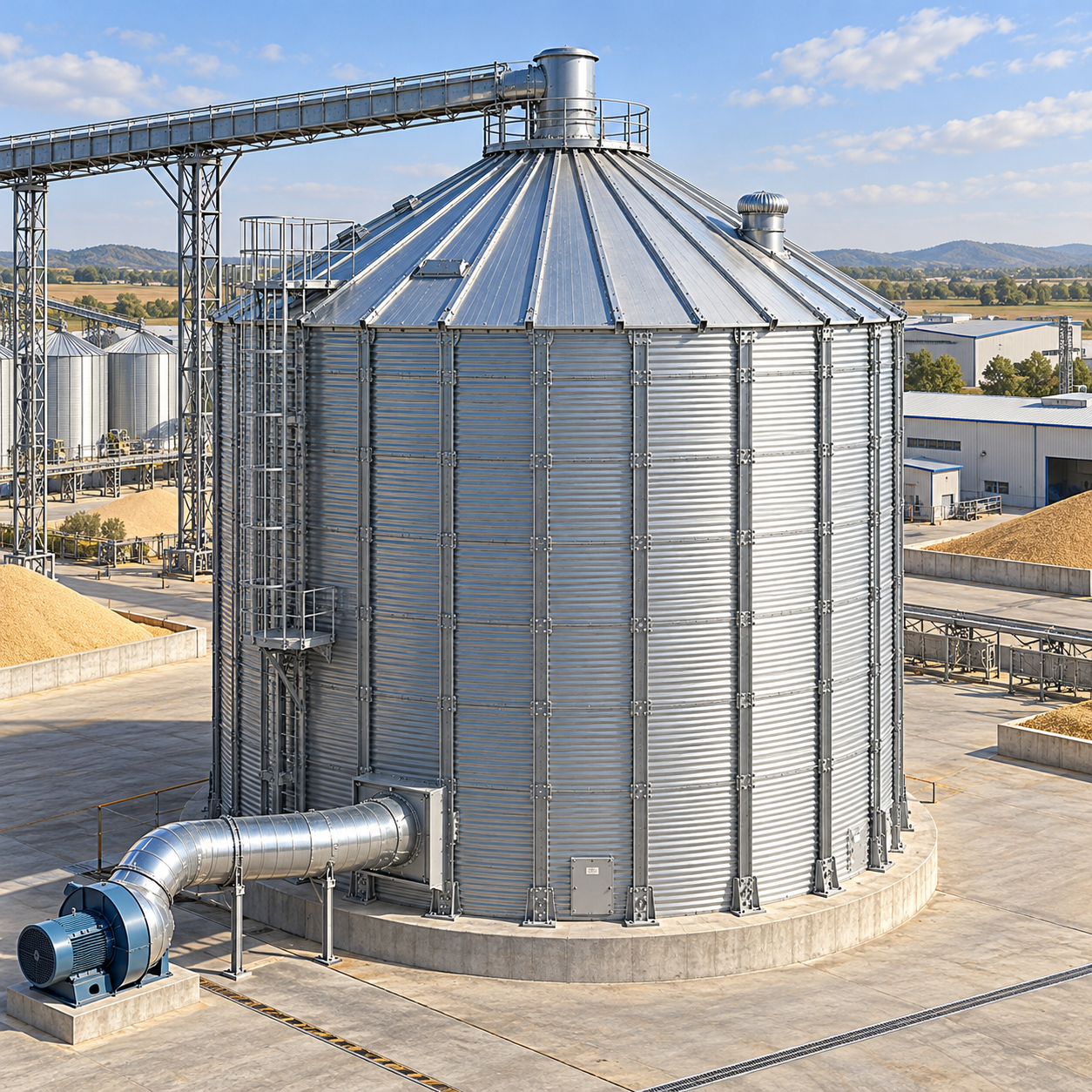
Steel grain silos store bulk crops in vertical enclosures, using a steel shell to contain the grain and a coordinated system to manage filling, airflow, monitoring, and discharge. Their storage limits come from both structural capacity and the condition of the crop. A silo can remain within its rated tonnage while grain inside deteriorates because it entered too wet, cooled unevenly, or received insufficient airflow.
A useful assessment therefore starts with two questions: what loads is the structure designed to carry, and what grain conditions can the storage system maintain? The answers determine whether a silo suits seasonal farm storage, rapid turnover at a grain terminal, or controlled supply to a processing plant.
The main components and what they actually do
Wall sheets, stiffeners, and connections
Many agricultural silos use bolted, corrugated galvanized steel sheets. Corrugation increases sheet stiffness, while the assembled wall resists outward pressure from the grain. Where vertical stiffeners are included, they carry defined axial loads toward the foundation. Sheet thickness, steel grade, bolt arrangement, and stiffener spacing form a single engineered system; changing one component affects the others.
Lower wall courses generally face greater grain pressure than upper courses. However, a silo wall cannot be assessed as a liquid tank: grain transfers load through internal friction and friction against the wall. Filling pattern, discharge behavior, and grain properties influence the resulting forces. Diameter and height alone do not establish structural capacity.
Galvanizing protects exposed steel against corrosion, but wet grain residues, fertilizer contamination, trapped moisture, and damaged coatings create local exposure problems. Corrosion around the base connection deserves attention because this area also transfers structural forces into the foundation.
Roof, filling inlet, and ventilation openings
The roof sheds rain and supports its specified environmental and equipment loads. A central inlet helps distribute grain symmetrically when used with suitable filling equipment. Conveyors, access platforms, and suspended machinery introduce additional loads that must be included in the design.
Roof vents provide an escape path for air driven through the grain. Restricted vents reduce aeration performance and create pressure differences across the enclosure. A weatherproof silo is not automatically a pressure vessel or a gas-tight storage system; sealing for controlled-atmosphere storage requires a separate design approach.
Foundation and anchors
The foundation supports the stored grain and structure, with the load path differing between flat-bottom and elevated hopper arrangements. It also resists relevant wind and seismic actions. Soil bearing strength, settlement, groundwater, drainage, and anchor placement influence the foundation design.
Uneven settlement can distort wall geometry, strain connections, and interfere with unloading equipment. A level base and accurate anchor setting are therefore installation requirements with lasting consequences. Water should drain away from the perimeter rather than collect against the wall or migrate beneath the storage floor.
Aeration, monitoring, and discharge equipment
Aeration systems combine fans with a perforated floor or ducts to move air through the grain. Their main purpose is temperature management. Temperature cables reveal conditions at selected locations, while sampling and moisture measurements provide information the cables cannot capture.
At the bottom, discharge outlets, conveyors, and sweep equipment control grain removal. Their arrangement affects both operating capacity and structural loading. A large outlet does not guarantee reliable flow if the crop has compacted, accumulated fines, or formed a crust.
Flat-bottom and hopper-bottom silos serve different duties
Flat-bottom silos suit substantial storage volumes where grain remains for longer periods. Grain above the main outlet flows out first; material left across the floor requires a designed reclaim system, often including a sweep auger. The floor arrangement must accommodate aeration, unloading equipment, and cleaning access.
Hopper-bottom silos use sloping floors to direct material toward an outlet. They suit buffer storage, batch handling, and applications requiring frequent emptying. The hopper and its supporting structure carry concentrated loads, so an elevated silo requires a different foundation and support design from a ground-supported flat-bottom unit.
A hopper does not guarantee complete discharge. Wall friction, outlet size, slope, and material cohesion determine whether grain flows cleanly or leaves stagnant pockets. A configuration suitable for clean, dry wheat may perform differently with damp grain or a product containing substantial fines.
Common uses across grain handling facilities
On farms, silos hold harvested crops until drying, sale, feeding, or further processing. Where grain arrives faster than a dryer can handle it, a separate wet holding silo provides temporary buffering. Its permitted holding period follows the incoming grain condition and available airflow, rather than the seasonal storage plan for dried grain.
Grain handling terminals use multiple silos to separate crops, grades, or lots. This segregation preserves options for blending and dispatch, provided filling routes and discharge systems prevent unintended mixing. Processing facilities use silos to maintain feedstock availability and stabilize the flow into milling or other production stages.
Downstream logistics buildings perform a different task. A Cross-Docking Facility transfers packaged freight between inbound and outbound vehicles, with its layout shaped by dock access and short travel routes. It can sit within the same distribution chain, but its floor area and handling capacity do not substitute for bulk grain storage capacity or grain conditioning equipment.
Rated capacity: volume, mass, and permitted loads
Silo capacity is often expressed in tonnes, but the enclosure holds a geometric volume. Converting that volume into mass requires an assumed bulk density. Different crops, moisture levels, and grain conditions produce different mass within the same space. A capacity figure is meaningful only when its density basis and filling limits are known.
Available space is not permission to add more weight. A denser product can reach the structural mass limit before the silo reaches its nominal fill level. Conversely, a lighter product may occupy the available volume without reaching the advertised tonnage.
Published volume may also distinguish between level-filled capacity and capacity that includes a grain heap. The permitted grain surface profile, roof clearance, and filling arrangement must match the design assumptions. Grain must not bear against roof components unless those loads were specifically included.
Structural limits also include wind, snow where relevant, seismic effects, and loads from attached equipment. An empty silo has less stabilizing weight against wind uplift, while a full silo introduces substantial grain-related forces. Both operating states require consideration.
Moisture and temperature set the practical storage period
There is no universal storage duration for grain in a steel silo. Crop type, moisture content, temperature, cleanliness, insect activity, and previous deterioration all affect how long quality can be maintained. A safe moisture target must correspond to the crop and intended storage conditions; a single percentage applied to every grain is unreliable.
Warm, moist grain supports faster biological activity. Cooling slows that activity, but it does not remove moisture already present. Aeration designed for cooling should not be treated as a drying system: meaningful drying requires suitable air conditions, airflow, and a drying strategy matched to the grain depth and moisture load.
Fines complicate this process. Small particles tend to collect beneath the filling point and restrict airflow through the central grain column. Air then follows easier paths, leaving poorly ventilated areas even while the fan is running. Cleaning incoming grain and managing segregation improve the consistency of airflow.
Seasonal temperature differences create another problem. Air movement within the grain mass can transport moisture toward colder regions, causing localized dampness or condensation. Wet material near the upper surface does not necessarily indicate a roof leak; moisture migration and condensation must also be investigated.
Monitoring works best as a trend. A sustained temperature rise at one location deserves investigation even when the average reading appears acceptable. Sensor spacing leaves unmeasured areas, so temperature readings need support from grain samples, moisture measurements, and observations made through designed access points.
Airflow and discharge impose operating limits
Fan selection requires both the required airflow and the resistance of the stored grain. Greater grain depth increases resistance, while crop characteristics and fines content change how easily air passes through the bulk. A fan suitable for a shallow grain layer can deliver inadequate airflow against a deeper column.
The ventilation path must remain continuous from the fan inlet through the floor or ducts, grain mass, and roof outlets. Blocked floor perforations, obstructed ducts, or inadequate venting reduce performance. Fan power alone does not demonstrate that cooling reaches the entire silo.
Discharge sequence is equally significant. Emptying through an off-center outlet creates uneven grain pressures that a silo designed only for central discharge may not withstand. Side outlets require explicit structural provisions. When multiple floor outlets are installed, their opening sequence must follow the engineered unloading arrangement.
Bridging and wall buildup signal abnormal grain behavior. Flow stopping while inventory remains does not establish that the space below a crust is filled. Grain can conceal a void and collapse without warning. Clearing blockages requires an established procedure that keeps people out of moving grain; entry also requires isolation of conveying equipment and controls for the enclosed atmosphere.
Site and installation details that shape long-term performance
The site layout needs room for filling equipment, truck movements, maintenance access, and drainage. Conveyor alignment matters because an offset grain stream can produce uneven filling and fines distribution. Future equipment additions also need structural review: attaching a new conveyor support to the roof changes the load path.
During erection, correct panel orientation, specified bolts, seal placement, and connection tightening affect weather resistance and structural behavior. Substituting wall sheets or fasteners based only on similar appearance can change the capacity of the assembled shell. Foundation tolerances and erection geometry must be resolved before filling exposes defects under load.
Before a storage duty is defined, its operating basis should identify the crop, bulk density, incoming moisture and temperature, intended holding period, filling rate, and discharge arrangement. These details connect the steel structure to the grain it will actually contain. Without them, a nominal tonnage describes only part of the storage task.
We are more than happy to serve you here. If you have any question, please feel free to contact us.