
Related Posts
- ▶ Prefab vs. Conventional Warehouse Construction: Comparing Timelines
- ▶ Planning a Prefab Warehouse: Clear Span, Height and Loading Bays
- ▶ How Long Does It Take to Build a Commercial Steel Building?
Online Message
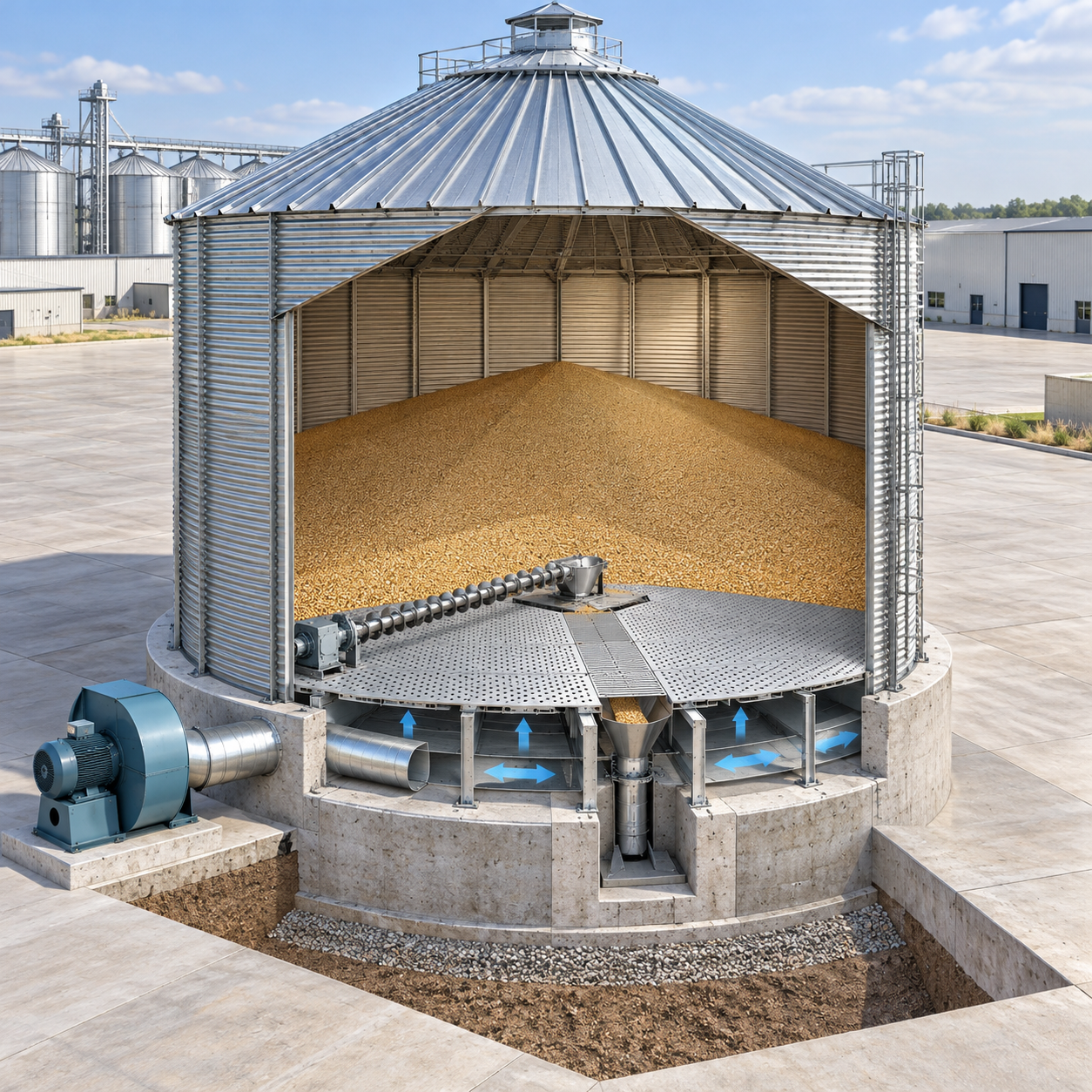
The lowest equipment quote for flat bottom grain silos is not necessarily the lowest installed cost. A steel shell package can exclude the foundation, aeration floor, fans, unloading equipment, electrical installation, and erection. Until these boundaries are clear, comparing quoted prices per tonne can reward an incomplete offer rather than a more economical storage system.
The decisive comparison is the cost of a commissioned silo that holds the specified grain quantity, maintains the required storage conditions, and discharges at the required rate. Foundation design, airflow resistance, and unloading arrangements must be defined before that comparison is reliable. These are connected engineering decisions, not accessories to add after selecting the shell.
Establish what “cost per tonne” actually includes
A useful budget separates the supplied equipment from the site works and services needed to make it operational. Otherwise, exclusions surface as variations after the supply contract has been awarded.
Use the same capacity basis for every offer. Nominal volume is not interchangeable with usable grain tonnage. Stored mass depends on bulk density, permitted filling height, roof-space allowance, and any operating restrictions. Require suppliers to state the grain type, design bulk density, usable volume, and maximum structural loading assumptions.
A larger capacity figure does not improve value if it relies on a heavier grain density than the intended crop. Equally, a silo designed for one loading condition should not be assumed suitable for a denser product simply because the physical volume is available.
Foundation cost starts with the ground, not the silo diameter
A foundation allowance based only on diameter and concrete volume is insufficient for a firm project budget. The foundation must transfer grain and structural loads into the ground while controlling settlement and maintaining the geometry needed by the silo wall, floor, and unloading system.
A geotechnical investigation should establish bearing conditions, settlement characteristics, groundwater conditions, and other relevant site constraints. Weak or variable ground can require soil replacement, improvement, or a different foundation solution. These costs cannot be resolved by negotiating the steel shell price.
The supplier should provide the foundation designer with project-specific reactions, anchor requirements, dimensional tolerances, and equipment interfaces. The local civil engineer must then design for the actual ground and applicable requirements. A generic foundation drawing is not a substitute for this coordination.
Diameter and height change more than steel quantities
For a given storage volume, a wider, lower silo occupies more ground area. That affects slab area, earthworks, and the distribution of aeration equipment. A narrower, taller silo reduces footprint but increases grain depth, which changes foundation loading and airflow resistance. Neither geometry is automatically cheaper once civil works and operating equipment are included.
The budget should therefore compare complete configurations rather than shell prices alone. A footprint saving may have value on a constrained site, but it can be offset by more demanding aeration or structural requirements.
Below-ground details can create expensive interfaces
Unload conveyor trenches, aeration ducts, inspection access, and discharge pits must be coordinated before concrete is poured. A conveyor selected late may require a different trench depth or discharge elevation. Altering completed concrete can cost more than resolving the equipment arrangement during design.
Groundwater and surface drainage also matter. Below-ground pits can require waterproofing and drainage provisions; poorly arranged external levels can direct rainwater toward the silo base. The foundation quotation should state whether these provisions, anchor installation, survey checks, and concrete quality testing are included.
Require a documented release point before concreting: approved foundation drawings, confirmed equipment dimensions, and agreed responsibility for checking embedded items. This is a practical cost-control measure, not merely an administrative milestone.
Price aeration against a storage duty, not a fan motor rating
Two aeration packages with the same motor power can deliver different results. The relevant specification is airflow through the stored grain at the expected system resistance. Fan selection must account for grain type, grain depth, fines, duct losses, and floor configuration.
Ask for the design airflow expressed on a consistent basis, such as airflow per unit mass or volume, together with the operating static pressure and fan performance curve. A free-air fan rating does not show what the fan will deliver against a filled silo.
The distinction between cooling and drying is equally important. Aeration intended to manage grain temperature should not be treated as a substitute for a drying system. If grain arrives above the moisture level suitable for the intended storage period, a low-cost cooling package does not remove that underlying requirement.
Full-floor and duct systems require different cost comparisons
A full perforated floor provides a broad air-distribution surface but adds floor panels, supports, installation work, and loading requirements. A duct arrangement can reduce the extent of elevated flooring, yet its suitability depends on duct layout, airflow distribution, grain depth, and the unloading method.
The comparison should include:
- Air distribution across the storage area and the design basis used to assess it.
- Floor or duct strength under the specified grain loading.
- Compatibility with the sweep and other unloading equipment.
- Access for inspection and removal of accumulated fines.
- Installation labour and any associated concrete recesses or channels.
Roof ventilation is part of the same system. Air delivered by the fans needs an adequate exit path. Confirm the specified exhaust provision and any operating restrictions rather than assuming the roof package automatically accommodates the selected fans.
Electrical scope deserves separate attention. Fan starters, overload protection, cabling, control panels, temperature monitoring, and automation may sit outside the mechanical equipment price. Confirm voltage, frequency, starting arrangements, and available site power before approving motors.
For an operating-cost comparison, use fan input power at the expected duty point, estimated annual running hours, and the local electricity tariff. Installed motor rating alone is an inadequate basis for estimating consumption. Controls should also reflect local temperature and humidity conditions rather than operating solely on a fixed timer.
Unloading cost depends on how empty the silo must become
A center outlet does not empty a flat-bottom silo completely. Gravity discharge leaves grain on the floor after material stops flowing toward the outlet. Intermediate sumps and a sweep system handle the remaining material, with the final cleanup requirement depending on equipment design and operating procedure.
A quote that includes an underfloor discharge conveyor but excludes the sweep is therefore not equivalent to a complete unloading package. Clarify whether “unloading capacity” refers to gravity discharge, sweep operation, or the capacity of the downstream handling line.
The effective discharge rate is limited by the bottleneck. A high-capacity silo outlet adds little value if the receiving conveyor, elevator, or truck-loading arrangement cannot accept that flow. Conversely, an undersized discharge system can extend dispatch hours and leave downstream equipment underused.
Compare routine operation and residual cleanup separately
Sweep selection should reflect silo diameter, grain characteristics, unloading frequency, and the required level of automation. Ask how the sweep advances, how it is started, which components require maintenance access, and how much intervention is necessary during normal operation.
Do not interpret “automatic sweep” as a guarantee of zero entry or zero residual grain. Require a written operating sequence and a clear description of any remaining cleanup. Grain engulfment, entanglement, and confined-space hazards make this a safety and labour issue as well as a purchase-price issue.
The supplier must also define the discharge sequence and permitted use of intermediate outlets. Uncontrolled or asymmetric withdrawal can impose loading conditions outside the silo design assumptions. Outlet arrangement, controls, and operating instructions need to be consistent with the structural design.
Factory-direct prices still need a delivered-and-installed boundary
Buying directly from a manufacturer can simplify the supply chain, but it does not automatically transfer local engineering, installation, or commissioning obligations to that manufacturer. An EXW or FOB price cannot be compared directly with a delivered, erected system without adjusting the scope.
Request packing quantities, shipping weights, container requirements, and a clear delivery term with a named place. Identify who pays for destination handling, inland transport, unloading, storage, and replacement of missing or damaged components. Confirm whether supervision means periodic guidance or full responsibility for erection.
If a farm development also includes an Industrial Steel Poultry House, keep silo civil works, grain aeration, and unloading equipment separately priced from the building package. Shared site infrastructure should have an explicit allocation so that neither contract assumes the other includes it.
Quality documentation should be relevant to the supplied silo. Request material specifications, coating details, traceability requirements, structural calculations, and inspection arrangements. A general quality-management certificate does not establish that a particular silo meets the project’s structural requirements or local approval conditions.
Responsibility for interfaces should be written into the contract: who verifies foundation dimensions, who accepts anchor tolerances, who checks electrical compatibility, and who demonstrates operation. Otherwise, a fault between packages can become a dispute rather than a corrective action.
Turn competing offers into a comparable project budget
A defensible comparison uses a common cost boundary:
Comparable installed cost = supplied equipment + logistics and import costs + civil works + erection + electrical integration + commissioning + explicitly identified risk allowances.
Keep risk allowances tied to unresolved conditions. Unknown ground conditions, unconfirmed utility capacity, and incomplete discharge interfaces should remain visible rather than disappearing inside a single contingency figure. Where an uncertainty can be resolved through investigation or design, resolving it may be more valuable than carrying a broad allowance.
Ask each bidder to return an inclusion-and-exclusion schedule against the same specification. Compare usable capacity, foundation assumptions, aeration duty, discharge performance, and completion responsibilities before comparing the adjusted total.
A modest equipment saving can be erased by additional concrete, a mismatched fan package, or an omitted sweep. The stronger offer is the one that makes the complete storage duty achievable at a transparent installed cost—and leaves fewer essential decisions to be priced after the order is placed.
We are more than happy to serve you here. If you have any question, please feel free to contact us.