
News center
Related Posts
- ▶ Prefab vs. Conventional Warehouse Construction: Comparing Timelines
- ▶ Planning a Prefab Warehouse: Clear Span, Height and Loading Bays
- ▶ How Long Does It Take to Build a Commercial Steel Building?
Online Message
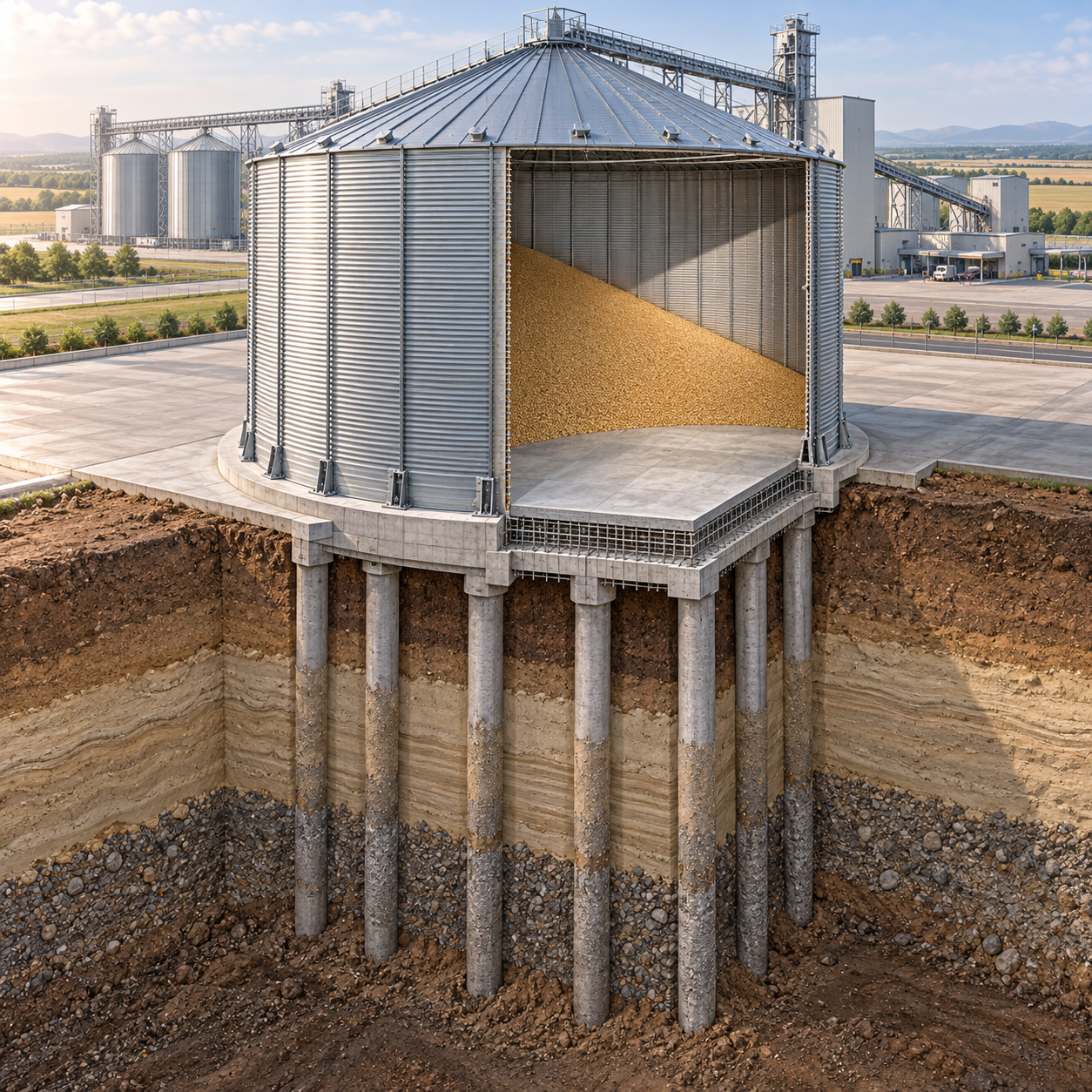
Planning Foundations for Flat Bottom Grain Silos on Weak Soils
Weak soils can turn a grain storage project into a costly cycle of settlement, structural distress, and schedule delays. For project managers planning Flat Bottom Grain Silos, foundation decisions must begin with reliable geotechnical data—not standard drawings alone. Soil bearing capacity, total and differential settlement, groundwater conditions, and loading patterns all influence whether ground improvement, a raft foundation, or piles offer the most practical solution.
The challenge is not simply keeping a full silo upright. Its shell, floor, unloading equipment, and connected conveyors must remain compatible as the ground moves. A foundation can satisfy a bearing-capacity check yet still settle enough to disrupt operation. Planning therefore needs to address structural safety, serviceability, and construction sequence together.
Start with the load path, not a foundation type
In a flat-bottom silo, grain loads reach the ground through more than one route. Much of the stored material bears on the floor, while friction between grain and the silo wall transfers vertical force into the shell supports or perimeter foundation. Roof equipment, access platforms, wind, seismic actions, and unloading arrangements add other demands. Their distribution depends on the silo system and operating conditions.
This matters when a supplier drawing shows a perimeter ring foundation with an internal ground-supported floor. Supporting the ring adequately does not prove that the floor will perform. If the interior settles more than the perimeter, aeration channels, floor joints, and unloading equipment may lose alignment. Conversely, perimeter distortion can affect shell geometry and anchor performance.
Request supplier-issued foundation reactions for the applicable load cases, including full, empty, filling, and discharge conditions. Identify whether asymmetric discharge, eccentric equipment loads, or partially filled conditions require assessment. Do not estimate every foundation action by dividing total silo weight by its footprint; that produces only a preliminary average pressure, not a design load model.
Commission ground investigation around the proposed silo group
A report prepared for a nearby light warehouse may not answer the questions posed by a heavily loaded grain silo. Investigation locations and depths should reflect silo diameter, anticipated stresses, variable ground conditions, and the interaction between adjacent foundations. Closely spaced silos can create overlapping stress zones and deeper settlement effects than an isolated structure.
The geotechnical engineer should establish a ground model, not just provide one allowable bearing-pressure value. Depending on the site, boreholes, cone penetration testing, groundwater observations, and laboratory testing may be needed to distinguish loose fill, soft clay, organic layers, and competent founding strata.
- Compressibility and consolidation: How much movement is expected, and how long will it continue after filling?
- Strength and variability: Are weak layers continuous, or do they change significantly across the footprint?
- Groundwater: How could seasonal levels affect excavation stability, buoyancy, drainage, or construction access?
- Additional hazards: Where relevant, investigate liquefaction, collapsible soils, expansive soils, aggressive ground chemistry, and uncontrolled fill.
Ask whether the quoted bearing pressure is governed by shear resistance or settlement, and whether it is expressed as net or gross pressure. These distinctions can change how the structural designer uses the recommendation. Investigation should extend far enough to assess consequential weak layers beneath an apparently competent surface crust.
Set settlement criteria before comparing prices
There is no universal settlement allowance suitable for every silo. Acceptable total movement, differential settlement, and tilt should be agreed by the geotechnical engineer, structural designer, silo supplier, and equipment supplier. The criteria need to cover the shell and floor as well as conveyors, ducts, utility connections, and discharge systems.
Uniform settlement may be less damaging to the silo itself than uneven movement, but it can still create problems at fixed connections. Differential settlement across a ring foundation can distort the shell. Movement between the floor and perimeter can damage internal interfaces even when the overall silo tilt appears modest.
Require settlement predictions for the intended operating sequence, not only for a single fully loaded silo. One silo filled beside an empty one can produce a different deformation pattern from a uniformly loaded group. Where consolidation is significant, distinguish movement expected during construction, initial filling, and subsequent operation.
Compare ground improvement, rafts, and piles by their limitations
Ground improvement: useful when the soil is treatable
Ground improvement can make shallow foundations practical, but the treatment must match the soil. Excavation and replacement may suit shallow unsuitable material. Densification methods are generally more relevant to suitable granular deposits. Preloading, sometimes assisted by vertical drains, may address consolidation in soft fine-grained ground where the programme allows. Deep mixing or rigid inclusions may suit other conditions.
These methods are not interchangeable. Stone columns, for example, require assessment of confinement, stability, and settlement rather than an assumption that aggregate automatically creates firm support. The design must define the treatment depth and extent, load-transfer arrangement, verification testing, and acceptance criteria. Treating only beneath the perimeter can leave the interior floor vulnerable.
Raft foundations: load distribution without eliminating settlement
A reinforced concrete raft can distribute loads and help control differential movement. It may be attractive where the soil has adequate strength but local variability makes separate supports difficult. Its effectiveness depends on stiffness, reinforcement, soil response, and how the shell loads enter the concrete.
A raft does not remove deep compressible layers. Increasing its area or thickness does not necessarily resolve long-term consolidation. Design checks still need to address overall settlement, bending, shear, cracking, and interfaces around trenches or unloading pits. A raft combined with ground improvement may be more practical than either measure alone.
Piles: deeper support with interfaces that still need attention
Piles may be appropriate where weak deposits are deep, settlement tolerances are demanding, or shallow treatment is impractical. Selection depends on the ground profile, loads, installation access, vibration restrictions, local equipment, and testing requirements. Assess group settlement and negative skin friction where surrounding soil may consolidate relative to the piles.
The critical question is what the piles support. A piled perimeter with an untreated ground-supported floor can create a pronounced movement mismatch. The designer must explicitly resolve whether the floor remains ground-supported, receives separate improvement, or becomes part of a pile-supported structural slab. These alternatives have different cost and detailing consequences.
Resolve supplier interfaces before releasing fabrication
Foundation coordination should produce a controlled set of dimensions, reactions, tolerances, and responsibilities. Anchor-bolt circles, embedment requirements, base details, floor elevations, aeration openings, and discharge pits must agree across drawings. Changes after concrete placement can require difficult remedial work; changes after steel fabrication can affect both disciplines.
For an export project, manufacturing capacity and engineering responsibility are separate checks. A China-based prefabricated steel manufacturer with a 120,000 m² plant, stated annual output of 100,000 tonnes, and deliveries to more than 20 countries may support fabrication and logistics planning. Those capabilities do not replace a site-specific foundation design. Verify the scope of ISO certification, CE documentation, and compliance with applicable AS/NZS or ASTM requirements against the actual contract and destination.
BIM coordination can help expose clashes between anchors, reinforcement, embedded services, and equipment openings. It is useful only when the models reflect approved information. Assign responsibility for revisions and require a formal interface review before foundation construction and steel production proceed.
Keep adjoining buildings and buried services in the ground model
Grain terminals often include transfer buildings, truck routes, utility corridors, and dispatch areas. These may use different foundation systems from the silos. Check relative movement where structures connect, and assess whether new fill, excavation, or dewatering could affect neighbouring foundations.
Where the site also includes a Cross-Docking Facility, its dock-to-dock routes, open traffic lanes, and bracing locations require their own structural coordination. A heavy-duty warehouse floor is not a substitute for a silo foundation specification. Keep loading assumptions separate while coordinating drainage, truck access, and settlement-sensitive connections across the site.
Pay particular attention to underground reclaim tunnels and pits. They interrupt the foundation geometry and can complicate waterproofing, excavation support, and groundwater control. Their positions should be settled early rather than fitted around an already completed foundation design.
Build verification and controlled first filling into the programme
The cheapest foundation tender can become expensive if it excludes testing, temporary works, or time-dependent ground behaviour. Compare options on total installed cost and programme risk, including working platforms, spoil disposal, dewatering, treatment verification, pile testing, and monitoring. Preloading may reduce foundation expenditure but require a waiting period that the operating schedule cannot accommodate.
Construction hold points should cover exposed founding conditions, ground-treatment acceptance, reinforcement and embedded items, concrete strength, and anchor surveys. If actual ground differs from the investigation, stop and obtain an engineering review rather than covering the discrepancy with additional concrete.
Establish survey benchmarks outside the expected movement zone and record baseline elevations before loading. Where required by the design, initial filling should follow an engineer-approved staged plan with settlement readings, defined observation periods, and action thresholds. Monitoring is not a substitute for design, and staged filling alone does not guarantee acceptable consolidation.
Before committing to a foundation for Flat Bottom Grain Silos, bring three documents into agreement: the geotechnical interpretation, supplier load-and-tolerance information, and the foundation design basis. If the team cannot explain how both the perimeter and floor will move under the planned filling sequence, the foundation decision is not ready for construction.
We are more than happy to serve you here. If you have any question, please feel free to contact us.