
News center
Related Posts
- ▶ Prefab vs. Conventional Warehouse Construction: Comparing Timelines
- ▶ Planning a Prefab Warehouse: Clear Span, Height and Loading Bays
- ▶ How Long Does It Take to Build a Commercial Steel Building?
Online Message
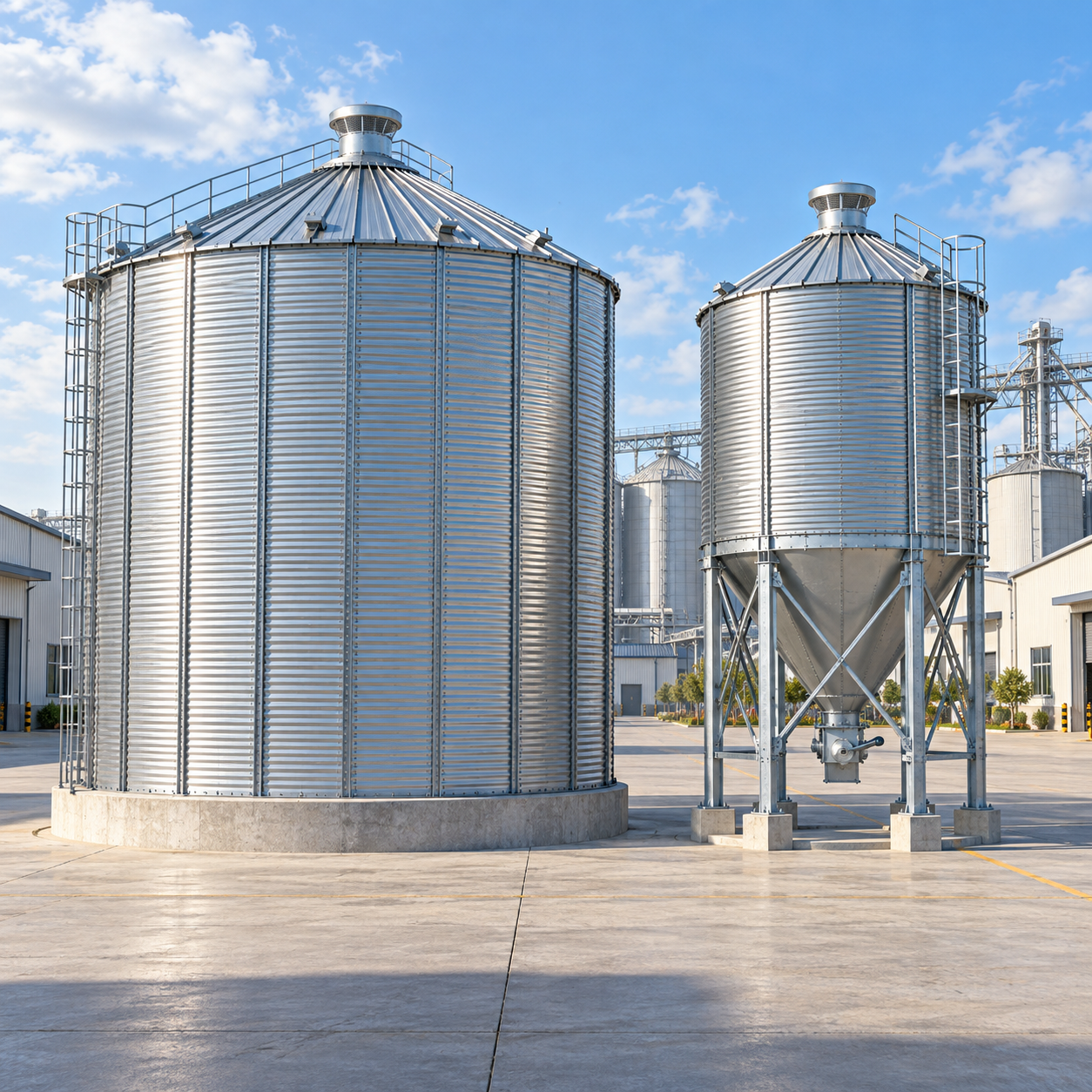
Flat Bottom Grain Silos are generally the stronger choice for large volumes held over extended periods, while hopper bottom silos suit storage that requires frequent, controlled discharge and easier emptying. The decision changes when grain condition, lot segregation, ground conditions, or discharge requirements outweigh the capacity advantage. A hopper does not inherently preserve grain better, and a flat floor does not automatically deliver the lowest installed cost.
For long-term storage, compare both configurations against the same grain specification, usable capacity, aeration duty, and unloading schedule. Otherwise, a lower quotation may simply exclude equipment or civil works included in the alternative.
Start with the storage cycle and usable capacity
A flat bottom silo carries grain above a floor supported by the foundation. Gravity discharge removes much of the contents through the central outlet, after which a sweep system moves the remaining grain toward the discharge point. This arrangement is well suited to substantial inventories that remain in storage between seasonal filling and planned withdrawal.
A hopper bottom silo directs grain toward an outlet through an inclined cone. The supporting structure elevates the vessel to accommodate the hopper and discharge equipment. Its value increases where complete emptying, frequent product changes, or repeated transfers are part of normal operation.
Storage duration alone does not settle the choice. A facility holding one grain type through a long season has different requirements from one holding several segregated lots for similar periods. Several smaller hopper units may justify their additional structure through segregation and simpler changeovers, even when the total stored tonnage could fit inside one flat bottom silo.
Capacity comparisons need a common basis. Quoted tonnes depend on assumed bulk density, while usable volume depends on maximum fill level, roof clearance, and the space occupied by internal equipment. Compare working capacity for the specified commodity, and identify any inventory remaining after normal discharge separately from the advertised capacity.
Grain condition matters more than bottom shape
Neither configuration compensates for grain entering storage too wet, too warm, or heavily contaminated with fines. Acceptable moisture content varies with commodity, grain temperature, storage duration, and intended quality. Set those acceptance conditions before selecting the vessel and its ventilation equipment.
For extended storage, aeration manages grain temperature and helps limit moisture migration. Ordinary aeration should not be treated as a substitute for a drying system when incoming grain exceeds the specified storage moisture. Cooling also requires air conditions and operating periods appropriate to the local climate.
Flat bottom silos commonly use perforated floors or aeration ducts. Their effectiveness depends on air distribution through the full grain mass. Grain depth, fines accumulation, duct arrangement, and fan performance all influence resistance to airflow. A fan selected only by motor power gives little assurance that the required air volume will reach the grain.
Hopper silos need equally deliberate airflow design. The cone changes the geometry available for air entry and distribution; an aeration arrangement copied from a flat floor is insufficient evidence of coverage. Request airflow calculations at the intended fill depth and a drawing showing how air enters the grain and leaves through the roof.
Temperature monitoring should cover representative locations rather than a single convenient point. Readings indicate conditions around the sensors, so trends require interpretation alongside grain inspections, moisture measurements, and operating records. Roof ventilation and condensation management also deserve attention, especially where outside temperatures fluctuate sharply.
Unloading: gravity flow has limits
A hopper outlet does not guarantee complete, reliable discharge. Flow depends on grain properties, moisture, fines, wall friction, hopper angle, and outlet dimensions. A cone that works well with clean, dry grain may behave differently with damp grain or material containing substantial foreign matter.
Mass flow, in which the stored material moves throughout the vessel during discharge, requires a suitable combination of hopper geometry, wall surface, and outlet design. Many hopper arrangements produce funnel flow instead, leaving material near the walls relatively stationary until later in the unloading cycle. A visibly steep cone alone does not establish the flow pattern.
For flat bottom silos, distinguish the main gravity discharge rate from the rate achievable during final sweeping. A fast central outlet cannot prevent the last portion of a batch from taking longer to recover. Sweep capacity, drive arrangement, floor clearances, and downstream conveyor capacity determine the practical emptying time.
Discharge sequencing also affects structural loading. Eccentric withdrawal can create uneven grain pressures, so outlet locations and operating sequences must match the structural design. Installing an additional side outlet later is a structural change requiring engineering review.
Bridging, wall buildup, or a buried sweep can turn an unloading problem into an entry hazard. Design for external inspection, isolation, and clearing wherever practicable. Routine emptying should have a defined method that avoids entry into moving grain or engagement with operating sweep equipment.
Foundations can reverse the apparent cost advantage
Flat bottom storage often benefits from a comparatively direct load path into the ground, but its foundation is still a major engineered component. Soil bearing capacity, settlement, groundwater, drainage, and local environmental loads determine the appropriate arrangement. Large diameters make differential settlement particularly important because uneven movement affects the shell, floor, and connected equipment.
Elevated hopper silos transfer loads through columns or other discrete supports. Concentrated reactions can require substantial footings, a raft, or piles where ground conditions demand them. Bracing, connections, and anchors must accommodate the specified combinations of stored grain, wind, seismic action, and operating loads.
Compare installed elevations as well as footprints. A hopper needs vertical space for its cone and discharge machinery. That affects overall height, access platforms, conveyor alignment, and sometimes the height of upstream elevators. A flat bottom arrangement may place unloading equipment below floor level, bringing excavation, water exclusion, and maintenance access into the calculation.
Require foundation reactions and equipment interface loads before civil design is finalized. Designing foundations from a preliminary silo diameter, then receiving different support reactions or discharge elevations, creates avoidable redesign and construction delays.
Evaluate the costs that change with operation
The useful comparison is the installed system over its expected storage cycles. Shell and roof prices leave out several items that strongly influence the result:
- Civil works: ground improvement, foundations, pits, drainage, and below-ground conveyor protection.
- Aeration fans, air distribution components, roof vents, temperature monitoring, and electrical controls must meet the same storage duty in both offers.
- Final emptying: account for sweep operation, residual grain recovery, cleaning access, and the time before the next lot can enter.
- Hopper support steel, elevated access, and conveyor interfaces add costs that a vessel-only quotation may omit.
Maintenance exposure differs as well. Flat bottom installations have sweep components and floor areas that need attention after emptying. Hopper installations require inspection of cone surfaces, outlets, gates, supports, and accessible connections. Corrosion protection should reflect local humidity, condensation, and environmental exposure; specifying galvanized steel alone does not resolve every detail at cut edges, fasteners, or water traps.
Long storage periods often strengthen the capacity economics of flat bottom units because emptying happens less frequently. As annual turnover rises, discharge reliability and changeover time carry more financial weight. A simple annual operating model using expected filling and emptying cycles is more useful than comparing purchase price per nominal tonne.
Keep the storage decision connected to the dispatch route
The receiving and dispatch arrangement determines whether easier silo discharge produces a practical benefit. If the downstream conveyor, weighing point, or truck loading equipment limits throughput, a larger hopper outlet will not shorten the overall loading cycle. Match the discharge rate to the complete material route and define how flow stops when downstream equipment trips.
Where grain is bagged before dispatch, the warehouse interface becomes a separate part of that route. A Warehouse Loading Dock & Canopy System concerns trailer access and weather protection at the building, rather than bulk flow inside the silo. Dock elevation should follow measured vehicle bed heights, with leveler travel, canopy drainage, and reversing impact loads coordinated with the building structure. These requirements should remain distinct from bulk truck loading beneath a silo outlet.
Site layout should also preserve access to fans, outlet drives, inspection points, and lifting positions for replacement equipment. An arrangement that fits the maximum number of bins onto a plot can leave essential components difficult to maintain.
Specify the comparison before requesting final quotations
A useful technical enquiry defines the commodity and expected range of bulk density, incoming moisture condition, storage duration, annual turnover, lot segregation, and required withdrawal rate. It should also state site conditions and the interfaces with receiving, conveying, and dispatch equipment.
For flat bottom proposals, request the gravity discharge sequence, expected residual inventory before sweeping, sweep operating method, and final cleanout provisions. For hopper proposals, request the basis for cone angle, outlet size, wall surface, and expected flow behavior with the specified grain. Both need aeration performance at design grain depth, monitoring coverage, foundation reactions, and accessible maintenance arrangements.
Retain Flat Bottom Grain Silos as the leading option when large working capacity and infrequent emptying dominate the operating model. Give hopper bottom designs greater weight when segregation, repeated discharge, and reduced floor cleanout have measurable value. Where these duties coexist, separate long-term storage from short-term transfer or dispatch bins, and size each configuration for the work it will actually perform.
We are more than happy to serve you here. If you have any question, please feel free to contact us.