
News center
Related Posts
- ▶ Prefab vs. Conventional Warehouse Construction: Comparing Timelines
- ▶ Planning a Prefab Warehouse: Clear Span, Height and Loading Bays
- ▶ How Long Does It Take to Build a Commercial Steel Building?
Online Message
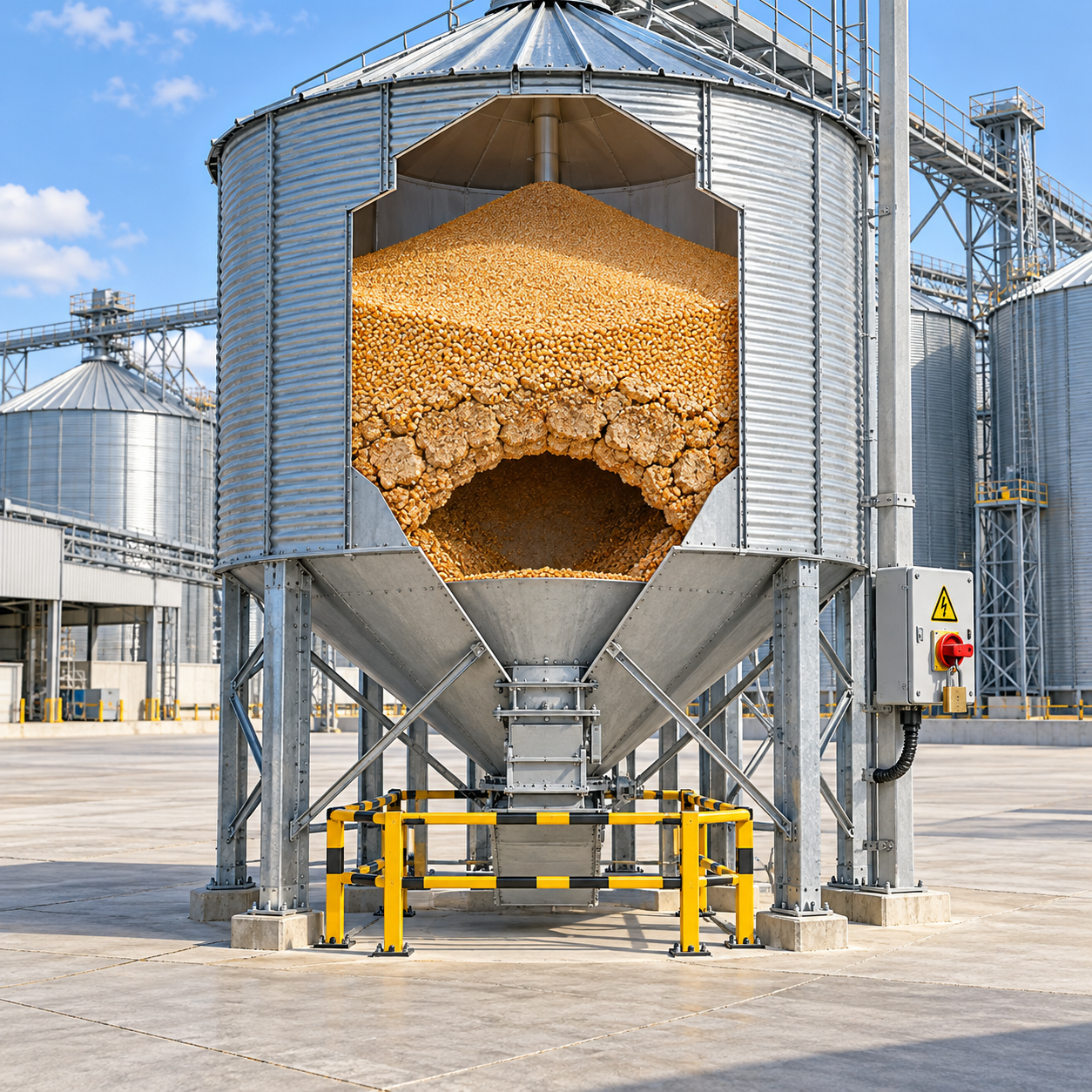
When grain stops discharging from hopper bottom grain silos, an empty bin is only one possible explanation. A bridge of bonded or interlocked grain may be holding material above the outlet, sometimes with a concealed void underneath. Treat an unexplained loss of flow as a potential engulfment hazard—not as permission to enter, open an access door, or knock the grain loose.
The immediate response is to stop discharge, prevent an unexpected restart, and keep people away from the silo interior and potential release points. Restoring flow safely depends on identifying whether the restriction is a grain bridge, a plugged outlet, frozen material, or a downstream equipment fault. Those conditions can look similar from outside but require different corrective measures.
Why a hopper does not guarantee free-flowing grain
A hopper directs grain toward an outlet by gravity, but its sloping walls cannot overcome every combination of grain cohesion, wall friction, and outlet restriction. Grain that flowed freely when loaded can behave differently after moisture migration, deterioration, freezing, or prolonged storage.
“Bridging” can describe two related conditions. One is a bonded surface crust spanning grain that has already discharged, leaving an empty space beneath it. The other is an arch of material across a restricted flow passage, including the hopper outlet. Both can interrupt discharge, but the hazard is not limited to the visible blockage: substantial material may remain suspended above an apparently empty space.
A separate condition, ratholing, occurs when grain flows through a central channel while surrounding material remains stationary. This can leave steep or near-vertical banks of grain. Their collapse can bury someone just as a bridge collapse can. A silo may contain more than one flow problem at the same time.
Neither a stable-looking surface nor a stopped conveyor proves that the contents are stable. A bridge can fail under a person’s weight, vibration, or changes in the material supporting it.
What causes grain to bridge?
Moisture creates bonds between kernels
Wet grain, localized condensation, and water entering through defective seals can create cohesive patches. Spoilage and mold can bind kernels into masses that no longer behave like loose grain. A relatively thin crust can conceal a much larger hazard if discharge removes material beneath it.
Average moisture readings alone may miss the problem. A bulk sample can appear acceptable while grain near a leak, wall, or condensation zone is significantly wetter. Storage suitability also depends on grain type, temperature, condition, and intended storage duration; a single moisture threshold is not a universal guarantee against bridging.
Fines concentrate where flow is most vulnerable
Broken kernels, dust, and other small particles can segregate during filling. A fines-rich region behaves differently from clean, intact grain: it can pack more densely, restrict airflow, and retain localized moisture. These effects increase the likelihood of cohesive material developing near the discharge path.
The practical issue is not simply the total percentage of fines. Their distribution matters. A concentrated pocket near the outlet can obstruct flow even when the overall grain lot appears satisfactory.
Storage conditions change material that originally flowed well
Long storage periods, settlement, repeated temperature changes, and biological deterioration can increase resistance to flow. Damp grain can also freeze into masses in cold conditions. Restarting discharge after a long idle period therefore presents a different situation from unloading immediately after filling.
Temperature trends, aeration history, moisture records, and previous discharge behavior help distinguish a developing storage problem from a sudden mechanical fault. They support diagnosis, but none confirms that a suspected bridge is safe to approach.
The hopper and outlet may not suit the grain’s actual condition
Flow depends on hopper angle, wall surface, outlet size and shape, and the properties of the stored material. Hopper angles also require care when comparing drawings: some are measured from horizontal, others from vertical. An angle quoted without its reference can be misleading.
A steeper hopper is not an automatic cure. The outlet must also resist arch formation, and the wall surface must permit movement under the expected conditions. Corrosion, rough joints, damaged liners, or internal projections can interfere with flow.
A partially opened gate or restricted transition can become the effective bottleneck, even where the nominal silo outlet is larger. Changes to gates, transitions, or flow aids therefore need engineering review rather than trial-and-error modification.
Recognizing the warning signs without entering
The strongest warning is a mismatch between expected inventory and actual discharge. If loading and unloading records indicate substantial grain remains but flow suddenly stops, do not assume the silo is empty.
Other relevant signs include intermittent discharge, repeated surges followed by stoppages, progressively declining throughput, and a history of wet, spoiled, or frozen grain. Abnormal conveyor current or a downstream blockage may instead indicate a mechanical restriction. These observations narrow the possibilities; they do not establish a safe working condition.
Level instruments also have limitations. A point-level device indicates conditions at its location, not the stability of the entire grain mass. A radar reading may describe a surface without revealing a void below it. Load measurements can support an inventory estimate but cannot identify the shape or strength of a bridge.
Use existing fixed cameras, instrumentation, and accessible operating records wherever possible. Do not climb onto grain, lean through a roof opening, or open a side access door to investigate. If visual inspection requires approaching an opening or working at height, it needs a separate, controlled procedure—not an improvised check.
When flow stops: secure the system before diagnosing it
Stop the discharge system and notify the person responsible for site safety and grain handling. Prevent anyone from entering the silo or working beneath outlets, inspection doors, and other locations where material could release.
Apply the site’s lockout/tagout procedure before inspection or maintenance that could expose someone to machinery or moving grain. Isolation must address the equipment involved, not just the nearest stop button. Depending on the installation, that can include conveyors, augers, powered gates, automatic controls, and pneumatic or hydraulic actuators.
An emergency stop or control-panel “off” command is not a substitute for verified energy isolation. Automatic restart commands and remote operation also need to be controlled.
Importantly, electrical isolation does not remove the gravitational energy stored in suspended grain. A bridge can collapse with every motor switched off. Lockout protects against unexpected equipment movement; it does not make entry beneath bridged material safe.
Once the area is secured, establish what happened before the stoppage:
- Did flow stop suddenly, decline gradually, or become intermittent?
- How much grain should remain according to inventory records?
- Were moisture, temperature, or aeration abnormalities recorded?
- Did the gate reach its intended position according to available indications?
- Did downstream equipment trip, overload, or show a blockage?
- Has the same problem occurred with this grain lot or outlet before?
Mechanical checks should remain outside the grain space and follow the equipment’s maintenance procedure. Removing a guard, opening a transition, or releasing a blockage can expose someone to moving parts or sudden grain discharge. Any diagnostic operation requiring powered equipment needs a specifically controlled procedure and a cleared area.
Why common attempts to restart flow can make matters worse
Do not enter to walk on the crust, shovel toward the outlet, or break a bridge from underneath. Standing on a bridge can collapse it into the void below. Working below suspended material places a person in the path of its release. Ropes, coworkers nearby, or a stopped auger do not eliminate those hazards.
Probing from a roof opening is not automatically safe either. It can expose someone to a fall, dust, sudden material movement, or being pulled off balance. A long pole does not turn an uncontrolled intervention into a safe procedure.
Hammering the shell, attaching an improvised vibrator, or striking the hopper can damage thin steel sheets, joints, supports, or coatings. It may also release material suddenly without resolving the underlying flow problem. Factory-installed vibration equipment must be used only within its approved operating conditions.
Compressed-air lances, air cannons, and other pressure-based methods are not general-purpose remedies. Uncontrolled use can disperse combustible dust, introduce pressure hazards, or create abrupt grain movement. Likewise, drilling or cutting an opening in a loaded silo can compromise containment and expose workers to an uncontrolled release.
Repeatedly cycling a gate or restarting a conveyor to “shake it loose” is also poor diagnosis. It can overload equipment or produce an unexpected surge. Changing discharge points or opening an unapproved side outlet may create uneven loading beyond the silo’s design assumptions.
What qualified assistance should establish
If checks do not identify a straightforward external equipment fault, keep the silo out of service and involve the manufacturer or a specialist experienced in grain-flow blockages. Provide the silo drawings, outlet arrangement, estimated inventory, grain condition records, and a description of any previous interventions.
The required assessment is more than a choice of unblocking tool. It should establish the likely obstruction location, the quantity and condition of retained grain, the structural implications of the proposed method, and how people will remain outside the release zone.
External clearing systems or remotely operated methods may be appropriate, but their suitability depends on the silo and blockage. Equipment that works in one installation can damage another or create unacceptable loading. The method needs a defined operating sequence, exclusion area, communication arrangements, and stopping criteria.
If entry is proposed, ordinary maintenance precautions are insufficient. Bridged grain and material capable of falling must be addressed within the applicable grain-entry safety requirements. Atmospheric testing, ventilation where required, an entry authorization system, an attendant, suitable equipment, and a practicable rescue plan may all be necessary. No permit or harness makes working beneath a bridge acceptable. Avoiding entry remains the preferred approach.
If someone becomes trapped, call emergency services immediately and stop grain movement using controls accessible without entering danger. Do not follow the person into the silo. Unplanned rescue attempts can create additional victims; grain entrapment requires trained responders and specialized methods.
Preventing the next stoppage
Prevention should address the reason flow failed. If wet crusting caused the blockage, repairing water entry and improving moisture management matter more than increasing vibration. If fines accumulated near the outlet, review cleaning, handling damage, and filling distribution. If otherwise suitable grain repeatedly arches at the same restriction, investigate outlet geometry and transitions.
Aeration should follow a grain-management plan suited to the commodity, climate, and storage objective. It can help manage temperature and moisture migration, but it does not substitute for drying grain that requires drying, and it is not a method for clearing an established bridge.
During a planned shutdown, when the silo has been safely emptied and released for inspection, examine the hopper surface, outlet, gate, seals, and transition connections. Check for corrosion, damaged liners, projections, incomplete gate travel, and evidence of leakage. Recurrent blockages justify a flow assessment using representative grain properties, not just a larger motor or a different operating habit.
After clearing, restart only under an authorized plan that accounts for a possible surge and downstream capacity. Record the cause, corrective work, and any remaining uncertainty. A return of flow is evidence that material is moving—not proof that every unstable deposit has disappeared.
The operating rule is straightforward: unexpected loss of discharge requires controlled diagnosis from outside the hazard. Keeping people away from suspended grain is more important than restoring throughput quickly.
We are more than happy to serve you here. If you have any question, please feel free to contact us.