
News center
Related Posts
- ▶ Prefab vs. Conventional Warehouse Construction: Comparing Timelines
- ▶ Planning a Prefab Warehouse: Clear Span, Height and Loading Bays
- ▶ How Long Does It Take to Build a Commercial Steel Building?
Online Message
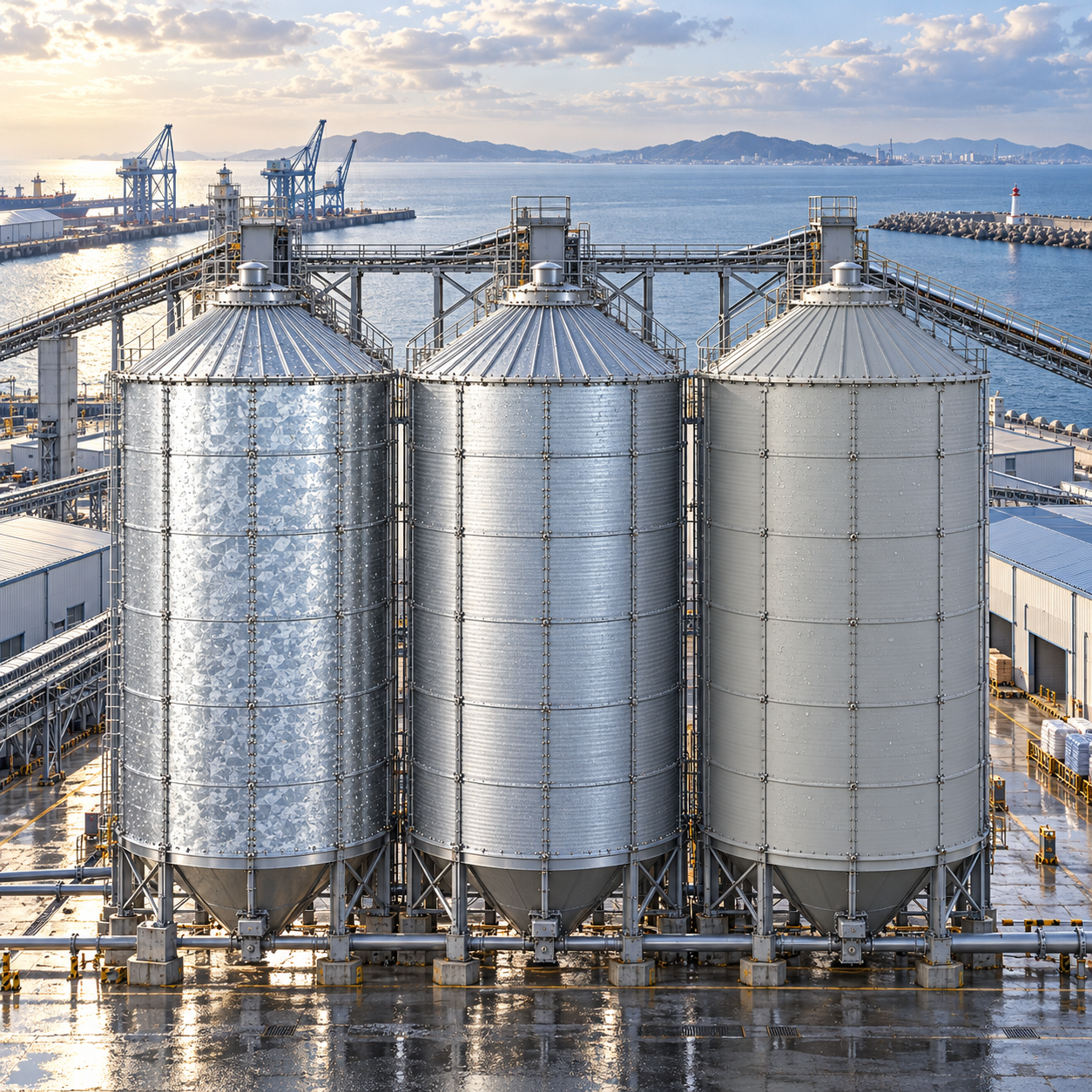
Comparing Coatings for Steel Grain Silos in Coastal Environments
Coastal exposure makes coating selection for Steel Grain Silos an engineering decision, not a finishing detail. Salt-laden air, persistent humidity, and condensation can accelerate corrosion, particularly at sheet overlaps, fasteners, roof connections, and the silo base. Yet choosing the thickest coating does not necessarily produce the most reliable installation.
Galvanized steel, zinc-aluminum alloy coatings, and protective paint systems behave differently when scratched, continuously damp, or exposed to moving grain. A useful comparison must consider substrate preparation, coating chemistry, fabrication damage, repairability, and grain-contact suitability. The objective is to specify protection that can be verified before shipment and maintained after erection—not simply to select the lowest initial price.
Define the exposure before comparing coatings
Distance from the shoreline is only a starting point. Prevailing winds, sheltered surfaces, nearby cargo operations, rainfall, and salt accumulation all affect corrosion. A surface washed regularly by rain can behave differently from an underside that collects airborne chlorides but rarely dries or receives cleaning.
ISO 9223 provides a framework for atmospheric corrosivity classification, while ISO 12944 addresses protective paint systems for steel structures. C4 or C5 may be relevant to coastal facilities, but neither should be assigned solely because a project is near a port. More severe conditions may require separate assessment. A coating durability category is also not a warranty or a prediction of the silo’s structural service life.
Separate the exterior atmosphere from the internal storage environment. Inside a silo, moist grain, roof condensation, dust deposits, and repeated filling and discharge create different demands. An exterior coating specification cannot automatically be extended to grain-contact surfaces.
Galvanized steel: practical protection with identifiable limits
Zinc provides both a barrier and sacrificial protection to steel. This makes galvanizing useful where small scratches or exposed edges are difficult to avoid. However, that protection has limits: persistent moisture and chloride accumulation consume zinc, and protection at a cut edge depends on the coating, exposed steel geometry, and environment.
For corrugated silo sheets, distinguish continuously galvanized sheet from components galvanized after fabrication. These are different manufacturing routes with different acceptance requirements. Formed sheets, heavy support members, ladders, and access platforms should not be grouped under one vague requirement such as “hot-dip galvanized throughout.”
Check how coating quantity is expressed. Sheet coating designations commonly describe total coating mass across both faces, whereas fabricated-component specifications may use local and mean thickness measurements. Comparing a mass designation directly with a thickness value can therefore produce a misleading ranking.
Galvanized construction is a reasonable baseline when exposure is understood, drainage is effective, and inspections remain accessible. Pay particular attention to base rings, sheet laps, and packing damage. Wet sheets stacked tightly during shipping or site storage can develop wet-storage staining before the silo is erected.
Zinc-aluminum alloys: specify the chemistry, not the label
“Zinc-aluminum” covers multiple coating compositions. Aluminum-rich coatings and zinc-rich coatings modified with aluminum or magnesium do not have identical behavior. The trade name alone is insufficient for comparing coastal corrosion resistance, forming performance, or protection around exposed edges.
Some alloy systems can outperform conventional zinc coatings under particular exposure conditions. That does not establish a universal service-life multiplier. Request evidence relevant to the proposed composition, coating mass, substrate, and exposure. Results from flat, undamaged laboratory panels may not represent corrugated sheets with punched holes, bolted joints, and installation scratches.
Fabrication compatibility deserves equal attention. Ask whether the coating has been evaluated after the intended corrugating and forming operations, and examine how cut edges and damaged areas will be treated. A repair product suitable for ordinary galvanized steel should not be assumed suitable for every alloy coating.
Salt-spray results can support quality assessment, but test hours should not be converted directly into years of coastal service. Exposure cycles, drying, deposits, and real joint geometry influence performance in ways a single accelerated test cannot fully reproduce.
Paint and duplex systems: preparation determines the outcome
A protective paint system can combine corrosion control with a renewable exterior finish. On carbon steel, a specified system may include abrasive blasting to Sa 2½ under ISO 8501-1, a zinc-rich epoxy primer, an epoxy intermediate coat, and a weather-resistant finish. The actual products, thicknesses, and application conditions must form a compatible, documented system.
Surface cleanliness is not just a visual question. Soluble salts, dust, oil, and unsuitable surface profile can undermine adhesion even when the steel looks properly blasted. Require project-specific acceptance limits and measurement methods, together with records of humidity, steel temperature, dew point, curing, and recoating intervals.
A duplex system combines galvanizing with paint. It can be attractive where exterior exposure is severe or maintenance access is expensive, because the paint limits exposure of the zinc while the zinc provides additional protection beneath the barrier. However, paint adhesion to galvanized surfaces requires suitable cleaning, preparation, and compatible products. Simply painting over fresh galvanizing is not a complete specification.
Thin corrugated silo sheets also require a different assessment from heavy structural steel. An otherwise sound coating may crack during forming or suffer damage around fasteners during assembly. Confirm the fabrication sequence and whether the proposed paint system tolerates it.
Grain contact and joint details can change the shortlist
Do not use exterior corrosion performance as evidence of food-contact suitability. For internal surfaces, obtain documentation addressing the intended grain, destination-market requirements, contact conditions, and any restrictions on cleaning or fumigation. A generic “food-grade” statement without a defined scope provides little assurance.
Abrasion requires its own review. Grain movement can wear internal surfaces, especially around discharge zones and changes in flow direction. A coating that withstands atmospheric exposure may not tolerate repeated rubbing or impact. Ask for relevant abrasion evidence and confirmation that any lining is compatible with the silo’s flow and discharge design.
Many early corrosion problems begin at connections rather than broad sheet surfaces. Review fastener materials, washers, sealants, lap orientation, and drainage together. Dissimilar-metal contact in a wet, salty environment can create localized corrosion risks; changing to a more corrosion-resistant fastener does not automatically resolve the whole connection.
Condensation control remains essential regardless of coating choice. Aeration, roof ventilation, grain moisture management, and temperature monitoring should be coordinated with the storage design. A coating cannot compensate indefinitely for repeated internal wetting.
Coordinate the silo specification with the surrounding terminal
Coastal grain installations often include conveyor supports, transfer buildings, and cargo-holding areas. Their corrosion strategies should be coordinated without assuming that every component needs the same finish. Heavy framing, thin silo sheets, and sheltered connections have different fabrication and maintenance requirements.
For an adjacent Port & Transit Warehouse, project options include hot-dip galvanizing, prepared-and-painted steel, or duplex protection under a site-specific C4–C5 coating specification. Available clear spans of 24–48 m and eave heights of 9–15 m under haunch concern cargo handling; they do not establish a suitable silo coating. The useful connection is a coordinated exposure assessment and inspection plan across the facility.
Factory capacity matters when that plan must survive production and export delivery. A China-based prefabricated steel manufacturer with a 120,000 m² plant, annual output capacity of 100,000 tonnes, and factory-direct supply to more than 20 countries offers manufacturing scale. Technical approval still depends on traceable coating batches, inspection records, packing controls, and repair instructions. ISO certification and stated CE, AS-NZS, or ASTM credentials should be checked for their exact scope rather than treated as blanket coating approval.
Make the final decision on maintainability, not coating price
For Steel Grain Silos, lifecycle cost includes access equipment, cleaning, inspections, local repairs, and downtime—not just the initial finish. Recoating a roof or upper shell near operating conveyors may cost more operationally than repairing an accessible support frame. Evaluate those locations separately.
Before approving a proposal, require a component-level coating schedule stating substrate, coating composition, mass or dry-film thickness, surface preparation, acceptance criteria, grain-contact restrictions, and repair method. Include inspection hold points before packing and after erection, when handling damage can still be corrected systematically.
Conventional galvanizing may be sufficient where exposure and maintenance are manageable. An alloy coating needs chemistry-specific evidence; a paint or duplex system needs credible application control. If suppliers cannot show how their proposed protection performs at formed edges, bolted joints, and repair locations, a higher nominal coating specification is not enough to close the technical review.
We are more than happy to serve you here. If you have any question, please feel free to contact us.