
News center
Related Posts
- ▶ Prefab vs. Conventional Warehouse Construction: Comparing Timelines
- ▶ Planning a Prefab Warehouse: Clear Span, Height and Loading Bays
- ▶ How Long Does It Take to Build a Commercial Steel Building?
Online Message
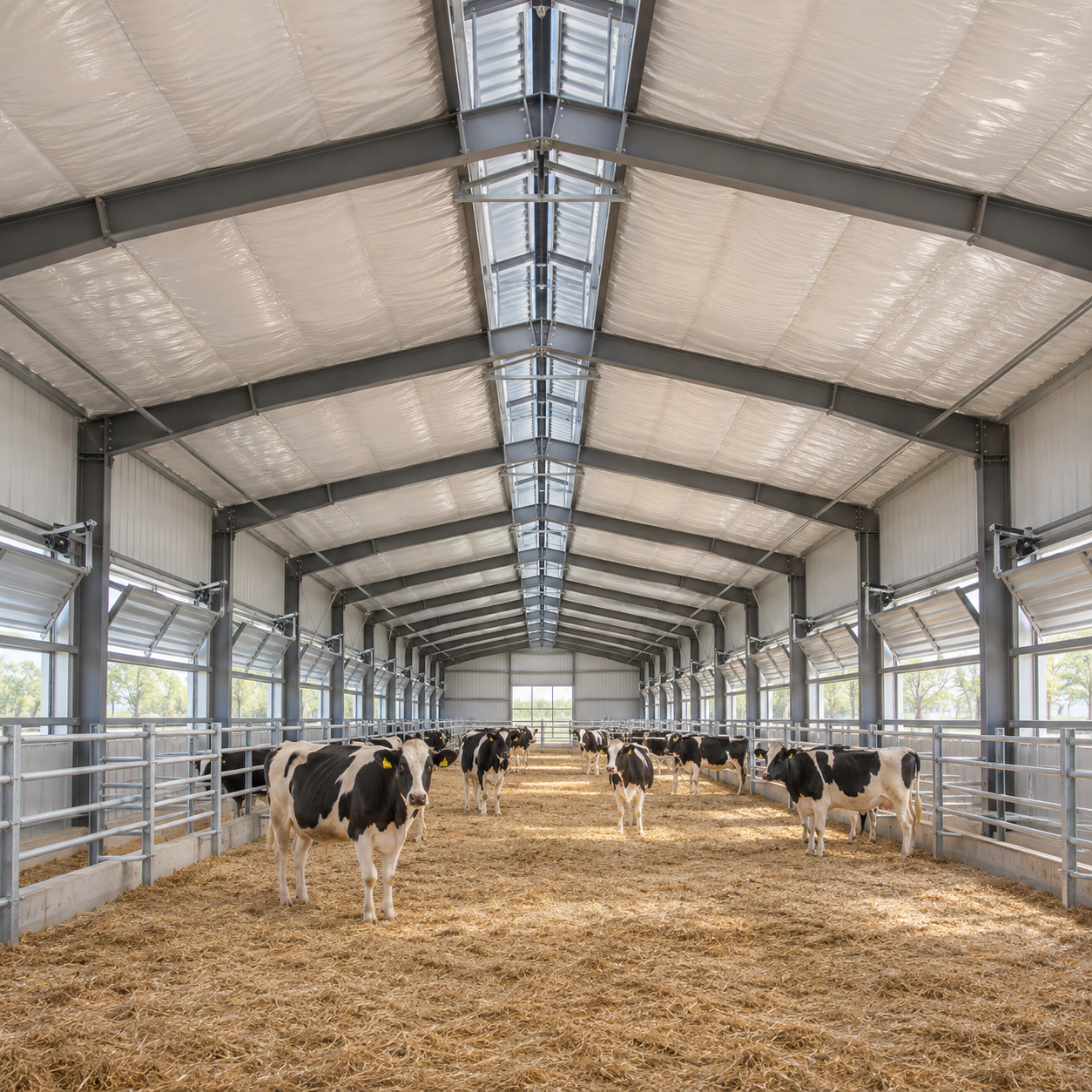
Humidity in a steel livestock building is controlled by removing moisture as fast as animals, bedding, manure, and water systems add it. That requires dependable air exchange, dry floors and bedding, and an insulated building envelope that keeps interior surfaces above the temperature at which water condenses.
Wet steel does not necessarily mean the roof leaks, and a high humidity reading does not identify the source on its own. The most useful diagnosis combines moisture measurements with an inspection of airflow, cold surfaces, drainage, and water use. A successful solution must also protect animals from drafts and avoid trapping harmful gases when the weather turns cold.
Why condensation forms inside steel livestock buildings
Animals release moisture through breathing and body heat. Manure, urine, wet bedding, spilled drinking water, and washdown add more. If ventilation does not remove enough water vapor, indoor air becomes more humid. When that air contacts a sufficiently cold surface, such as an exposed roof panel or steel frame, water can condense.
The critical condition is the relationship between surface temperature and the indoor air’s dew point. Dew point is the temperature at which water vapor in the air begins to condense. A roof panel can therefore drip even when indoor air does not feel exceptionally humid: if the panel is cold enough, its inner face can fall below the dew point.
Relative humidity is useful, but it must be read alongside temperature. Air can show a higher relative humidity simply because it has cooled, even if no additional water has entered the building. Conversely, heating a barn can lower its relative humidity without removing any water. Unless ventilation carries that moisture outside, condensation may return when the building cools.
Condensation can appear on roof sheets, purlins, columns, fasteners, doors, and uninsulated penetrations. Repeated wetting can contribute to corrosion, particularly where moisture combines with manure deposits or cleaning chemicals. Dripping onto bedding also creates a cycle: wet bedding releases more moisture and can increase the ventilation needed to keep the building dry.
Start by reducing water at its source
Ventilation has to remove moisture from the entire building, so preventable water losses increase both the ventilation load and, in cold weather, the heat needed to maintain suitable conditions. Look for persistent wet patches before changing fan sizes or adding insulation.
Drinking systems deserve close attention. Leaking valves, poorly adjusted drinkers, damaged pipework, and splashing around troughs can keep adjacent bedding damp. Place and adjust equipment for the species and age of the animals, and provide a surface and drainage arrangement that can tolerate routine spills without directing contaminated water toward clean bedding.
Manure and bedding management are equally important. Remove wet material at intervals appropriate to the housing system, and address areas where urine or wash water accumulates. Adding dry bedding on top of a saturated layer may improve the surface temporarily while leaving a substantial moisture source underneath.
External water must also be kept out. Roof drainage, gutters, downpipes, site grading, and door thresholds should direct rainfall away from the building. Inside, floor slopes and drains need to suit cleaning practices and the type of effluent produced. Drainage design must also account for local environmental and manure-handling requirements; moving dirty water away from bedding is not a substitute for collecting and managing it properly.
Provide ventilation in every season
Ventilation removes water vapor along with heat, odors, and airborne contaminants. The aim is not simply to open as much of the building as possible, but to provide the right air exchange and distribution for the animals, weather, and moisture load.
Cold-weather ventilation
Closing inlets and switching off fans to conserve heat can rapidly increase humidity and allow gases to accumulate. A minimum ventilation provision should remain available in cold weather, sized for the animal population and housing conditions rather than selected by a generic fan count. Design guidance for the relevant species and production stage, together with local conditions, is essential.
Cold incoming air should mix with warmer indoor air before reaching animals. In a mechanically ventilated building, inlet placement, opening size, fan operation, and the building’s air leakage all affect that mixing. If air enters mainly through uncontrolled gaps, it may create cold drafts in occupied areas while leaving other sections poorly ventilated.
Natural ventilation relies on wind and temperature differences, so performance varies with weather. Adjustable sidewall openings and ridge outlets can provide an airflow path, but their effectiveness depends on building width, roof geometry, surrounding obstructions, and outdoor conditions. An open ridge alone cannot guarantee moisture removal when there is little driving force or insufficient inlet area.
Warm and humid weather
Higher ventilation rates help remove animal heat and moisture, but outdoor conditions limit what ventilation can accomplish. When incoming air contains a great deal of water vapor, it may provide less drying capacity than expected. Relative humidity alone is not enough to make that comparison: warm outdoor air at a lower relative humidity can contain more water vapor than cooler indoor air at a higher relative humidity.
Air movement can improve animal comfort in warm conditions, but circulation fans that only move indoor air do not remove moisture by themselves. They need to operate alongside a ventilation path that exchanges indoor and outdoor air. Evaporative cooling also adds moisture to the air, making appropriate exhaust capacity and control especially important.
Fan controls, inlets, curtains, and backup arrangements should be considered as one system. A fan that is correctly sized on paper will not deliver its intended airflow if shutters are stuck, belts are worn, screens are clogged, or inlets are unable to supply enough air. Power-loss provisions should reflect the consequences of losing ventilation for the particular animals and housing system.
Insulate the roof and control air leakage
Ventilation reduces the amount of moisture in the air; insulation reduces the chance that remaining moisture will encounter a surface cold enough for condensation. In many steel livestock buildings, the roof is the most important place to examine because a large metal surface is exposed to outdoor temperatures and can drip onto the occupied area.
An insulated roof assembly should be designed as a complete system, not as a layer of insulation attached wherever space is available. The continuity of insulation, the position and sealing of air-control and vapor-control layers, and the ability of the assembly to dry all matter. The appropriate arrangement depends on climate, indoor conditions, roof construction, and applicable local requirements.
Warm, moist indoor air can travel through gaps around lights, pipes, fasteners, doors, and panel joints. If it reaches a cold surface inside a roof or wall assembly, condensation may occur out of sight. Sealing those air paths is therefore as important as selecting insulation with an adequate thermal performance. Materials and finishes should also be suitable for livestock exposure, cleaning methods, and any applicable fire requirements.
Steel framing can create thermal bridges: heat moves through the metal more readily than through adjacent insulation, leaving a colder line on the interior. Condensation that follows the pattern of purlins or frames is a useful clue. Greater continuity of insulation across structural members, where compatible with the building design, can reduce these cold spots. Simply increasing insulation between members may leave the bridges substantially unchanged.
Some metal roof systems use an anti-condensation fleece or similar liner to absorb limited moisture and release it later as conditions dry. This can reduce dripping under suitable conditions, but it does not remove water from the building or replace ventilation. Its capacity is finite, and it needs an opportunity to dry. Manufacturer instructions should be checked for the intended roof slope, installation, and livestock environment.
Use measurements to distinguish the cause
A single humidity reading near a door or heater can be misleading. Measure temperature and relative humidity at representative locations, including animal level and areas where condensation appears. Compare readings over time and during different operating conditions, especially overnight, after cleaning, and during cold or humid weather. Keep sensors away from direct drafts, water spray, and surfaces that distort the reading.
Measurements become more useful when paired with observations:
- Drips concentrated beneath a cold roof, especially after a cold night: Condensation is a strong possibility. Check indoor dew point, roof insulation, thermal bridges, and overnight ventilation.
- A wet patch beneath a roof joint after rainfall: Inspect for a leak as well as condensation. Track whether wetting follows rain rather than indoor humidity or temperature changes.
- Wet bedding around drinkers: Check equipment adjustment, leaks, splashing, and local drainage before increasing whole-building ventilation.
- Stale air or noticeable ammonia when openings are closed: Review minimum ventilation and manure management. Smell is not a substitute for appropriate gas monitoring, and dangerous conditions must not be judged by odor alone.
- Condensation or staining inside an insulated assembly: Investigate air leakage, damaged vapor-control layers, and water entry before covering or replacing materials.
There is no single humidity setpoint that resolves every livestock application. Suitable indoor conditions depend on species, age, health, housing design, and temperature. A target should be taken from relevant husbandry and engineering guidance, then checked against the building’s ability to maintain good air quality without exposing animals to harmful cold or drafts.
Choosing improvements for an existing building
The most effective upgrade depends on the limiting factor. If the roof drips while bedding and drinkers remain dry, examine roof temperature and overnight air exchange. If the air is humid and bedding is saturated, insulation alone will not remove the moisture source. If condensation is localized around a penetration or structural member, a whole-building fan upgrade may leave the cold spot unresolved.
For a building with an uninsulated metal roof, a practical evaluation is to establish whether an insulated roof assembly can be installed with continuous air sealing and an appropriate moisture-control strategy. Retrofitting insulation without addressing trapped water, leaks, or air pathways can conceal corrosion and create new condensation inside the assembly. Existing steelwork should be inspected and treated as necessary before it is covered.
For a building with inadequate ventilation, assess fan capacity and inlet design together. Adding extraction without a planned inlet path can increase resistance, reduce delivered airflow, and draw cold air through gaps at animal level. For naturally ventilated buildings, check whether doors, partitions, stored materials, or nearby structures obstruct the intended airflow path before assuming larger openings will solve the problem.
Any change should be assessed under the conditions that caused the original problem. A dry afternoon after repairs is not proof that overnight condensation has been eliminated. Continued records of indoor and outdoor conditions, wet areas, and equipment operation provide a more reliable basis for adjustment.
Humidity control is a balance between moisture production, air exchange, and surface temperature. When those three elements are considered together—and water sources and drainage are maintained—the building is better positioned to keep bedding dry, limit condensation on steel, and provide a healthier environment for livestock.
We are more than happy to serve you here. If you have any question, please feel free to contact us.