
News center
Related Posts
- ▶ Prefab vs. Conventional Warehouse Construction: Comparing Timelines
- ▶ Planning a Prefab Warehouse: Clear Span, Height and Loading Bays
- ▶ How Long Does It Take to Build a Commercial Steel Building?
Online Message
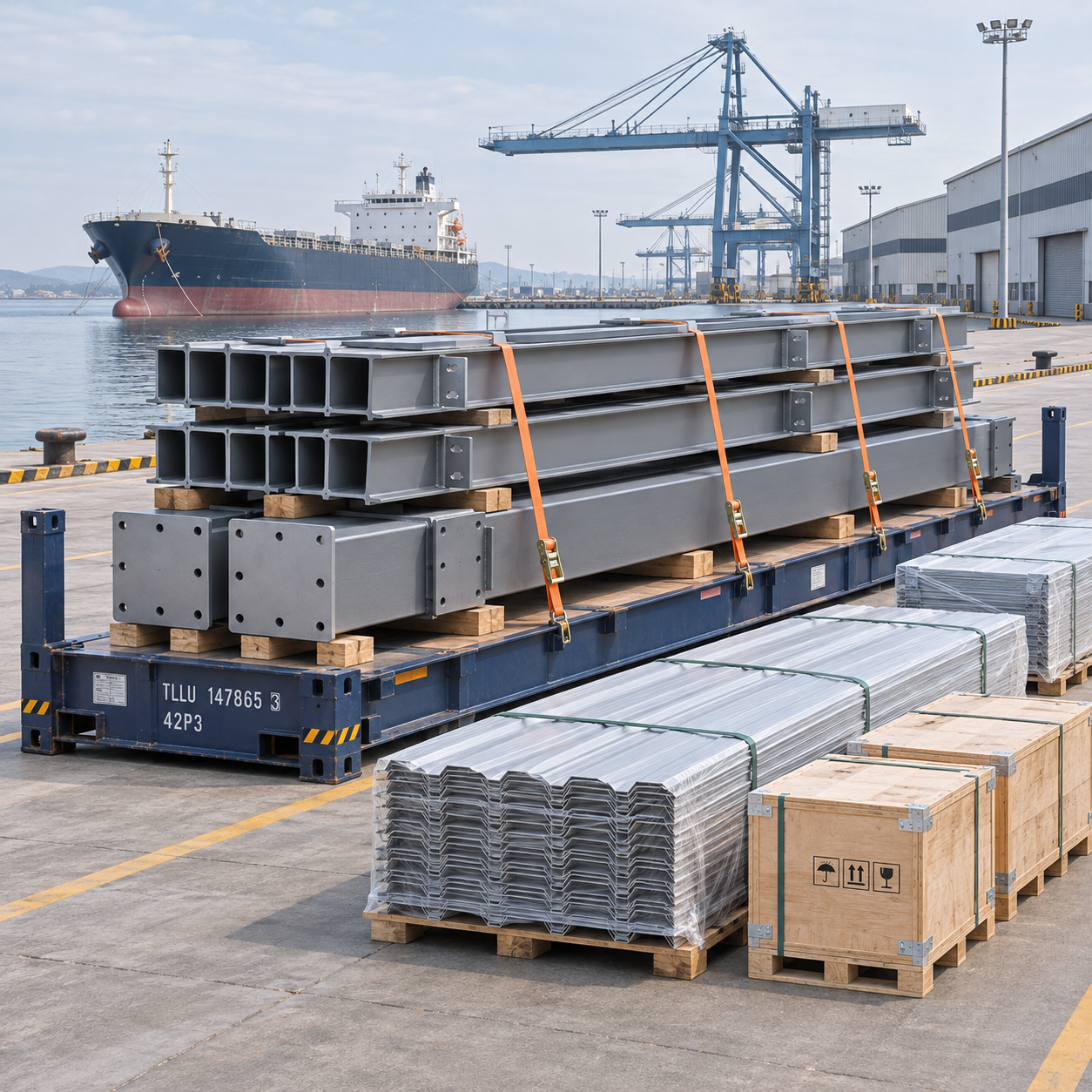
Prefabricated steel buildings are generally shipped overseas as separate, labeled components, not as complete structures. Columns and beams are fabricated for assembly, roof and wall panels are packed in bundles, and bolts and other small parts are secured in boxes or crates. At the destination, the shipment is unloaded, checked against the packing list and moved to the construction site for erection.
Most shipments travel by sea, but the choice of equipment depends on more than the building’s floor area. The length and weight of individual members, the total cargo volume, port facilities and the route from the port to the site all affect whether the order can move in standard containers or needs flat racks, open-top containers or conventional cargo service. These decisions should be considered while the building is still being detailed: a member that is difficult to transport can affect both freight cost and the connection design.
What is actually shipped?
A prefabricated steel building package may include primary structural members, secondary framing, roof and wall cladding, trims, fasteners and accessories. Depending on the contract, it can also include insulation, doors, windows, gutters and other building components.
The steel frame is normally divided into transportable pieces. A large column, for example, may be fabricated in sections with bolted connections for assembly on site. Purlins and girts are bundled separately; sheets and panels are stacked to protect their surfaces and edges. Each piece or bundle should have an identification mark that can be matched to the packing list and erection drawings.
Not every part of the finished building necessarily travels with the steel package. Concrete foundations, reinforcing steel and some locally sourced materials may be supplied separately. Buyers should establish the supply boundary before comparing freight quotations: a quote for the structural frame alone is not equivalent to one covering cladding, insulation and accessories as well.
How the shipping method is selected
The question of how prefabricated steel buildings are transported overseas usually comes down to the dimensions and handling requirements of the cargo. Total weight matters, but a single long or awkwardly shaped member can determine the shipping method for the whole order, or require part of it to move separately.
Standard containers
Standard dry containers are a common choice when the pieces fit through the container door and can be loaded, secured and unloaded within the applicable weight limits. They offer an enclosed space for steel members, panels and boxed accessories, and can be transferred between ships, trucks and, where available, rail without unpacking the cargo.
Fit should be checked against usable internal dimensions and door openings, not just the nominal container length. A beam may appear short enough on paper but still be difficult to maneuver through the door. Its end plates, lifting arrangements and the space needed for securing the load also affect the loading plan.
Weight distribution is equally important. A container may have enough empty volume for additional steel but lack sufficient allowable payload, or the cargo may concentrate too much weight in one area. The container operator’s limits, road restrictions and loading requirements on the intended route all need to be considered.
Open-top containers and flat racks
An open-top container can be useful when cargo fits within the container footprint but is difficult to load through the end doors. Loading from above may allow a crane to place heavy or awkward bundles inside. Whether cargo can extend above the container depends on the equipment, carrier acceptance and route.
A flat rack provides a platform for oversized or heavy components that cannot be handled in an enclosed container. It can accommodate cargo that projects beyond the equipment’s dimensions, subject to carrier approval, securing arrangements and route restrictions. Such cargo may incur additional charges and require more detailed handling plans.
Both options can solve a loading problem, but they do not remove the need to check onward transport. A member accepted at the origin port may still face limits on a destination road, bridge or site access route.
Breakbulk or conventional cargo
For very large, heavy or numerous pieces, a shipment may move as breakbulk cargo on a conventional vessel rather than inside containers. Components are handled as individual pieces or secured bundles, and the plan depends on the vessel service and handling facilities available at both ports.
Breakbulk can accommodate pieces that are impractical for container equipment, but it brings its own considerations: lifting points, port handling, vessel schedules, cargo securing and exposure during operations. It should be assessed as a complete route, not assumed to be cheaper simply because the cargo is large.
A project may also use more than one method. Long primary members might travel on flat racks or as breakbulk, while cladding and fasteners move in enclosed containers. Splitting the cargo can solve dimensional constraints, though it also makes arrival coordination more important.
Why transport planning starts with the drawings
Fabrication and freight planning influence each other. Before members are released for manufacture, the parties should review the longest, heaviest and most awkward pieces against the proposed shipping equipment and the destination route. This is particularly important for buildings with large spans, tall columns, crane-supporting members or substantial welded assemblies.
One option is to divide a long member into smaller sections. That can improve container utilization or make inland delivery easier, but it introduces additional field connections. The structural designer must decide whether those connections are appropriate and specify the plates, bolts and erection requirements. A freight-driven change should not be made by cutting a finished member without an approved design revision.
Conversely, keeping a member in one piece may reduce site assembly work while increasing ocean and inland transport complexity. The better choice depends on the combined cost and feasibility of fabrication, freight, unloading and erection. Comparing container count alone can hide expenses elsewhere in the delivery chain.
Loading sequence deserves attention too. If the erection contractor needs primary columns first, placing those pieces behind cladding bundles can slow unloading. On a multi-container order, the loading plan should identify what is in each container and, where practical, reflect the planned erection sequence.
Packing, protection and identification
Steel is robust, but overseas transport exposes a shipment to repeated handling, vibration, moisture and changes in temperature. Packing should protect the cargo while allowing it to be lifted and unloaded without damaging the building components.
Primary steel members are commonly grouped and secured using appropriate supports and restraints. Contact points need attention: poorly placed chains, straps or other securing materials can damage coatings or deform thinner sections. Bundles also need suitable lifting arrangements, especially when their weight or shape makes handling difficult.
Roof and wall sheets present a different problem. Their painted surfaces, edges and profiles can be scratched or distorted if bundles shift or are lifted incorrectly. Insulated panels and other finished products may need additional edge protection, separation and handling provisions. Packaging should suit both the product and the expected transport and storage conditions.
Moisture protection requires care. Water can enter during loading, port handling or storage, and condensation can form during transit. Trapped moisture between tightly packed coated sheets can damage their finish. Wrapping alone is not a guarantee of protection; packing, drainage, ventilation and prompt inspection after arrival all matter.
Small parts can create disproportionate delays. Anchor bolts, structural bolts, washers, brackets and flashing accessories should be packed securely and identified by type and destination within the building. A crate marked only “hardware” may be difficult to reconcile with the drawings when erection starts.
For each package, useful identification includes its mark, contents, weight and handling information. The packing list should connect those marks to the relevant drawings. If the order is divided across several containers, the list should also show which packages are in each one.
What happens from factory to site?
The physical journey begins with fabrication, inspection, marking and packing. The cargo is then delivered to the port or another loading location, where it is placed in containers or prepared for the chosen vessel service. Depending on the agreed delivery terms, the manufacturer, buyer or appointed logistics providers may arrange different stages of this work.
After ocean transit, the shipment is discharged at the destination port, cleared through customs and collected for inland transport. The construction site must be ready to receive the cargo, with suitable access, unloading equipment and storage space. A container delivery and a flat-rack delivery may require different equipment and handling arrangements.
The commercial invoice, packing list and transport document are central to the shipment. Other documents may be required depending on the destination, cargo and transaction, such as origin documentation, permits or evidence of compliance. Requirements should be checked with the freight forwarder and customs broker for the actual route; a document package suitable for one country is not necessarily sufficient for another.
Import requirements for the building itself should also be considered separately from customs paperwork. Structural design, product compliance and local building approval can involve different authorities and documents. Successful customs clearance does not by itself establish that the building is approved for construction.
Delivery terms should be written into the purchase contract using the agreed Incoterms rule and named place, where applicable. These terms allocate defined transport obligations, costs and risk between seller and buyer; they do not replace a detailed agreement on cargo insurance, unloading, storage or responsibility for damage claims. Both parties should know who books freight, who handles import clearance and where responsibility transfers.
Checking the shipment on arrival
Before unloading, compare container or seal details and the visible condition of the cargo with the transport documents. During unloading, check package marks and quantities against the packing list, and record visible damage or signs of water exposure. Photographs and prompt notice to the carrier, insurer and supplier can be important when a claim may be necessary; applicable deadlines depend on the contract and transport terms.
A complete package count is not the same as a complete erection kit. The receiving team should also reconcile critical components against the drawings, including connection plates, bolts and accessories. Missing items are easier to trace when their package marks and container locations have been documented.
Storage after delivery affects the condition of the materials. Steel should be kept clear of standing water and supported to avoid distortion. Cladding and insulated panels should be stored and handled in accordance with the applicable product instructions, with particular attention to water trapped inside bundles. Damaged coatings or distorted pieces should be assessed before installation rather than concealed during erection.
For a buyer planning an overseas order, the most useful early request is a preliminary shipping plan alongside the building quotation: the proposed component sizes and weights, expected packages, shipping method, loading assumptions and delivery point. That information makes it possible to check port handling and site access before fabrication decisions become expensive to change.
We are more than happy to serve you here. If you have any question, please feel free to contact us.