
News center
Related Posts
- ▶ Prefab vs. Conventional Warehouse Construction: Comparing Timelines
- ▶ Planning a Prefab Warehouse: Clear Span, Height and Loading Bays
- ▶ How Long Does It Take to Build a Commercial Steel Building?
Online Message
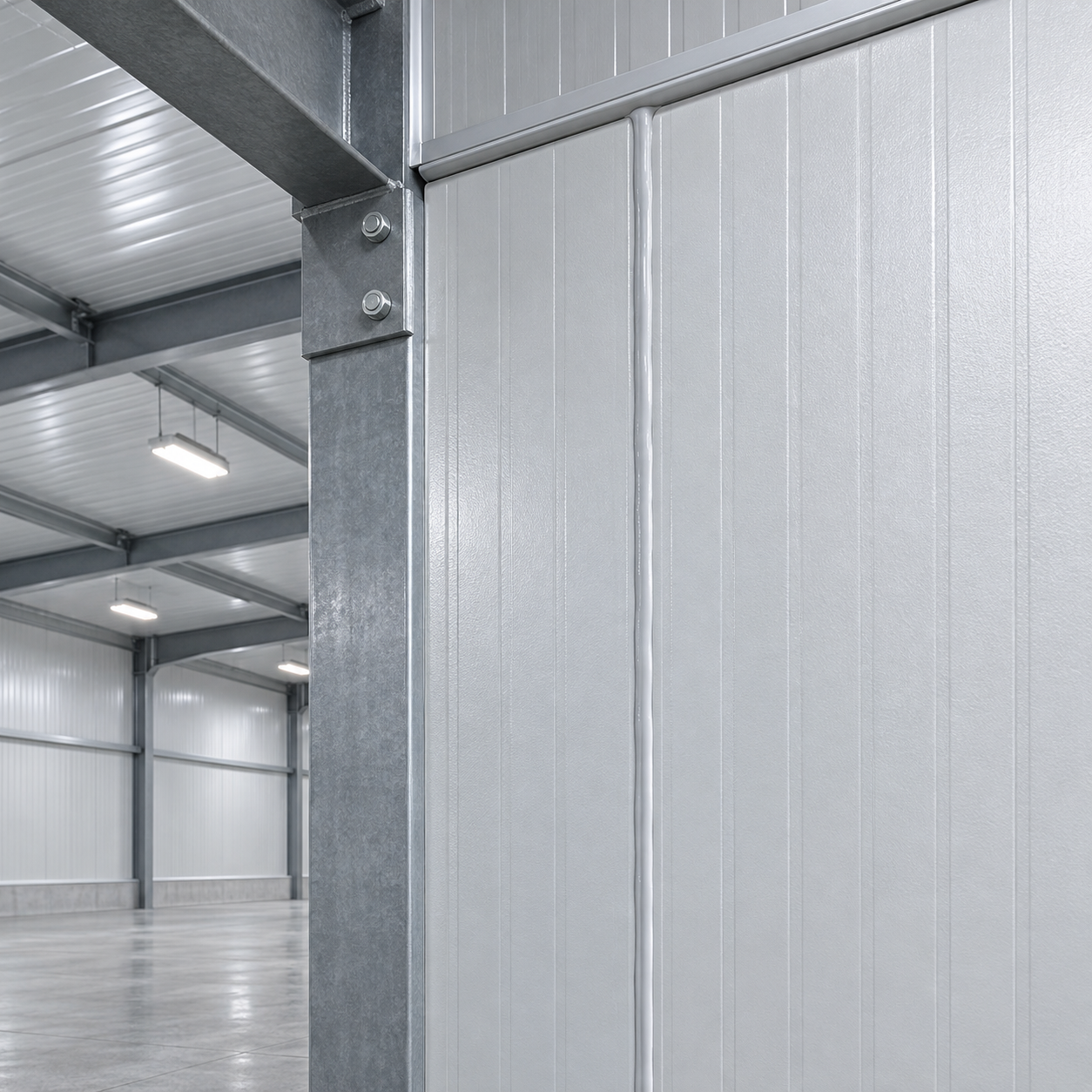
Do cold storage steel buildings need vapor barriers? In most cases, yes. A properly designed vapor control layer helps keep moisture-laden air away from cold surfaces and limits moisture movement into the insulated enclosure. Without it, condensation or frost can accumulate inside walls and roofs, reducing insulation performance and contributing to corrosion.
The important decision is not simply whether to add a sheet of plastic. A chilled warehouse, a deep-freeze room, and a cooled room inside a larger building can require different assemblies. The control layer’s location, continuity, and material properties depend on operating temperatures, humidity, climate, and the insulation system.
Where the moisture comes from
Warm air generally contains more moisture than cold air. When that air enters a cold assembly and cools below its dew point, water can condense on a steel surface or within insulation. In a freezer, the moisture may form frost instead. Repeated accumulation can wet insulation, damage finishes, and leave steel components exposed to prolonged dampness.
Moisture reaches these locations through two main paths. Air leakage carries water vapor through openings around joints, fasteners, doors, and penetrations. Vapor can also move by diffusion through materials. Both mechanisms matter, but a small unsealed opening can allow substantial moist air movement even when the surrounding material has low vapor permeability.
This distinction affects the solution. A material may resist vapor diffusion but still perform poorly as an air barrier if its joints are open. Conversely, an airtight assembly is not automatically suitable for every vapor exposure. The wall, roof, and floor details need to address both functions.
Which side should the vapor control layer be on?
For a cold room that stays colder than the surrounding air, the principal vapor control layer is generally placed on the warm side of the insulation. In a refrigerated building surrounded by warm, humid outdoor air, that often means toward the exterior. For a cold room inside an unrefrigerated warehouse, the warm side may face the surrounding warehouse instead.
Consider the conditions on each side of every assembly rather than relying on “inside” or “outside” as a rule. A wall between a freezer and a chilled room still has a warmer side, even though both spaces are refrigerated. A roof exposed to hot, humid weather may face a different moisture load from an internal partition.
Operating conditions can also change. A room used for cold storage during one season and allowed to warm during another may experience a reversal in the direction of vapor drive. Some climates create changing conditions across the year as well. In those cases, adding an impermeable layer on both sides without analysis can trap construction moisture or moisture that enters through defects. The assembly should be evaluated for the expected temperature and humidity range, including shutdown and defrost periods where relevant.
Is steel cladding itself enough?
Steel sheet has very low vapor permeability, but a steel building is not made from an uninterrupted sheet. Cladding laps, fastener holes, panel joints, edges, and penetrations can provide leakage paths. A metal face may form part of the intended control layer, but only when the complete assembly—including its connections—is designed and installed to perform that role.
Standard exterior cladding should therefore not be assumed to serve as the cold-storage vapor barrier. Ask which surface is the designated control layer, how it connects across joints, and how it continues around openings and at the floor and roof.
Choosing an assembly: panels, membranes, and insulation
Insulated metal panels are commonly used for refrigerated enclosures because they combine insulation with metal facings. Depending on the panel design, the facings and sealed joints can form part of the vapor and air control system. Their performance depends on the specified joint sealant, installation sequence, perimeter details, and treatment of cuts and penetrations—not just on the panel core.
Other assemblies use insulation with a separate membrane, facing, or coating as the vapor control layer. This can be useful when the insulation or structural arrangement does not provide a continuous sealed surface on its own. The selected membrane must be compatible with its substrate, adjacent sealants, expected temperatures, and installation conditions. A product intended for a conventional warm building should not automatically be substituted into a freezer assembly.
Spray-applied foam may contribute insulation and, depending on the product and thickness, resistance to air or vapor movement. It should not automatically be treated as a complete vapor barrier. Confirm the manufacturer’s tested properties and whether additional control layers or protective coverings are required for the specific assembly.
When comparing proposals, look beyond insulation thickness. Request an assembly detail that identifies the vapor control layer, its vapor permeance, the air-sealing method, and the treatment of joints. The required performance should be determined for the project’s design conditions and applicable local requirements rather than selected from a generic material label.
The details most likely to interrupt continuity
A vapor control layer can perform only as well as its connections. On drawings, follow the designated layer around the complete refrigerated enclosure. It should have a defined path across walls and ceilings, around openings, and to the floor or foundation detail. Pay particular attention to transitions between materials supplied or installed by different trades.
- Panel joints: Check that joint profiles, sealants, and installation tolerances match the approved system. Gaps, displaced sealant, or damaged panel edges can create a direct route for humid air.
- Roof-to-wall junctions: The roof control layer must connect to the wall layer. A well-sealed wall and roof can still leak at an untreated perimeter.
- Doors and loading openings: Inspect frames, thresholds, seals, and surrounding panel connections. Frequent opening also introduces humid air into the room, a separate issue that the wall vapor barrier alone cannot solve.
- Service penetrations: Refrigeration pipes, electrical conduits, drains, and supports need sealed interfaces. Allow for movement and avoid details that pull apart when equipment operates or temperatures change.
- Fasteners and structural supports: Confirm how attachments pass through or connect to the control layer. Exposed steel can also create thermal bridges, producing cold spots even where the vapor layer is intact.
- Floor edges: Coordinate the wall vapor control layer with the specified floor moisture-control system. Freezer floors may also need insulation and ground-frost protection; a wall membrane alone does not address those requirements.
Details above suspended ceilings or behind flashings deserve attention before they are concealed. Once finishes and equipment are in place, finding and repairing a discontinuity can require opening an otherwise completed assembly.
Condensation or frost has appeared: where should you look?
Start by recording where the moisture appears and under what operating conditions. Frost near a pipe penetration suggests a different investigation from widespread condensation on an exposed steel member. A local cold spot may be caused by a thermal bridge or missing insulation, while moisture concentrated at a joint may point to an air leak. Both can occur together.
Check the room’s temperature and humidity, door operation, and nearby sources of humid air. Inspect accessible seals and panel joints for damage or separation. Around pipes and conduits, look for cracks in sealant, unsealed sleeves, or gaps hidden behind covers. On the warm side of the enclosure, staining or corrosion can help indicate a persistent moisture path, although the visible location may not be the entry point.
Avoid sealing only the visible wet area before identifying where moisture is entering. Trapped moisture may remain inside the assembly, and an added impermeable coating can make drying harder. An investigation may require controlled opening of the wall or roof, moisture assessment, or an air-leakage test. Any opening should be repaired to restore insulation and the continuity of the specified control layers.
Frost inside the refrigerated room is not always evidence of a failed wall vapor barrier. Humid air can enter through open doors, damaged door gaskets, or pressure differences created by ventilation and refrigeration operation. Examine those routes before deciding that panels need replacement.
Plan the vapor-control work before construction
Early coordination is particularly important for prefabricated steel buildings because the structural frame, insulated enclosure, refrigeration equipment, and service penetrations may be designed or installed separately. Provide the enclosure designer with the intended operating temperature and humidity, outside design conditions, room layout, door usage, and any expected changes in use.
- Define the refrigerated boundary. Identify which walls, ceilings, floors, and internal partitions separate spaces with different conditions.
- Select the assembly as a system. Confirm insulation, vapor and air control layers, panel joints, sealants, and compatible materials for the service temperatures.
- Draw the transitions. Show how the control layer connects at corners, foundations, doors, structural members, and every planned service penetration.
- Protect the work during installation. Keep insulation dry, repair damaged facings, and seal joints according to the specified installation method before they are covered.
- Verify before handover. Inspect concealed details at suitable stages and use the project’s specified testing or inspection procedures to identify deficiencies while repairs are accessible.
For low-temperature freezers, mixed-temperature rooms, or assemblies with possible seasonal vapor-drive reversal, the enclosure design warrants particular scrutiny. The question is not whether every cold-storage building needs the same membrane; it is whether the complete enclosure can control air and vapor movement under its actual operating conditions without trapping moisture.
We are more than happy to serve you here. If you have any question, please feel free to contact us.