
Related Posts
- ▶ Prefab vs. Conventional Warehouse Construction: Comparing Timelines
- ▶ Planning a Prefab Warehouse: Clear Span, Height and Loading Bays
- ▶ How Long Does It Take to Build a Commercial Steel Building?
Online Message
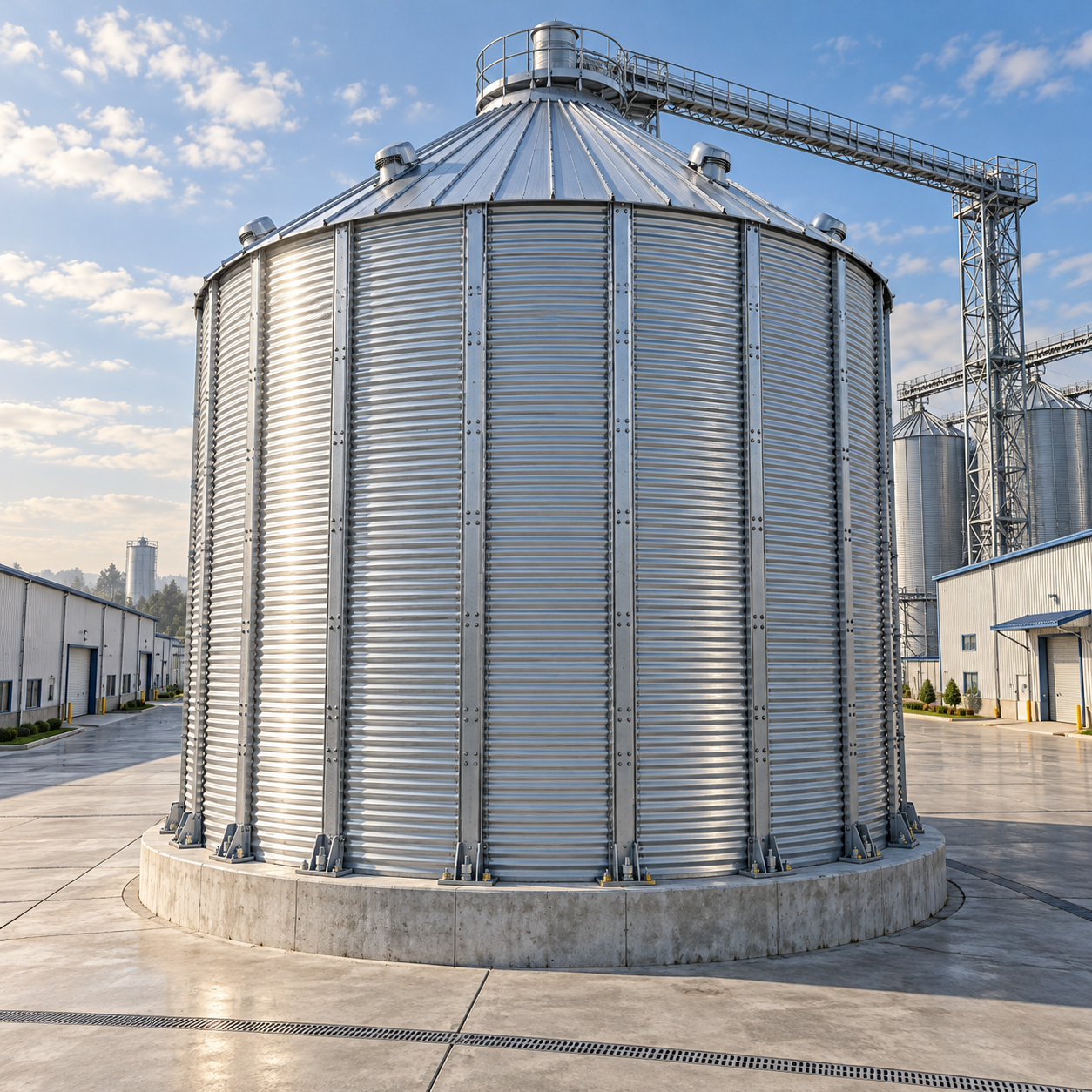
Steel grain silos are governed by the building regulations adopted at the project location, together with the standards accepted for silo loads, steel resistance, foundations, and construction. No single structural code covers every part of the design. ASCE 7 and AISC 360, for example, establish important requirements in a US design framework, but citing them alone does not establish adequate treatment of grain pressures or thin-wall shell buckling.
The first approval document should therefore be a project-specific design basis identifying the jurisdiction, adopted editions, silo classification, stored materials, operating conditions, and site hazards. A standard used at the manufacturing location does not automatically satisfy the destination’s requirements. Where local regulations leave a technical gap, the proposed supplementary method needs documented acceptance through the project’s approval process.
Establish the code hierarchy before comparing calculations
Start with the legally applicable building regulations and their referenced standards. Then establish which provisions apply to the silo shell, supporting structure, anchorage, and foundations. Contract specifications can add requirements, but they cannot remove statutory obligations.
A silo’s classification matters. An agricultural structure, an industrial storage installation, and a silo connected to a processing building can follow different permitting routes. An agricultural exemption, where one exists, needs confirmation against the actual location and use; it does not establish that grain pressures, overturning, or structural instability can be ignored.
The latest published edition is not necessarily the edition adopted by the jurisdiction. During standards transitions, a calculation package can inadvertently combine provisions from different generations. Record the edition and amendments beside each reference, including the source of nationally determined parameters.
Grain pressures need their own design model
Building load standards describe environmental and occupancy actions, but stored grain creates a separate loading problem. Pressure depends on bulk density, wall friction, internal friction, silo geometry, and the filling and discharge arrangements. A capacity stated only in tonnes leaves too much undefined: different grains or bulk densities change both the stored weight and the pressure distribution.
Grain does not behave as a liquid with a simple hydrostatic pressure profile. Friction transfers part of its weight into the wall, creating vertical compression as well as horizontal pressure. The supporting shell, stiffeners, hopper, and foundation must receive these forces through a consistent load path.
The design inputs should distinguish measured properties, conservative specified values, and values taken from an accepted standard. A single “typical grain” assumption needs a stated range of permitted commodities and conditions. Wall friction must also correspond to the actual contact surface, including corrugation, liners, or coatings where relevant.
Filling and discharge can govern different components
A symmetrical filled condition does not represent every operating state. Eccentric filling, discharge away from the center, and flow channels near the wall introduce uneven pressures. Silo loading standards address these effects through prescribed cases, localized loads, or other methods within their scope.
For a silo with several outlets, the permitted operating sequence belongs in the design basis. Opening one outlet while neighboring outlets remain closed can produce a different pressure field from simultaneous discharge. If the design relies on restricted outlet operation, that restriction needs a defined control arrangement and inclusion in the operating documentation.
Hoppers require particular attention at the transition to the vertical wall. Geometry changes concentrate forces, while discharge conditions influence normal pressure and friction on the hopper surface. Ring beams, support brackets, welds, and bolts must transfer the resulting forces. A shell calculation that stops above the transition leaves a significant part of the load path unresolved.
Thin-wall buckling determines whether the steel model is suitable
Yield strength alone is an inadequate measure of silo resistance. Thin steel shells can buckle under axial compression, wind pressure, shear, or combinations of actions before the material reaches its nominal yield strength. Shell slenderness, geometric imperfections, support conditions, and local discontinuities strongly affect the result.
For a Eurocode design, EN 1993-4-1 works with relevant supporting provisions, including shell stability rules where applicable. Under another framework, the calculation package needs an accepted resistance method suitable for the shell type. A frame model using beam elements does not, by itself, demonstrate the stability of a cylindrical wall.
Corrugated bolted silos introduce further distinctions. Sheet behavior differs along and across the corrugations, and vertical stiffeners participate in carrying wall friction loads. The model needs to represent how sheets, stiffeners, and connections share those forces. Treating corrugated sheet as a smooth plate of equal thickness requires technical justification.
Connection resistance can govern even where the sheet appears adequate. Bolt bearing, tear-out, net-section rupture, lap arrangement, and load transfer at stiffener splices require assessment. The specified thickness must also identify whether it refers to base metal or coated thickness, because protective coating does not contribute equivalent structural resistance.
Where buckling resistance relies on fabrication tolerances, those tolerances become acceptance criteria. Out-of-roundness, local dents, erection misalignment, and uneven support levels need limits consistent with the calculation method. A design assuming controlled geometry requires corresponding inspection records.
Site wind and seismic inputs change the governing condition
The empty silo deserves a separate wind assessment. With little stabilizing grain weight, uplift and overturning can govern anchorage, while external pressure can govern shell instability. The full silo introduces greater gravity loading and wall compression. Neither condition reliably substitutes for the other.
A quoted wind speed is incomplete without its definition. Averaging period, reference height, exposure, topographic effects, and the adopted code’s risk or importance provisions influence the design pressure. Copying the same numerical wind speed between different national frameworks can produce inconsistent results.
Seismic design likewise requires more than a generic seismic zone. Site ground conditions, the adopted hazard parameters, structural classification, and the permitted analysis method affect the result. The model must address how the stored material participates in the response under the selected provisions; simply adding the entire grain mass to a conventional building model requires justification.
Elevated silos add flexibility through columns and bracing. Their support response, force distribution, and displacement demands differ from those of ground-supported silos. Attached conveyors, access towers, and service platforms also introduce interface forces or movement constraints. These connections need explicit treatment rather than an assumption that each structure acts independently.
Draw the boundary between the silo, foundation, and adjacent buildings
Building regulations continue to govern applicable site hazards, structural safety, and approval requirements. Silo-specific standards supply the specialized treatment of stored-solid actions and silo resistance. The boundary is therefore a division of technical responsibilities within one coordinated design.
Foundation design needs reactions for the relevant combinations, including compression, uplift, horizontal force, and overturning moment. A single total vertical load is insufficient for anchor design or assessment of uneven ground pressure. Reaction schedules should identify whether values are characteristic, service-level, or factored, together with the combinations that generated them.
Settlement can alter the shell’s support conditions. Differential movement around a ring foundation can introduce distortion and additional stress even when average soil bearing pressure is acceptable. Geotechnical assumptions, foundation stiffness, anchor positioning, and base details therefore need coordination with the silo calculation.
At a shared logistics site, an adjacent Multi-Bay Logistics Park Warehouse can have its own frame design basis under GB 50017 or EN 1993, as specified for that building. That reference does not establish the silo’s grain-pressure or shell-buckling compliance. Connections through conveyors, platforms, or shared supports require agreed forces, movement allowances, and responsibility boundaries.
Documentation that supports a defensible approval
A useful submission makes the design reproducible. It connects the approved inputs to the analysis, the analysis to component resistance, and the resistance assumptions to the fabrication drawings. Software names and calculation cover sheets provide little evidence without that connection.
The technical package should contain:
- A controlled design basis: jurisdiction, adopted standards and editions, classification, design life, site actions, grain properties, and the permitted filling and discharge arrangements.
- Traceable calculations. Load cases, combinations, pressure distributions, shell and stiffener checks, connection resistance, anchorage, and foundation reactions need identifiable links to the drawings.
- Material and fabrication evidence: specified grades, thicknesses, fasteners, welding requirements, protective systems, and inspection criteria. A proposed grade substitution requires assessment of the properties used in design, including strength, ductility, toughness where required, and weldability.
- Defined interfaces and operating limits. These include attached equipment loads, outlet restrictions, erection conditions, and any dependence on ventilation or pressure-relief arrangements.
Certification documents need equally precise interpretation. ISO 9001 concerns a quality management system. CE marking, where applicable, relates to the relevant product legislation and declared characteristics. Neither, by itself, establishes that a particular silo satisfies the site’s structural loading, foundation, or seismic requirements.
Structural standards also do not resolve every grain-handling hazard. Combustible dust, pressure relief, machinery safety, and access provisions follow applicable requirements of their own. Their structural interfaces still belong in the design: pressure-relief reactions, equipment supports, and openings can affect shell strength and load transfer.
Approval should identify the drawing revision and operating envelope covered by the calculations. A later change to stored commodity, outlet position, conveyor loading, shell opening, or support arrangement then has a clear reference point for engineering review before fabrication or operation proceeds.
We are more than happy to serve you here. If you have any question, please feel free to contact us.